
Is Trump’s war of choice becoming a war of necessity?
Clip: 3/27/2026 | 13m 10sVideo has Closed Captions
Is Trump’s war of choice becoming a war of necessity?
What does victory in Iran look like? Asking the president isn’t much use. He’s provided strikingly different answers, based, seemingly, on his mood. What is true is that Iran remains in control of the Strait of Hormuz, and it is unclear how President Trump plans to open up this crucial chokepoint. The panel discusses whether Trump’s war of choice is becoming a war of necessity.
Problems playing video? | Closed Captioning Feedback
Problems playing video? | Closed Captioning Feedback
Major funding for “Washington Week with The Atlantic” is provided by Consumer Cellular, Otsuka, Kaiser Permanente, the Yuen Foundation, and the Corporation for Public Broadcasting.
Is Trump’s war of choice becoming a war of necessity?
Clip: 3/27/2026 | 13m 10sVideo has Closed Captions
What does victory in Iran look like? Asking the president isn’t much use. He’s provided strikingly different answers, based, seemingly, on his mood. What is true is that Iran remains in control of the Strait of Hormuz, and it is unclear how President Trump plans to open up this crucial chokepoint. The panel discusses whether Trump’s war of choice is becoming a war of necessity.
Problems playing video? | Closed Captioning Feedback
How to Watch Washington Week with The Atlantic
Washington Week with The Atlantic is available to stream on pbs.org and the free PBS App, available on iPhone, Apple TV, Android TV, Android smartphones, Amazon Fire TV, Amazon Fire Tablet, Roku, Samsung Smart TV, and Vizio.
Buy Now
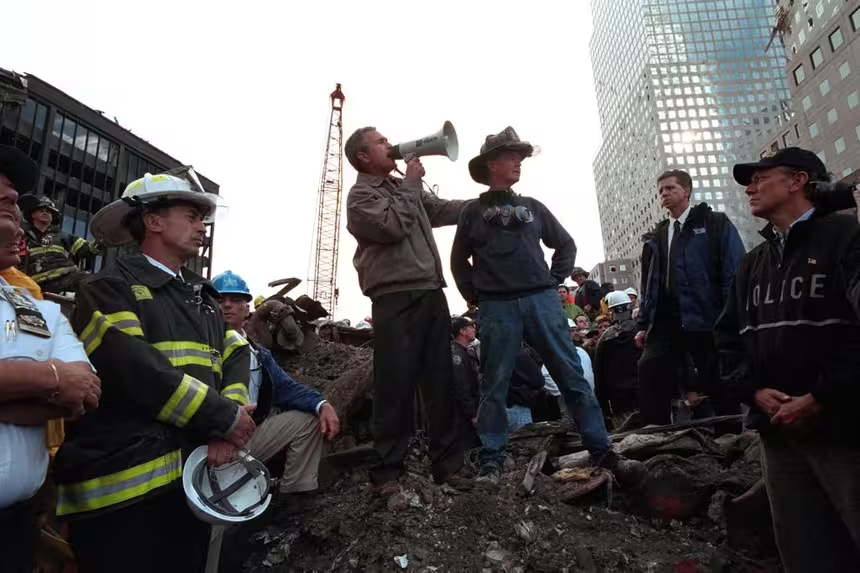
10 big stories Washington Week covered
Washington Week came on the air February 23, 1967. In the 50 years that followed, we covered a lot of history-making events. Read up on 10 of the biggest stories Washington Week covered in its first 50 years.Providing Support for PBS.org
Learn Moreabout PBS online sponsorshipJeffrey Goldberg: David, if they don't open the Strait of Hormuz and make it safe for commercial shipping, that's obviously not a victory.
David Ignatius, Columnist, The Washington Post: That is what's called defeat.
That is a failure to achieve the fundamental war that the president has or should have.
Iran has taken the Strait of Hormuz hostage.
And so when there's a hostage-taking, you have a choice.
You either try to free the hostage by force-Missy was talking about sending in Marines and other troops to seize territory-or you free the hostage by negotiation or some wily combination of the two.
And I think that's basically the choice that Trump has.
If he tries to walk away from this, having left global commerce in a very precarious situation, global markets really now being affected by the closure of the strait, which walks away, we've achieved our goals, that's it, it's up to you, fellows, I think the world will just be irate and I don't think you can get away.
I heard today from an Arab who's been involved in parts of these discussions an idea for some kind of international process that, in effect, oversees the Strait of Hormuz.
That is like what the U.N.
did in the negotiations that opened the Black Sea to commerce again in the Ukraine war.
I mean, the Black Sea was a no-go zone.
The U.N.
negotiated a process.
It got buy-in from everybody.
And it's not inconceivable that something like that could be done for the Strait of Hormuz.
Iran is demanding that it charge tolls.
Well, that's not going to work.
But it's conceivable that you could have some kind of international regime that's a way out that actually would get buy-in from just about everybody.
Jeffrey Goldberg: How hard is it to open the Strait of Hormuz militarily?
David Ignatius: Military?
So, I think landing troops who are going to be there as targets indefinitely is a terrible idea.
The problem, I mean, I've been up there and seen it, as others around the table may have, it is really such a tiny area.
It's so easy to mine.
It's so easy.
You could float a tanker out at midnight with no transponders and sink it, and you block a big part of that passageway.
Jeffrey Goldberg: Right.
Peter, David wrote this week, Trump is convincing as a risk taker but not a suicidal one.
He has an instinct for self-preservation amid the chaos he inflicts.
Oil prices spiking, markets-Nasdaq in correction territory.
Peter Baker, Chief White House Correspondent, The New York Times: Yes.
Jeffrey Goldberg: You covered this man for a long time.
Is he just going to throw his hands up?
Peter Baker: Well, I think one of the things that's been surprising is his willingness to absorb that pain for as long as he has, because he's a famously impatient man, right?
But one of the things we've seen also has affected his policies in the past have been pressure points on economics.
When the bond markets have reacted badly to some of his tariff decisions, he's been willing to reverse course or switch gears, and he hasn't yet so far on this.
But I think his calculation is that once it's over, and it'll be over in two weeks, three weeks, however many weeks you want to say, it'll all be back to normal and everything will be fine.
At least that's what he's telling himself, right, that gas prices will come back down, the markets will recover by the time the midterms come along, whether that's lost or not for the Republicans, we can be already, but it'll all be back to normal.
People won't mind.
But the problem is that if there's a big disparity between saying we've won, which is what he says, we've won already-past tense, we've won-and sending 8,000, 10,000, 20,000 troops to the ground, and even if it's a fake-out, even if it's a strategic ambiguity in order to leverage negotiations, what he's at least putting on the table is a much more extended and extensive involvement on a long-term basis in the region, which is exactly what Americans thought they were voting against when they voted for him.
Jeffrey Goldberg: Right.
Whatever he does, he is not going to be doing it with many European allies.
The Europeans, of course, as well as Asian countries, more dependent on the oil and gas that flows through.
Susan, you wrote this week, America's friends in Europe ought to take note of what the president said at 6:16 a.m.
on Thursday when he started his day by denouncing not only the ayatollahs of the Islamic Republic, but the nations of NATO that have so far refused to join the U.S.
in its war on Iran.
This is in all caps: The USA needs nothing from NATO, but never forget this very important point in time.
I'm not even 100 percent sure I understand what he means by "never forget this important point in time."
But he's trolling NATO precisely when he could use some help.
It seems like he has more anger at U.S.
allies sometimes than he has at the anti-American ayatollahs who run Iran.
Susan Glasser, Staff Writer, The New Yorker: For sure, or, for example, the leaders of Russia, you know, who have now become beneficiaries of this war.
And in fact, in many ways, Vladimir Putin is getting-I think it was a $38 billion windfall-and that's even if the war stops in April, which there's no guarantee that it will, because we've allowed, lifted temporarily sanctions on some of its oil in order to ease the pressure in the markets created by Trump's war.
Donald Trump-there's a through line here-you know it well, you know, he has consistently denigrated America's allies and its alliances going back to the very beginning of his time in politics.
And my theory of the case is: pay attention to what Donald Trump is fulminating about late at night and early in the morning.
That is as close as the world has ever come to a direct pipeline into the id of an American president.
Donald Trump has it out for NATO.
He has it out for America's European allies.
He continued after that posting to complain about it in a cabinet meeting in increasingly strident terms, again on Friday.
We'll see if he follows through.
But I think what you are seeing over the last six months, especially after Donald Trump's threat to hold out the possibility of using military force against our NATO ally, Denmark, to seize its territory in Greenland, that was a real breaking point for many of America's partners.
It's remarkable that our partners, both in Europe and Asia, by the way, who were also asked in Japan and South Korea to participate in this conflict, to help open the strait, they all said a very loud no.
This is your war, Donald.
And I think David's point about, you know, if we can continue in a sort of limbo here in the Strait of Hormuz, Donald Trump declares victory, walks away, and it's still not safe for those tankers to go through, the resentment, which was already building up, is going to be enormous.
And I think it's very hard to see a scenario here where this doesn't represent a big blow to American international power and standing in many ways.
Jeffrey Goldberg: No.
If the strait is not open, the U.S.
will look like the thing that Donald Trump professes to hate more than anything-a loser.
But, Missy, just to make a point of clarification here, the U.S.
does not need NATO or Japan or South Korea to open up the Strait of Hormuz.
It would just be harder and it would require more American resources.
Missy Ryan, Staff Writer, The Atlantic: No, the U.S.
military doesn't need the French military or the Danish military.
What the United States would do, if it took the decision to do so, it would first-the biggest barrier to trying to clear the strait is making sure that the countermine ships are not hit by drones, they're not hit by missiles.
That is why they're not in the region.
That's why they haven't started this work yet.
So, what they would need to do is feel confident enough that the anti-ship missiles, that the drones aren't going to come out and hit these ships.
Then the United States would get combat air patrols around the Littoral Combat Ships, which are the countermine ships.
They would have destroyers go in.
And technically, it's something that can be done.
There are always mines that are missed.
We saw this in the Gulf War in 1991.
We saw this in the tanker wars in the 1980s, where American ships were hit despite the belief that they already had been cleared.
So, it can be done.
I think, for Trump, it's more of another grievance against these countries where he feels like he's doing the heavy lifting.
We don't need this oil.
And I think that he wants the moral support.
He wants to be head of a coalition, just like Joe Biden was in Ukraine.
And it's more about that than the military capability.
Jeffrey Goldberg: I have a large question for the panel, which is prompted by a moment that I want you to watch, courtesy of the Speaker of the House, Mike Johnson.
Let's watch this for a minute.
Rep.
Mike Johnson (R-LA): And so tonight we have created a new award.
We are going to do something we've never done before.
We're going to honor him with a new award that we'll present annually from this point forward.
But he is the suitable and fitting recipient of the first-ever America First Award.
We can think of no better title for what that is.
That's this beautiful golden statue here, appropriate for the new golden era in America.
Jeffrey Goldberg: Peter, I mean, I'll ask this of everyone.
It's a real challenge for the United States, not only on this issue-the war currently-but others, that the president is unusually susceptible to flattery and unusually resistant to criticism or self-reflection.
This was extraordinary.
Peter Baker, Chief White House Correspondent, The New York Times: Yes.
Jeffrey Goldberg: It's one of the many extraordinary things that happen all the time now.
But talk about a president with that kind of personality in a situation in which he has to be assimilating vast quantities of intelligence, including intelligence you might not want to hear.
Peter Baker: Right, yes.
No, flattery is the way you get to him, and information is not.
And look at the other one that happened this week, by the way, Mike Johnson giving him this made-up award.
But the other thing that's going on this week is the Treasury Department-Donald Trump's Treasury Department-has decided to put Donald Trump's signature on the dollar bill and every other dollar bill.
No president has ever had their signature on the currency before.
But it's one more way of stamping his identity on not just the buildings he built as a developer, but on American institutions.
His name is now in the Kennedy Center.
His name is now on the Institute of Peace.
He wants his name on Dulles Airport, on Union Station, on Penn Station.
He wants his name on programs for tax cuts and prescription medication.
And it's all about his ego and narcissism.
It's not subtle, and everybody plays that.
So, if you are a speaker of the House or you are a foreign leader, you know that, and that's the game that needs to be played.
You're not going to win them over by logic.
You might win them over by flattery.
Jeffrey Goldberg: I would just make a small editorial note-I've made this before-that if I were trying to be more popular, I would not put my name on Dulles Airport.
I just want to-that's special for the Washington Metro region.
But David, let's-if we could wrap this up here with you.
You spent a career covering Middle East dictators, leaders, men with massive egos who had difficulty assessing reality around them.
We are now in the most serious war of Donald Trump's presidency.
Talk about his personality and his psychological and emotional needs in the context of how the decisions are going to be made.
David Ignatius, Columnist, The Washington Post: So, if you want to understand how Trump sailed through intelligence warnings, what appeared to have been warnings from the chairman of the Joint Chiefs of Staff that General Caine gave him, just watch one of the cabinet meetings or the clip that you just showed with Speaker Mike Johnson.
I mean, the degree of flattery, the inability, it seems, for people just to level with him and say, "Mr.
President, don't, Mr.
President, stop."
He is not a person who's able to hear that.
I'm reminded of Vladimir Putin, I'm sorry to say it, in February 2022, who sailed into Ukraine thinking it'd be over in a week, that it was going to be an easy kind of march to Kyiv and is still stuck four years later in a war he can't get out of.
And it happens when people are flattered and they don't listen to the evidence.
Jeffrey Goldberg: We'll talk about Ozymandias next week on this show.
I'm sorry that we're going to have to leave it there, but I want to thank our guests for joining me.
 New
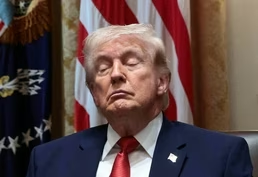
NewTrump's mixed messages and shifting goals in the Iran war
Video has Closed Captions
Trump's mixed messages and shifting goals in the Iran war (9m 44s)
Providing Support for PBS.org
Learn Moreabout PBS online sponsorship
- News and Public Affairs

Top journalists deliver compelling original analysis of the hour's headlines.

- News and Public Affairs

FRONTLINE is investigative journalism that questions, explains and changes our world.












Support for PBS provided by:
Major funding for “Washington Week with The Atlantic” is provided by Consumer Cellular, Otsuka, Kaiser Permanente, the Yuen Foundation, and the Corporation for Public Broadcasting.