
Trump’s secret flight
Clip: 8/14/2026 | 10m 18sVideo has Closed Captions
Trump’s secret flight
As if Trump needed reminding that Iran now shadows his presidency, we learned this week that he had to be secretly moved – by catering truck, no less – off of Air Force One, which was allegedly being targeted by Iranian agents. It raises questions about Iran’s continued ability to wreak havoc on the U.S. and its friends.
Problems playing video? | Closed Captioning Feedback
Problems playing video? | Closed Captioning Feedback
Major funding for “Washington Week with The Atlantic” is provided by Consumer Cellular, Otsuka, Kaiser Permanente, the Yuen Foundation, and the Corporation for Public Broadcasting.
Trump’s secret flight
Clip: 8/14/2026 | 10m 18sVideo has Closed Captions
As if Trump needed reminding that Iran now shadows his presidency, we learned this week that he had to be secretly moved – by catering truck, no less – off of Air Force One, which was allegedly being targeted by Iranian agents. It raises questions about Iran’s continued ability to wreak havoc on the U.S. and its friends.
Problems playing video? | Closed Captioning Feedback
Where to Watch Washington Week with The Atlantic
Washington Week with The Atlantic is available to stream on pbs.org and the PBS app.
Buy Now
10 big stories Washington Week covered
Washington Week came on the air February 23, 1967. In the 50 years that followed, we covered a lot of history-making events. Read up on 10 of the biggest stories Washington Week covered in its first 50 years.Providing Support for PBS.org
Learn Moreabout PBS online sponsorshipJeffrey Goldberg: Good evening, and welcome to Washington Week.
It's a strange story, certainly, this Air Force One business, though the Trump administration does manufacture plenty of strange storylines.
It's also a deadly serious story, one that raises questions not only about the dubious decision-making that led to this Air Force One caper, but about Iran's continued ability to wreak havoc on the U.S.
and its friends months after the president promised that the threat of the Islamic Republic would be neutralized.
Iran is a shadow over the White House and over the Republican Party.
Something that could help the Republicans out of their predicament, the Democratic Socialists of America.
I'll discuss this tonight with my guests, Elisabeth Bumiller, writer-at-large at The New York Times, Adam Harris is a staff writer at The Atlantic, and a co-host of the Radio Atlantic podcast, Dan Lamothe is a national security reporter for The Washington Post, and Liz Landers is the White House correspondent for PBS NewsHour.
Thank you, Liz, for doing double duty tonight.
We appreciate it.
Dan, let's start with you.
You broke the story.
Explain what happened on Air Force One and why it happened.
Dan Lamothe, National Security Reporter, The Washington Post: Yes.
Thank you for having me.
Just an extraordinary tip that I received, and, you know, just running it down.
I mean, the idea that President Trump, leaving a NATO summit with the -- you know, the world's eyes on him, moves -- tells the world that he's sending his new plane back to Britain, tells the world he's taking the old Air Force One instead.
Jeffrey Goldberg: The new plane being the one given to him by Qatar.
Dan Lamothe: Yes.
Jeffrey Goldberg: Yes.
Dan Lamothe: Only to learn that he took neither of those planes, and in fact, moved by catering truck secretly to the third, smaller plane, the C32, without telling anyone, and then not telling anyone for the next calendar month until we reported that story out.
Jeffrey Goldberg: Yes.
And why do they say they did it?
And who knew and who didn't know?
Dan Lamothe: Yes.
So, I mean, obviously there is legitimate concerns about the president's life.
Iran has made efforts in the past.
They received a tip from Israel saying that they thought the president's life was in danger that there could've been a threat on him or the aircraft.
So, that threat was assessed later to be not high confidence, but in the moment, without a lot of time to act, they chose to put this all in motion.
Jeffrey Goldberg: Right.
Liz, not unusual to protect the president, obviously, a worthy cause.
Not telling the people who got on Air Force One that they believed they had intelligence or the suspicion that Air Force One was going to be targeted, that's the truly unusual aspect of this story.
Liz Landers, White House Correspondent, PBS NewsHour: Right.
There were White House staffers aboard the plane that was apparently what was going to be targeted, also Secret Service.
There are also military officers on board that plane, too, and press as well.
And I think as a reporter, when you travel with the president, you have an expectation that he is a target at any given time.
But for the actual circumstances to be so real that the president is then moved off the plane, I don't think that that's something that most White House press are thinking about when they're traveling with him.
And, in fact, the White House Correspondence Association, this was reported by a number of media outlets, has apparently sat down with the White House press shop to have a conversation about the future of keeping the press corps that travels with the president safe and informed of where he is.
Jeffrey Goldberg: Yes, what would be the normal way of doing this?
Dan Lamothe: Decoys are not uncommon.
But typically it's a short duration thing where, from the outside world, you wouldn't necessarily be sure which plane he was on.
You know, a common example, when you watch the Marine Corps helicopters roll in with the president, they usually come in group of, groups of three.
From the ground, you can't really tell which one, and then at some point it becomes apparent.
Jeffrey Goldberg: Right.
Dan Lamothe: When they've done this overseas in the past, you know, one example that came up a lot this week was President Clinton in 2000 landing in Pakistan.
That was immediately apparent once he stepped out of the other aircraft.
And there was at least some amount of White House staffers and certainly a member of the White House press corps who had been briefed in advance, hey, we need to do this.
Here's why.
In this case, no one knew, outside of a very select amount of senior White House staff, Secret Service, and it was just kept quiet really from then on.
Jeffrey Goldberg: Right.
Elisabeth, you've supervised coverage of many White Houses, you've covered many White Houses.
What strikes you about this as -- what's the larger meaning of this very strange episode?
Elisabeth Bumiller, Writer at Large, The New York Times: Just the way the -- the civilians on the plane were potential sacrificial lambs, and that they were so unaware of it.
Our colleague, Peter Baker, wrote a great story this week about it.
He quoted Andrew Marlowe, who was the screenwriter for Air Force One, the 1997 thriller starring Harrison Ford.
In it, the president's plane is hijacked, and Marlowe told Peter that, you know, I don't think I could've written that as a -- you know, movies are not real life, but I don't think I could've written that into a movie because you want the president to be heroic, and that kind of action would not be perceived, he felt by an audience as a heroic action.
So, that was interesting.
And I would not have liked to have been on that plane and not been aware of the risk that I was taking.
Jeffrey Goldberg: If you were a member of the press corps, you would have gone on the plane had you known, or would you have said, wait a second, what's going on here?
Elisabeth Bumiller: I don't know.
I don't know.
I don't think I would've -- I would've thought long and hard about it.
Jeffrey Goldberg: Right.
What about you, Adam?
Just say yes.
Be heroic.
Adam Harris, Staff Writer, The Atlantic: I'll have to say yes.
I'll sacrifice.
But it is.
There's a -- having the knowledge of it as opposed to sort of being left in the dark about it, you're able to make an informed decision, right?
Jeffrey Goldberg: Right.
Adam Harris: And they were sort of told to close their window shades as opposed to actually even having the ability to know.
Jeffrey Goldberg: Dan, the real story here is transparency.
If you did not find this out, we would not be talking about this.
It's very odd to see this story just emerge a month later.
You've been dealing with the administration for some time.
Is this what you have come to expect in terms of transparency and accountability?
Dan Lamothe: Short answer is yes.
I mean, who knows how many things we don't know?
I would say when this tip was brought to me, initially, it sounded pretty surreal even for kind of current events.
So, it took a lot to kind of grow the confidence that, hey, we really had this right.
And the fact that we initially got a straight no comment and then the statement that kind of half explained, it was like, we got this.
Let's go.
Jeffrey Goldberg: Right.
The larger context of this is Iran and its shadow over American foreign policy, over this administration, even over the midterms, which we'll get to in a second.
I want you to listen, Elisabeth, to something that the president just said earlier today to get a sense of how he's ostensibly seeing this war.
Why don't we just listen?
Donald Trump, U.S.
President: Pretty soon, I'll be declaring the Hormuz Strait a territory of the United States.
Essentially, that's what it -- we have the blockade.
No ships get through unless we want them to.
Jeffrey Goldberg: So, this comes after the president said that his new approach to Iran, this week's new approach, would be to low-key it.
Not not entirely clear what that means.
It's been a while.
Elisabeth Bumiller: Six months.
Jeffrey Goldberg: Six months.
The Strait of Hormuz was opened before the war.
Now, he's talking about owning it.
Give us your sense right now of where this war is.
It seems as if the White House is desperate to tell the American people, and the American voter, we won.
You don't have to think about Iran anymore, and we're not going to think about Iran anymore.
Is that fair?
Elisabeth Bumiller: No, because I think that Iran - - you know, again, this is a little premature, but it reminds me of Jimmy Carter.
I think Iran wants this to keep going certainly through the midterms and potentially into 2028.
I mean, right now, I think what we've been seeing the last six months, I think we'll see more of, that Trump makes some statement, there seems to be some movement towards negotiations.
The stock market goes up, you know, and then the Iranians say, we're not negotiating, there's exchange of fire, and we're back at it.
That's what has been going on for six months.
I don't see how this changes.
And I don't - - I think Trump must've been trolling people when he said that he was going to annex the Strait of Hormuz.
That's -- Jeffrey Goldberg: Yes, I couldn't tell if he was joking or coming to a spontaneous policy realization.
Adam Harris: Yes.
I mean, you never really necessarily know with him.
But what you've seen from the administration in the last week, you have Scott Bessent saying that, you know, they're going to have economic sanctions unlike anything that we've seen before.
You have Pete Hegseth saying that they can keep the blockade going sort of indefinitely.
So, they're trying to project this confidence.
But at the same time, you have Republicans on Capitol Hill saying that, well, the enemy gets a vote, too, and when this war is over and when they say they're done with the fighting.
And I think that that is really starting to weigh on the administration, which has continuously tried to project confidence over the last six months, even as it's been quite clear that their control or lack thereof is the sort of central factor in this.
Jeffrey Goldberg: Dan, you're an expert on these sorts of things.
What are the chances that the blockade achieves Trump's goals?
I mean, the Navy is a powerful navy.
Possible?
Dan Lamothe: I mean, the blockade is causing pain.
I mean, there's a fair amount of reporting out there to that extent.
But I think the blockade also comes with an opportunity cost.
The longer you do this, the more strain you put on the U.S.
Navy, the sailors, the ships.
You know, the fact that you have nowhere to take a quick port stop, which is a problem for both the delivery of food, any kind of repairs, there's nothing easy about doing this blockade long-term.
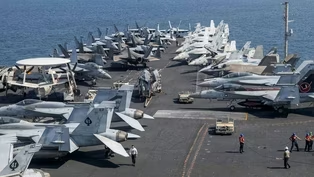
Carrier conditions become symbol of Iran war miscalculation
Video has Closed Captions
Poor conditions on U.S. carrier become symbol of Iran war miscalculation (10m 42s)
Providing Support for PBS.org
Learn Moreabout PBS online sponsorship New Episode
- News and Public Affairs

Top journalists deliver compelling original analysis of the hour's headlines.
 New Episode
- News and Public Affairs

FRONTLINE is investigative journalism that questions, explains and changes our world.
 From My Station
 New Episode
 New Episode
 New Episode
 New Episode


 New Episode
 New Episode
 New Episode
Support for PBS provided by:
Major funding for “Washington Week with The Atlantic” is provided by Consumer Cellular, Otsuka, Kaiser Permanente, the Yuen Foundation, and the Corporation for Public Broadcasting.