
December 31, 2025 - PBS News Hour full episode
12/31/2025 | 57m 46sVideo has Closed Captions
December 31, 2025 - PBS News Hour full episode
December 31, 2025 - PBS News Hour full episode
Problems playing video? | Closed Captioning Feedback
Problems playing video? | Closed Captioning Feedback
Major corporate funding for the PBS News Hour is provided by BDO, BNSF, Consumer Cellular, American Cruise Lines, and Raymond James. Funding for the PBS NewsHour Weekend is provided by...
December 31, 2025 - PBS News Hour full episode
12/31/2025 | 57m 46sVideo has Closed Captions
December 31, 2025 - PBS News Hour full episode
Problems playing video? | Closed Captioning Feedback
How to Watch PBS News Hour
PBS News Hour is available to stream on pbs.org and the free PBS App, available on iPhone, Apple TV, Android TV, Android smartphones, Amazon Fire TV, Amazon Fire Tablet, Roku, Samsung Smart TV, and Vizio.
Providing Support for PBS.org
Learn Moreabout PBS online sponsorshipLISA DESJARDINS: Good evening.
I'm Lisa Desjardins.
Geoff Bennett and Amna Nawaz are away.
On the "News Hour" tonight: new tactics by Russian President Vladimir Putin.
Why European leaders say he invented an assassination plot and what it means for any Ukraine peace deal.
And we join a scientific expedition in the icy seas around Antarctica.
Our Miles O'Brien takes us on board the journey to understand a massive melting glacier.
And how a U.S.-backed road and rail project in an unstable region could unlock trade with Central Asia.
SIMON OSTROVSKY: There are still a lot of hurdles to get over before the White House's vision of peace becomes a reality on the ground here in Armenia on the border with Iran.
(BREAK) LISA DESJARDINS: Welcome to the "News Hour."
Millions across the country will ring in the new year tonight with bubbly drinks, loved ones and the warmest clothes they can find.
That's because arctic temperatures and heavy snow are sweeping across large parts of the U.S.
Plows in Upstate New York have been working to clear roadways for New Year's travelers, as forecasters warn of squalls across the region.
In New York City, the estimated one million people who are expected to gather in Times Square tonight are facing the coldest ball drop in nearly a decade.
And a dose of arctic air is keeping temperatures low from the Midwest to the Appalachians.
Meantime, on the West Coast, California is bracing for heavy rains and the risk of flooding just days after a Christmas week storm soaked many parts of the state.
In many parts of the world, of course, it is already 2026.
Auckland, New Zealand, was the first major city to ring in the new year with a fireworks display a full 18 hours before it strikes midnight on the U.S.
East Coast.
Australia followed a few hours later.
Celebrations in Sydney were mixed with mourning of the 15 lives lost in this month's Bondi Beach shooting.
Before the fireworks, the city held a candlelit moment of silence.
And a change in Hong Kong's celebration.
The city held a light show, canceling its renowned fireworks display over the harbor after a massive building fire killed at least 161 people there last month.
President Trump says he's removing National Guard troops from Chicago, Los Angeles and Portland, at least for now.
In a social media post, Trump - - quote -- wrote: "We will come back, perhaps in a much different and stronger form, when crime begins to soar again, only a question of time."
Troops had already left Los Angeles after a judge's ruling blocked their deployment earlier this month.
And while forces had been sent to Chicago and Portland, they were largely kept off the streets as legal challenges play out.
President Trump has issued his first vetoes since returning to office, rejecting two bills that passed Congress unanimously.
Critics say both were vetoes about revenge.
One bill supported a water pipeline in Colorado.
Mr.
Trump said it was a drain on federal taxpayers.
But Republican Congresswoman Lauren Boebert and the state's two Democratic senators questioned that, saying Trump retaliated for disputes related to Jeffrey Epstein and election denier Tina Peters.
The other bill would give Native Americans in Florida with one tribe more land control.
The president has blamed that tribe for not backing his immigration policies.
It will largely be up to Republican leaders in Congress to decide if they want to override those vetoes.
Newly released transcripts and videos show that former special counsel Jack Smith told lawmakers that the January 6 riot -- quote -- "does not happen without President Trump."
That's from a closed-door hearing earlier this month with the House Judiciary Committee.
Lawmakers grilled Smith for eight hours earlier this month over two criminal investigations he launched into Trump.
One focused on the president's role in trying to overturn the results of the 2020 election, while the other related to classified documents after Trump's first term ended.
Here's Smith in his opening statement.
JACK SMITH, Former Special Counsel: The decision to bring charges against President Trump was mine.
But the basis for those charges rests entirely with President Trump and his actions, as alleged in the indictments returned by grand juries in two different districts.
LISA DESJARDINS: Smith faced questions about his decision to gather phone records of other Republican members of Congress as part of the investigation.
Republicans decried that as weaponization of the justice system against Trump and his allies.
Here's an exchange with Smith about that.
MAN: To the extent members of Congress and senators are up in arms that this happened to them and they're seeking accountability, who should be held accountable for answering these questions?
JACK SMITH: Well, I think who should be accountable for this is Donald Trump.
These records are people, in the case of the senators, Donald Trump directed his co-conspirators to call these people to further delay the proceedings.
He chose to do that.
LISA DESJARDINS: The release of the video and transcript comes after Smith had initially asked that his hearing be done in public.
A Trump-appointed judge dismissed the classified documents case in 2024 and the 2020 election case was dropped after he won the election.
In Iowa, a win for Democrats in a holiday special election for the state's Senate.
Renee Hardman's victory in a suburban Des Moines district blocks Republicans from regaining a supermajority in that chamber.
That means Republican Governor Kim Reynolds will need some Democratic support to approve appointees.
Hardman's victory also makes her the first Black woman to be elected to the Iowa State Senate.
Another brazen heist in Europe, this one in Western Germany involving tens of millions of dollars in cash and property stolen from a savings bank.
Police in the city of Gelsenkirchen released a photo showing where the suspects drilled through a basement wall to access thousands of safety deposit boxes.
The bank estimates that more than 95 percent of its boxes were broken into.
As news of the heist broke out, hundreds of concerned customers flooded the scene.
As of earlier today, no arrests have been made.
Wall Street posted a lackluster day to end what was otherwise a banner year for stocks.
The Dow Jones industrial average dropped about 300 points.
The Nasdaq lost more than 170 points.
The S&P 500 fell for a fourth straight session, but it was up more than 16 percent for the year.
Former U.S.
Senator and Colorado Congressman Ben Nighthorse Campbell has died.
A member of the Northern Cheyenne Tribe, Campbell was the only Native American in the House when he served there, and also the only one in the Senate during his two terms there.
He was known as a fiscal conservative and a social liberal, who started as a Democrat, but switched parties in 1995.
Campbell led a multifaceted life, previously working as a Teamster, a jeweler, and a rancher.
He even competed in the 1964 Olympics in judo.
His family says Campbell died of natural causes.
Ben Nighthorse Campbell was 92 years old.
And actor Isiah Whitlock Jr., best known for playing the corrupt politician Clay Davis on HBO's "The Wire," has died.
ISIAH WHITLOCK JR., Actor: The people know what I have done for West Baltimore and this city as a whole.
They know these charges ain't nothing but B.S.
LISA DESJARDINS: Whitlock's character was a fan favorite, known for his frequent usage of a profanity starting with S-H.
Fans would often approach him on the street to mimic his drawn-out delivery.
That was one of more than 120 acting credits, which included a recurring role on the political satire "Veep," plus multiple films with director Spike Lee, like "25th Hour" and "BlacKkKlansman."
Whitlock's manager announced his death on social media, citing a short illness.
Isiah Whitlock Jr.
was 71 years old.
Still to come on the "News Hour": an unprecedented flood of misinformation prompts the editors of PolitiFact to dub 2025 the year of the lies; photojournalists who covered the most important stories of the year reflect on capturing some of 2025's most impactful images; and a social worker gives her Brief But Spectacular take on building hope and better futures for foster kids.
A U.S.
official tells "News Hour" that the CIA has assessed Ukraine was not targeting Vladimir Putin in a recent drone attack, a claim that Putin made to President Trump and that Trump seemed to accept earlier this week.
And, this afternoon, a President Trump social media post suggested he agreed with what Europeans argue tonight that it's Russia that is blocking a peace deal with Ukraine.
Nick Schifrin begins with Russia's latest strikes on Ukraine at a tense diplomatic moment.
NICK SCHIFRIN: Russia's New Year's Eve welcome in Ukraine's third largest city on Moscow's battlefield of choice, civilian infrastructure, where the victims were the vulnerable, the elderly, four-legged family members, and a 7-month-old infant.
By day, their homes blackened, the now-homeless spent New Year's night displaced, a Christmas tree the only thing left standing in a ruined apartment.
TETIANA, Odesa Resident (through translator): We have been left out on the street.
Any family could find themselves in the same situation.
Everyone is equal now.
No one knows where the next strike will land.
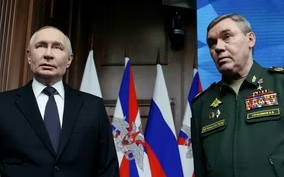
NICK SCHIFRIN: And, today, about 400 miles to the north, Russia's top general threatened more strikes.
Valery Gerasimov told troops posted near Ukraine's Northeast border that their mission was to seize what he called buffer zones inside two Ukrainian provinces, even though the current U.S.
peace plan calls for Russia to withdraw entirely from those exact provinces.
GEN.
VALERY GERASIMOV, Chief of General Staff, Russian Armed Forces (through translator): The president of the Russian Federation ordered to continue expanding the line of defense next year.
NICK SCHIFRIN: But it's not defense that Russia is playing when it comes to information operations.
Moscow released these images today of what it claimed were Ukrainian drones that targeted a Vladimir Putin residence complete with a map of the drone's alleged route.
That Putin home in Northwest Russia, exposed by former opposition leader Alexei Navalny's foundation, has 75,000 square feet located on a property that spans 370 lakeside acres and, according to another Putin critic, home to Putin's secretive family with Alina Kabaeva.
Putin alleged the attack on the phone with Trump earlier this week, and Trump accepted it.
DONALD TRUMP, President of the United States: It's a delicate period of time.
This is not the right time.
It's one thing to be offensive, because they were offensive.
It's another thing to attack his house.
It's not the right time to do any of that, and can't do it.
NICK SCHIFRIN: But, tonight, a U.S.
official confirms to "PBS News Hour" that the CIA has concluded Ukraine was not targeting Putin's residence.
A person familiar with the meeting says CIA Director John Ratcliffe briefed that conclusion to President Trump.
And, this afternoon, President Trump posted this story with the headline: "Russia is the one standing in the way of peace."
Today, European leaders agreed.
Top E.U.
diplomat Kaja Kallas wrote it was a -- quote -- "deliberate distraction, and Moscow aims to derail real progress toward peace by Ukraine and its Western partners."
Senior European officials told "PBS News Hour" today the story was a -- quote -- "false flag, an 100 percent lie," and a French official said its intelligence concluded the claim had no credible evidence.
And for perspective on all this, we turn to Angela Stent.
She is the former national intelligence officer for Russia, author of "Putin's World: Russia Against the West and with the Rest," and a senior fellow at the American Enterprise Institute, a think tank in Washington.
Angela Stent, thank you very much.
Welcome back to the "News Hour."
So let's talk about this new CIA assessment.
Of course, the U.S.
has sensors that can detect drones.
It has relationships with its Ukrainian partners.
Talk us through what would go into this assessment just in the last few days.
ANGELA STENT, American Enterprise Institute: So they would be looking very carefully at the path of the drones.
Now, we have to say that the Novgorod region, which is near where Putin's residence is, is home to a number of defense-related industries, including drone production.
So it's quite understandable that the Ukrainians might have wanted to target that, given all the bombardment that they have been experiencing in the past months and, even as you said yourself tonight, New Year's Eve.
And so that would have been the assessment looking at the path of these drones.
I watched the Russian footage.
And, of course, it's really -- they show you drones, but it doesn't show you exactly where it's located.
So it would have been really being very specific about what the location was and concluding that, yes, there were probably Ukrainian drones in the area, again, targeting these defense-related industries, but certainly not targeting Putin's own residence.
NICK SCHIFRIN: So, given that, is it possible that Vladimir Putin, that Russian intelligence thought or believed that these drones were in fact aimed at him?
ANGELA STENT: Well, I find that rather difficult to believe.
I think the Russian intelligence services are pretty talented at figuring out where the drones are going.
But it's quite possible someone could have misreported it or they could have conflated various things.
So -- and they might have told Putin that.
That's quite plausible too.
I mean, what happens inside the Kremlin is clearly a black box.
And so we can only speculate about that.
NICK SCHIFRIN: And so, therefore, would the U.S.
intelligence community conclude to Donald Trump, to the president that Putin was lying to him on the phone?
Or could the assessment be that, hey, Russia might have thought that these drones were heading there, so he wasn't specifically lying to you, Mr.
President?
ANGELA STENT: It could have been either of those things, I think, depending on who was talking to him.
But the very fact that he has now posted on social media that Russia is the obstacle here, he's reversed what he said when he first spoke to President Putin and Putin told him that they had told him that they had targeted, that they tried to assassinate him, which is what he told him, I think he would - - he now understands that this wasn't true.
And he is now beginning to understand perhaps that Vladimir Putin really doesn't want to sign peace agreement with Ukraine and that the reason he told President Trump that the Ukrainians had tried to assassinate him was to try and persuade President Trump that Russia had every right to keep hitting Ukraine.
NICK SCHIFRIN: So let's talk about that reversal, as you just called it.
We did hear President Trump basically accept Putin's story, now, as you said, posting this story that The New York Post did about how Putin is blocking peace efforts.
Let's talk about the intelligence community for one second.
How significant is it that President Trump, who has doubted the I.C.
in public in the past, seemed to accept CIA Director Ratcliffe's assessment that, yes, boss, look, it's not what you thought, it's not what Putin told you, but it's actually this?
ANGELA STENT: It must have been pretty convincing evidence.
And I think, fortunately, he clearly trusts the wisdom of his CIA director and his judgment.
And there must have been enough people around him to convince him that he should accept what Director Ratcliffe said.
NICK SCHIFRIN: So, given all this, what do you think would be the impact on the talks, given that President Trump is now effectively rejecting the story that, as you have been saying, Putin inserted into the narrative in order to kind of break up the talks or break up the momentum of the talks?
ANGELA STENT: So, now it will be up to President Trump, I think, to discuss this with his chief negotiators currently, which is Steven Witkoff and Jared Kushner, who've been talking to Putin, were just recently there, and so that they might pull back, I think, from trying to still persuade the Ukrainians that they should be willing to make some what they call a land swap.
They had President Zelenskyy with them in Mar-a-Lago in Florida this weekend, and apparently did agree on a peace plan which would not have involved Ukraine doing that.
But from what we have heard previously, certainly from Mr.
Witkoff, he has believed that the only way that you will get to peace and really the only obstacle is if Ukraine gives up territory to Russia that Russia doesn't control.
That's not true.
Putin is after much more than territory.
And so maybe there now has to be, I think, an agreement, a consensus between the president and his chief negotiators and also Secretary of State Rubio that in fact Russia is the obstacle to peace and that Putin has just been playing them along because he does not want the Trump administration to impose more sanctions on Russia or reverse itself on supplying Ukraine with certain weapons, which would enable the Ukrainians to push back against the Russians more effectively.
NICK SCHIFRIN: And very briefly, because I only have about 40 seconds left, you just mentioned weapons.
The U.S.
has restrained some weapons to Ukraine.
What's been the impact for Ukraine's ability to have leverage both on the front lines, but, crucially, at the negotiating table?
ANGELA STENT: This has reduced Ukraine's own leverage.
President Zelenskyy spent much of 2025, in essence, negotiating with President Trump to make sure that the U.S.
doesn't fully withdraw its support from Ukraine.
And so were Ukraine to be able to maintain - - to obtain some of these weapons, that would certainly increase President Zelenskyy's leverage.
NICK SCHIFRIN: Angela Stent, thank you very much.
ANGELA STENT: Thank you.
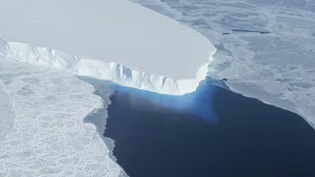
LISA DESJARDINS: Some call it the Doomsday Glacier, a vast expanse of antarctic ice roughly the size of Florida.
Formerly named the Thwaites Glacier, as temperatures rise connected to human activities, it's melting fast and threatens to raise global sea levels.
That's why a team of nearly 40 researchers is embarking on a two-month journey to study it.
And, of course, our science correspondent, Miles O'Brien, is with the expedition.
He joins us now from an icebreaker in the Southern Ocean on his way to one of the most remote locations on the planet.
Miles, let me just start with, where are you and how close are you to this glacier?
MILES O'BRIEN: Sixty degrees latitude, Lisa, about 160 west of longitude, right in the middle of the Southern Ocean.
And, normally, this would be a wild ride, but we have had a very benign cruise so far, having left New Zealand a little less than a week ago, chugging along at about 10 or 11 knots, making our way down to West Antarctica and the Thwaites Glacier.
And the fact that I can have a communication at all with you like this is a modern marvel of technology, the fact that we have satellite-based Internet systems that give us this kind of bandwidth, which we will have with us for the entirety of this scientific expedition.
So it's an opportunity to report on an urgent scientific mission in real time, and that was something I couldn't resist.
LISA DESJARDINS: Well, we're happy to have you on, but I want to ask you.
This is not the first voyage, of course, to Antarctica for scientific purpose, but what's different about this one?
MILES O'BRIEN: Well, this glacier is what's different.
The Thwaites Glacier, as you pointed out, has a tremendous capacity to potentially raise sea levels all over the globe by about 10 feet if it melts and collapses and the ice behind it flows into the sea.
It is unique because it is unstable on a good day.
It sits below sea level.
And, as it happens, where the glacier meets the ocean, climate change has changed the ocean currents such that warm water is lapping right up against it.
And what is happening right now is, it's being eaten away from beneath.
And, as that happens, it accelerates, because it's going downhill below sea level.
So what scientists want to know is, what's the temperature of that water?
How quickly is that melt occurring?
And could it be accelerating in ways they can't predict right now?
No one has ever gotten data from this part of the world ever.
LISA DESJARDINS: Well, that's an astounding thing.
MILES O'BRIEN: Yes.
LISA DESJARDINS: I think the question maybe on a lot of people's minds, though, is, I know you're trying to pinpoint a little bit more about how long this glacier can go, what exactly its situation is right now, but what are the parameters here?
It obviously would take a long time for this entire glacier to sink into the sea, but it doesn't have to raise the ocean level 10 feet to have an impact around the globe.
What are we talking about generally?
MILES O'BRIEN: Well, that's true.
And that's the big question mark.
If you don't know what's happening beneath that glacier, you really can't make a prediction or forecast as to what lies ahead.
So scientists would like to drill a hot water drill hole right at that spot where the glacier meets the land and the sea.
They call it the grounding line.
They want to drop down several instruments to get some instantaneous data.
And then they want to leave behind a mooring that will be attached to a device that can offer real-time constant data of the temperatures at that location over time.
That will give them the insight as to how worried we should be about Thwaites.
The thought is, if it's not an accelerating process, this is not something we have to worry about for quite some time.
But what if it does begin a cascade of acceleration?
That's a big question and quite a troubling one which scientists hope to answer.
LISA DESJARDINS: This, for you, is a lifelong goal, and you are keeping people abreast of what happens through entries, journal entries.
You will be talking to us.
But I wonder what in particular are you curious about when you get there?
MILES O'BRIEN: Well, I'm curious to see science in this very rigorous, difficult environment.
This is a two-month voyage that comes down to just a day or so of key science, when you consider that drill site.
All these scientists work so hard and so long with a very narrow window of opportunity to do their work.
So, for them, it is the ultimate game day, kind of the Super Bowl.
And, for me, as a reporter covering science and climate, I'm thinking of it as kind of a journalistic Super Bowl.
And I have even got the right NFL-style headset to cover it.
So I'm very excited to be there.
I'm very excited to see science that has urgency and great relevance, not to just a few people, but literally the whole planet.
LISA DESJARDINS: The ever intrepid Miles O'Brien, thank you, and we will keep in close touch.
MILES O'BRIEN: You're welcome, Lisa.
Look forward to it.
LISA DESJARDINS: Today, in Cambodia's capital, soldiers arrived to a hero's welcome after they were released from five months of captivity by neighboring Thailand.
There's a tenuous cease-fire between those two countries.
It is one of eight conflicts that President Trump has claimed to have solved since he began his second term.
Those range from tensions tackled in his first term, to ongoing diplomatic disputes, to wars where he has personally helped negotiate cease-fires.
One of those is between Azerbaijan and Armenia, bitter rivals since the collapse of the Soviet Union.
Their leaders met the president in the Oval Office this summer.
Special correspondent Simon Ostrovsky and producer Katia Patin traveled to the Armenian border with Iran to assess whether that agreement could lead to peace facilitated by a corridor named after President Trump himself.
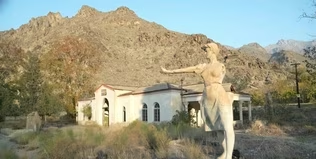
SIMON OSTROVSKY: A picturesque river valley cuts through the Caucasus Mountains, on one side, the Islamic Republic of Iran, on the other, Armenia, a country that was recently defeated in a war with Azerbaijan.
An uneasy peace has held since an agreement was signed in Washington in August backed by Trump.
But the deal's survival depends on Azerbaijan gaining access to this strip of Armenian territory along Iran's border.
That's because these Armenian lands separate Azerbaijan from its enclave of Nakhchivan, currently reachable only by air or overland through Iran.
Enter the Trump Route for International Peace and Prosperity, known as TRIPP, a proposal to turn this high-security border zone into a transit corridor for rail and road traffic linking Azerbaijan to Nakhchivan.
This railway line has been abandoned since the outbreak of war between Armenia and Azerbaijan, and the agreement reached between the two countries with the help of the Trump administration could dramatically alter the geopolitical map of this strategic region.
But there are still a lot of hurdles to get over before the White House's vision of peace becomes a reality on the ground here in Armenia on the border with Iran.
As with many Trump foreign policy initiatives, this deal isn't just about transport or cessation of hostilities.
It envisions a raft of commercial opportunities, including a U.S.-Armenian joint venture that will operate the Trump Route on a for-profit basis, an A.I.
data center powered by Nvidia chips and Dell servers, cooperation on nuclear energy.
And, in Azerbaijan, ExxonMobil plans to explore for gas.
But there are complexities to overcome.
The region's terrain presents significant engineering challenges, and the proposed corridor would operate right under the nose of Iran, which the Trump administration bombed recently.
On top of that, Armenia outsources its border security to Russia under a mutual defense treaty, something we found out the hard way when a Russian patrol stopped to check our paperwork.
MAN (through translator): What's your agency called again?
SIMON OSTROVSKY: PBS.
MAN (through translator): It's American, correct?
At this time, I'm issuing a warning.
SIMON OSTROVSKY: Your warning has been received.
We just got stopped by a Russian FSB Border Patrol.
They actually manned this border on behalf of Armenia, and they let us off with a warning, said that we shouldn't be filming so close to the border, but they were really interested in what we were doing here.
The Trump Route for international Peace and Prosperity is supposed to be manned by American contractors to manage this route.
Are they going to have to contend with the Russian border guards here as well?
And how's that going to work?
I think that that hasn't been figured out yet, and it's just one of the challenges that this peace plan still faces.
This American proposal is just the latest in a series of developments that have marginalized Russian influence in the South Caucasus.
Russian peacekeepers were swept aside when Azerbaijan took control of the disputed Nagorno-Karabakh enclave in 2023.
Stretched thin by its war in Ukraine, Moscow didn't intervene, a decision that led to the exodus of Karabakh's Armenian population.
Russia's role inside Armenia appears now to be at risk too, as polls show public sentiment towards Moscow plummeting.
This Armenian resident of the border area told me he felt betrayed and wanted Russian troops out under any future settlement.
KARLOS KHACHATARYAN, Resident (through translator): They're traitors, not allies.
SIMON OSTROVSKY: TRIPP is about much more than a regional transport link.
It's the critical missing segment in a proposed European corridor known as the Middle Passage, which would open Western trade routes to Central Asia, a region rich in rare earth minerals and other resources.
A direct connection through NATO ally Turkey would allow the five landlocked Central Asian states to avoid routes through Russia, China or Iran.
Officials from both Armenia and Azerbaijan seem eager to play up the commercial potential for America.
Here's Hikmet Hajiyev, assistant to the president of Azerbaijan.
HIKMET HAJIYEV, Assistant to the President of Azerbaijan: But the United States companies and United States private sector will also get a tremendous opportunity and using this route entering Central Asian market and including the rare earth material and some other business activities, a therefore win-win situation for everybody, including the United States companies.
SIMON OSTROVSKY: Armenia's Deputy Foreign Minister Vahan Kostanyan argues that a U.S.
pledge of $145 million in financial support, which includes funding for TRIPP and for enhancing Armenia's border capacities, is part of what will help make any peace more durable.
VAHAN KOSTANYAN, Armenian Deputy Foreign Minister: There is an agreement between Armenian and U.S.
government that we will be establishing a joint company together, which will have a right to develop infrastructure.
It has a huge potential for regional, but also global logistic change.
SIMON OSTROVSKY: What's clear is that a lot of the details still have to be worked out, but peace, if it sticks, would benefit Azerbaijan and Armenia and the wider region.
There is one big loser, of course, and that's Russia.
As America's footprint increases in the South Caucasus, Russia's will decrease, and it seems like Moscow is already on the back foot.
VAHAN KOSTANYAN: According to the agreement that Armenia and Russia signed back in the '90s, simultaneously, when Armenian border guards will increase their capacities, the number of Russian border keepers should be decreased.
And we already have these examples.
SIMON OSTROVSKY: I'm just still a little bit confused about what's going to happen to the Russians.
They're staying or not staying?
VAHAN KOSTANYAN: We are on or off.
SIMON OSTROVSKY: Relations with Russia are obviously a sensitive topic.
Yerevan doesn't want to anger its longtime ally prematurely.
But since the signing of the agreement in Washington, the Trump administration has achieved something Russia never could, an end to the skirmishes that plagued the Armenian-Azerbaijani border until last summer.
HIKMET HAJIYEV: I will divide the regional history in two parts, until the 8th of August and after the 8th of August.
A lot of things have tremendously changed in the region of the South Caucasus.
Since the independence of Armenia and Azerbaijan, these two countries were literally in a war.
But now we have real peace on the ground.
SIMON OSTROVSKY: Time will tell if TRIPP ever gets built or if a final peace settlement ending the war is ever signed.
But, for now, it appears the U.S.
is seizing an opportunity to reshape a region long dominated by Moscow.
For the "PBS News Hour," I'm Simon Ostrovsky in Meghri, Armenia.
LISA DESJARDINS: On this New Year's Eve, we're looking back at this unprecedented political year that saw a flood of claims and misinformation.
For the past 15 years, the fact-checkers at the nonprofit PolitiFact have sorted through hundreds of statements by politicians to name the number one lie of the year.
But, this year, the editors have done something a little different, instead dubbing 2025 the year of the lies.
I recently explored this decision with PolitiFact editor in chief Katie Sanders.
And a warning: This conversation contains images of starvation that some viewers may find disturbing.
Katie, let's start with that change.
Why is this the year of the lies?
KATIE SANDERS, Editor in Chief, PolitiFact: Well, we have been doing this for a long time.
And the volume and severity of the inaccurate claims was just overwhelming.
And we felt that it was insufficient to name just one our lie the year.
So we wanted to catch people's attention and take stock of the times we're in.
And so we thought renaming it and giving it a different purpose might do that.
LISA DESJARDINS: As you're implying, there were almost too many lies for you to talk about just one.
Many of them revolved around President Trump and his administration, everything from words about tariffs to the Venezuelan boat strikes.
But we're going to try and focus on a couple here, starting with health misinformation.
President Trump and his health and human services secretary, Robert F. Kennedy Jr.
talked about vaccine safety at some points.
They also had a news conference in September in which they said that pregnant women should not use Tylenol.
To this day, the White House Web site says it's a -- quote -- "fact" that Tylenol is linked to autism.
What are the facts?
KATIE SANDERS: It's not.
This is another example of the administration running with associations and unproven research that has not been corroborated elsewhere.
And we have spoken to numerous health groups and medical professionals and experts since that September news conference who have stuck to what the research conclusions are, which is that this is one of the few over-the-counter medications that are available to pregnant women to manage pain during pregnancy.
This one really stuck out in a year of countless statements about health and health policy that were not rooted in fact and created a lot of confusion, frustration among providers and patients on the ground.
LISA DESJARDINS: On to immigration.
This has been a big part of this Trump administration.
Deportations.
The Trump administration has said that they are focused on the worst of the worst.
Does that claim hold up?
KATIE SANDERS: I think that, when you look at the data, it is pretty clear that that impression is not reflected.
They are arresting violent criminals, but the majority of people who are being detained and then deported are people who are in the country illegally, but did not commit criminal activities.
I think almost 73 percent of people who have been detained did not have criminal convictions.
So it's clear that the Trump campaign and the Trump administration has been framing it one way, but, when you look at the statistics and you read countless anecdotes and videos of people who are being affected by this policy, it's clear that this is not true.
Most people who are being affected are not what they had described as violent criminals shorthanded as the worst of the worst.
LISA DESJARDINS: You also allowed readers to vote for what they saw as the number one lie of the year, and they chose some words by Israeli Prime Minister Benjamin Netanyahu from July, in which he said at that time that there was no starvation in Gaza.
What's the context for that?
KATIE SANDERS: The context was, over the summer, there were a lot of visuals coming out of Gaza showing people who were emaciated.
And this wasn't just visual evidence, but there were human rights organizations and other influential groups that were documenting starvation in that part of the world as a result of the Israeli actions.
And so that got a Pants on Fire rating from us, because it was not only wrong.
It was ridiculous.
It was contrary to all available evidence.
LISA DESJARDINS: Now, you are aware that there is a conversation coming from President Trump about whether there is media bias against him.
He says that there is.
And most of your claims here that you have looked at or that you say are lies or falsehoods are from the Trump administration and others in power.
How do you gut-check yourself to make sure that you're not biased or you're not being fed a narrative that you're following?
KATIE SANDERS: We check ourselves a few ways.
We check both sides of the political debate.
There were examples of Democratic officials, Hakeem Jeffries, Governor J.B.
Pritzker in Illinois, who were on our readers choice ballot for saying some things that were clearly false.
So we call it both ways.
And I would just say, as the editor of PolitiFact, we receive a number of pitches from what the Trump administration is saying on a daily basis.
And we're very selective in what we choose to pursue.
We can't get to everything.
And so I think there is a serious volume difference coming from the White House and other places, but we have been covering President Trump as a candidate or an official for a decade.
And so that's not very different from our experience.
LISA DESJARDINS: Thinking about this idea of the year of the lie, what are the stakes about facts in this country right now?
KATIE SANDERS: The stakes are high for facts and the erosion of information integrity.
And one of the points I made in my opening column was that, yes, we're spotlighting several statements from the Trump administration, but the lows of the year for political rhetoric and influential speech are not the White House's alone.
And we're contending with a really fraught online information environment, where A.I.
slop is abundant, misleading, out-of-context narratives abound, and you just can't believe what you see.
And we worry that people are too numb to the drumbeat of misinformation.
They have tuned it out.
And that is very dangerous, frankly, for us to be in.
And so I hope that our year of the lies catches people's attention and reminds them why it's important to improve media literacy and pause before taking everything at face value.
LISA DESJARDINS: And this is why we're so happy that you're talking to us and why we will clearly pay attention to your work next year as well.
Katie Sanders of PolitiFact, thank you so much.
KATIE SANDERS: Thank you.
LISA DESJARDINS: Tonight, we're also highlighting our annual review of some of the year's biggest images, stories through photography.
We hear from four photojournalists.
Among them, they documented life on the front lines in Ukraine, major changes in immigration enforcement in the U.S., the historic election of a new pope, and more.
It's part of our ongoing series on arts and culture, Canvas.
MARIO TAMA, Getty Images: My name is Mario Tama.
And I'm a staff photographer with Getty Images.
EVGENIY MALOLETKA, Associated Press: My name is Evgeniy Maloletka.
I'm a Ukrainian photojournalist.
I'm working currently for the Associated Press as a chief photographer here in Kyiv.
YARA NARDI, Reuters: I'm Yara Nardi.
I'm a staff photographer for Reuters, and I'm based in Rome.
VICTOR BLUE, Freelance Photojournalist: My name is Victor Blue.
I'm a freelance photojournalist and I'm based in New York City.
MARIO TAMA: The morning of January 7 started out ominously.
I was awoken at 3:00 a.m.
by the sound of the Santa Ana winds, and the Pacific Palisades Fire broke out later that morning.
By that evening I was covering the Eaton Fire in Pasadena and Altadena.
I never imagined that I'd be covering two major fires simultaneously on the same day burning through communities here in Los Angeles.
As photojournalists, our role is to act as the eyes of the public.
I think of my job as to be there on the ground documenting what I find, what I see, but not just the flames, not just the destruction.
I believe it's our duty to try to capture the human toll, the human element.
VICTOR BLUE: It's been an intense and historic year for our country's relationship to its immigration and to immigrants and the immigrants that make up our country.
And it's been gratifying to have been able to spend a lot of time covering that.
And the big change is the hyperaggressive focus on capturing and removing folks with various levels of status.
And there was like a flattening of folks, and either you lived here or you didn't, you belong or you don't.
And the aggressive enforcement of that perspective I think surprised a lot of the country and I think definitely is a historic shift for our society.
EVGENIY MALOLETKA: 2024 was the beginning of the war of the drones, of massive, massive use.
But this year, it's increased and three or four times higher the using of drones.
Both sides, Ukrainians, the Russians, use different type of these drones to target each other.
It's really hard nowadays to photograph what's going on at the battlefield and to show because of the dangerous and the security situation because of the drones.
I'm constantly coming back and forth for the rehabilitation stories, because I know that so many of our soldiers who return from the battlefield with wounds, and they are trying to live a normal life.
This is so important for me, as a Ukrainian, to tell as much stories as possible about all the Ukrainians, about -- and what is happening with Ukraine nowadays in all of it, and how we live under the rockets, under these drones, trying to live a normal life.
And this is our reality.
YARA NARDI: Covering the pope's death and the conclave and then the election of the new pope is one of the most important stories that I ever covered.
Even if you are secular, it's really - - it's something big.
It's something that touch all over the world.
There's one shot that I really, really love that I took from the top of Saint Peter's Basilica.
You can see millions of people in a totally silence.
And this was one of the deepest moments that I ever live in my life, just the silence.
I remember the silence.
(CROSSTALK) YARA NARDI: When Pope Leo was elected and he came out from the balcony, I was really surprised, because I spent the last months thinking about who would be the next pope, and I never thought about him, to be honest.
I can see people really welcoming to him.
They really want to know him, touch him, especially touch him.
Most of the time, my picture are about hands, hands touching other hands, pope hands.
(LAUGHTER) YARA NARDI: I love this side of the story.
MARIO TAMA: I remember the morning that the National Guard troops arrived in L.A.
And although that day started peacefully, it eventually turned into chaos.
And you're trying to just maintain constant situational awareness.
It's a little bit hard to describe, but you're kind of running on instinct and on feel.
I'd heard of a major federal immigration raid happening at a cannabis farm out in rural Ventura County.
This was like a large-scale, almost like military-style raid.
And so members of the community showed up and were protesting out in this rural farmland.
It was a striking contrast between federal agents in gas masks and helmets with less lethal munitions standing in this pastoral farmland with protesters on the other side.
And it was just something I never imagined that I would witness.
VICTOR BLUE: The agents and the migrants are the two great protagonists in this trauma.
As photojournalists, we're standing back kind of trying to understand both of those kind of categories of people, trying to communicate faithfully and accurately the experience they're having as they interact in this way.
I'm not there to celebrate one side of this debate and I'm not there to demonize the other side of the debate.
I'm there to help readers understand how complex and how three-dimensional and how nuanced everybody involved is.
I'm not trying to make the decision for anybody what they think or feel about any of these issues.
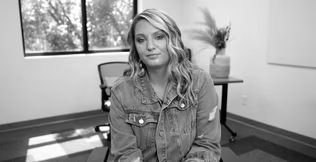
LISA DESJARDINS: Kaitlyn Davis is a social worker in Elgin, Oklahoma, who drives close to nine hours round-trip in the flatlands to meet face-to-face with foster children under her care.
This is due in part to a chronic shortage of foster families, especially in rural areas.
Long-distance placements are stretching a child welfare system that aims to help youth navigate sudden loss of homes, schools, friends, pets.
Davis shares her Brief But Spectacular take on building hope for better futures.
KAITLYN DAVIS, Child Welfare Worker: Foster parents are one of the most important roles of child welfare.
If we don't have placement for these kids, they are in the office, they go to shelters, they go into group homes.
So we really have to have foster parents that are willing to step up and take these kids that are dealing with trauma and just need somebody to love on them.
I work with Oklahoma Human Services and child welfare, and I am a permanency planning specialist.
The range for the kids we work with are newborn to 18 years old.
They are dealing with a trauma.
They really need somebody that is going to just stick with them and get through the hard times.
We are coming in on the hardest day in their lives, so I don't want them to feel like they're just another case and client for me.
I want them to know that I'm a support for them and I'm willing to help them in any way possible.
The questions that I get on the first visit really depend on the age.
It's: Am I going to see my mom and dad?
Am I going to see my sibling?
When am I going to have a visitation?
How long is this going to take?
Am I ever going home to mom or dad?
We're a stranger to them.
We're coming in at a point to where they don't understand what's going on, why they were taken from their parents.
Leaving their family is a big one, absolutely, but it's also leaving their church, their friends, their other family members.
Sometimes, they have dogs and cats that they're really close to.
It's a whole new identity going to a new foster placement.
On hard days, I always go back to think about my family and think about, what kind of worker would I want them to have if I was in that situation, just because, I mean, this could happen to anybody.
Foster parents are one of the most important roles of child welfare.
It is a lot of work to be a foster parent, but the reward outweighs that.
My name is Kaitlyn Davis, and this is my Brief But Spectacular take on helping kiddos.
LISA DESJARDINS: You can find additional Brief But Spectacular episodes at PBS.org/NewsHour/Brief.
American pianist and composer Chloe Flower is on a mission to get young people into classical music.
She's doing it by collaborating with rap, house and pop stars and creating her own genre of music, a style she's coined popsical.
While Flower may be the new face of classic music with a contemporary take, her new Christmas album honors the female composers who came before her.
Independent Television News correspondent Amelia Jenne has this story.
AMELIA JENNE: A world-renowned pianist and composer who collaborates with house, rap, and pop artists, a musical activist on a mission to draw young people into classical music.
Chloe Flower has created not just her own label, but her own genre of the same name.
CHLOE FLOWER, Musician: I do hip-hop, but I'm not a hip-hop pianist.
I do house, but I'm not a house pianist.
So, for me, explaining to labels and to people what my sound is, I just thought it was easier to say popular music and classical music mixed together, popsical.
AMELIA JENNE: She began playing piano over tracks for social media, and after Cardi B spotted her version of Kendrick Lamar's "Humble," she made Chloe the centerpiece of her Grammy set.
CHLOE FLOWER: I don't know if you know "Money."
This is it.
There's nothing else in the whole entire song, not a pad, not like a chord, not a choir.
There's nothing else.
And so I was like, I will do it if I can write a few solos, and then just have a moment.
She taught me that women can empower women even at the highest level in the music industry.
During the rehearsal, she actually said to the team, "I want Chloe to have her moment in music."
And she gave me the center stage.
She brought my piano, the Liberace piano, from Vegas.
She paid probably $20,000 to have that restored and sent over.
It's, for me, all about classical music.
I'm like, bring more people into classical music, because it's such a timeless art form.
It's so valuable.
Like I said, in order for us to get kids to want to learn an instrument and adults, they have to be excited about it.
So when you start combining and working with these artists at these kids' revere, that's cool.
I think it can help change that narrative.
AMELIA JENNE: Her latest Christmas album called "She Composed: The Holidays" revives music entirely written by women from as early as the ninth century.
CHLOE FLOWER: Kassiani from what is now modern-day Istanbul, Turkey, she was a stunning, amazing woman and she was supposed to marry the emperor.
And she decided that she was too outspoken for that.
So she started her own convent and started composing.
And she's actually the earliest known composer whose work still exists.
Florence Price, she's from late 1800s, early 1900s and she's an American composer of color.
So not only did she suffer from misogyny, but she also had to deal with the Jim Crow South in America during that time.
And I think she's just so inspirational, because she really overcame so much.
One of the most amazing things, I think, about her career is that her work went completely undiscovered, even though she's from the early 1900s.
They discovered a huge amount of her work when they were doing a house renovation, when a tree had collapsed onto an attic.
And this family was like, what is all this musical notation here?
And they realized it was Florence Price, who had already been successful during her time.
And this was discovered in 2009.
AMELIA JENNE: There's an amazing fact that I have heard you speak about, that 5 percent of orchestral music played right now is written by women, even though there is lots more of it out there.
Did that sort of tie into why you wanted to make this?
CHLOE FLOWER: Absolutely.
I think that number is high for the holidays.
It's noticeably absent to me in the concert halls.
We have heard like 5,000 versions of "Sleigh Ride" and Handel's "Messiah" and Tchaikovsky's "Nutcracker," but there's so much music out there that was written by women that is seasonal that exists.
So I wanted to kind of make that the new norm.
(MUSIC) LISA DESJARDINS: And that's the "News Hour" for tonight.
I'm Lisa Desjardins.
Thank you for joining us.
And on behalf of our entire "News Hour" family, happy new year.
Azerbaijan-Armenia peace plan hinges on small strip of land
Video has Closed Captions
Clip: 12/31/2025 | 8m 10s | Azerbaijan-Armenia peace plan hinges on narrow strip of land along Iran border (8m 10s)
A Brief But Spectacular take on helping children
Video has Closed Captions
Clip: 12/31/2025 | 2m 32s | A Brief But Spectacular take on helping children in foster care (2m 32s)

Chloe Flower fuses classical and contemporary in 'popsical'
Video has Closed Captions
Clip: 12/31/2025 | 5m 14s | Chloe Flower fuses classical and contemporary music in a style coined 'popsical' (5m 14s)

News Wrap: Millions ring in new year amid Arctic weather
Video has Closed Captions
Clip: 12/31/2025 | 8m 9s | News Wrap: Millions ring in new year amid Arctic temperatures and heavy snow (8m 9s)
Onboard an expedition to study a massive, melting glacier
Video has Closed Captions
Clip: 12/31/2025 | 5m 19s | Onboard an expedition to study a massive, melting glacier in Antarctica (5m 19s)

Photojournalists reflect on capturing impactful images
Video has Closed Captions
Clip: 12/31/2025 | 6m 36s | Photojournalists reflect on capturing 2025's most impactful images (6m 36s)
Trump signals Russia is blocking path to peace in Ukraine
Video has Closed Captions
Clip: 12/31/2025 | 9m 49s | Trump signals Russia blocking path to peace as CIA rejects Putin's drone attack claim (9m 49s)

Why PolitiFact has labeled 2025 the 'Year of the Lies'
Video has Closed Captions
Clip: 12/31/2025 | 6m 47s | Why PolitiFact has labeled 2025 the 'Year of the Lies' (6m 47s)
Providing Support for PBS.org
Learn Moreabout PBS online sponsorship
- News and Public Affairs

FRONTLINE is investigative journalism that questions, explains and changes our world.

- News and Public Affairs

Today's top journalists discuss Washington's current political events and public affairs.










Support for PBS provided by:
Major corporate funding for the PBS News Hour is provided by BDO, BNSF, Consumer Cellular, American Cruise Lines, and Raymond James. Funding for the PBS NewsHour Weekend is provided by...