
Mideast experts on Trump’s push to reopen Strait of Hormuz
Clip: 3/16/2026 | 7m 44sVideo has Closed Captions
Middle East experts discuss Trump’s pressure on NATO to reopen Strait of Hormuz
Iran is still blocking the Strait of Hormuz and President Trump is now demanding that NATO allies act to help reopen it. For two views on this and the war, Amna Nawaz spoke with retired Vice Admiral Kevin Donegan and Nathalie Tocci. Donegan is the former commander of the U.S. 5th Fleet and is now at the Middle East Institute. Tocci is Professor of Practice at Johns Hopkins SAIS Europe.
Problems playing video? | Closed Captioning Feedback
Problems playing video? | Closed Captioning Feedback
Major corporate funding for the PBS News Hour is provided by BDO, BNSF, Consumer Cellular, American Cruise Lines, and Raymond James. Funding for the PBS NewsHour Weekend is provided by...
Support provided by:

Mideast experts on Trump’s push to reopen Strait of Hormuz
Clip: 3/16/2026 | 7m 44sVideo has Closed Captions
Iran is still blocking the Strait of Hormuz and President Trump is now demanding that NATO allies act to help reopen it. For two views on this and the war, Amna Nawaz spoke with retired Vice Admiral Kevin Donegan and Nathalie Tocci. Donegan is the former commander of the U.S. 5th Fleet and is now at the Middle East Institute. Tocci is Professor of Practice at Johns Hopkins SAIS Europe.
Problems playing video? | Closed Captioning Feedback
How to Watch PBS News Hour
PBS News Hour is available to stream on pbs.org and the free PBS App, available on iPhone, Apple TV, Android TV, Android smartphones, Amazon Fire TV, Amazon Fire Tablet, Roku, Samsung Smart TV, and Vizio.
Providing Support for PBS.org
Learn Moreabout PBS online sponsorshipAMNA NAWAZ: Iran is still blocking the Strait of Hormuz, a critical shipping lane, and President Trump is now demanding that NATO allies act to help reopen it.
For two views on this and the larger war, we turn now to retired vice admiral Kevin Donegan.
He's former commander of the U.S.
Fifth Fleet, which operates in the Middle East.
He's now a distinguished military fellow at the Middle East Institute.
And Nathalie Tocci, she's professor of practice at the Johns Hopkins University School of Advanced International Studies in Europe.
Welcome to you both.
And, Nathalie, I will begin with you.
How do the European allies feel about President Trump calling on them to help the U.S.
and to get involved in the Strait of Hormuz?
NATHALIE TOCCI, Johns Hopkins University School of Advanced International Studies: Well, they have very little intention of getting dragged into a war, which they didn't participate in deciding, which they weren't consulted on, and which fundamentally they actually don't see that deploying warships to the Strait of Hormuz would actually make any difference.
Because the truth of the matter is that Iran is exploiting its asymmetric advantages.
And so deploying further ships on the straits would make no difference.
What would make a difference is for the war to end, and that's for President Trump to decide.
AMNA NAWAZ: Nathalie, staying with you for this, what about the president's message when he says the U.S.
has spent billions of dollars protecting NATO allies for 40 years, as he says, and you don't want to get involved in something that's very minor?
How is that message going over in Europe?
NATHALIE TOCCI: Well, again, it's going very badly, because, of course, let's not forget that, when it comes to NATO, Article 5 of NATO was invoked only one time, and it was invoked by the United States over Afghanistan.
And European allies did actually come to the rescue in many respects.
So Europeans have very often actually participated.
I mean, think also about Iraq in 2003 in wars that they weren't fully convinced about.
But, of course, what made a difference back then compared to now was not only the process of consultation and coordination before the war actually began, but fundamentally the fact that there was a social contract across the Atlantic that paid off for Europeans.
And now the trust in that relationship is broken from Ukraine to Greenland.
And so in a sense, on the one hand, you have a war that Europeans disagree with.
On the other hand, you have a transatlantic relationship which is actually no longer fulfilling in many respects its promise.
And so why on earth would Europeans have to comply?
AMNA NAWAZ: Admiral Donegan, how prepared is the U.S.
military to respond to this moment, to Iran blocking the Strait of Hormuz?
And what's the preferred option or plan to get that done?
VICE ADM.
KEVIN DONEGAN (RET.
), Former Commander, U.S.
Navy Fifth Fleet: Yes, sure.
So how prepared is the U.S.?
Well, the U.S.
has been looking at this problem and developing plans for this problem for decades.
The idea before was a much higher complexity, because the thought process was, if Iran followed through on its stated threat, and for many, many times it would close the straits, that, together, the United States would join with other nations and open it up, so to speak.
In other words, the idea was, we would together figure out a way to get traffic to flow through the straits.
The difference now, of course, is, there's been a conflict.
Iran's in a different situation in terms of its capabilities.
And I think, if we were to do something or when we would do something related to traffic starting to get on the straits, it would be at the completion of the operation or sequenced when Iran is further degraded, if that makes sense to you.
AMNA NAWAZ: So, Admiral, if the U.S.
has been planning for this, preparing this for decades, as you say, why does it seem like the U.S.
failed to anticipate that Iran would take this step, not preposition assets or bring allies on board before?
VICE ADM.
KEVIN DONEGAN (RET.
): Well, in essence, the idea was never to simultaneously keep traffic flowing through the straits while a conflict would be ongoing.
The thought process was, you degrade Iran's power projection capability and ability to hold hostage the straits.
And then when that's complete and the timing is right and the conditions are set, then the U.S.
would move and help reestablish flow.
And what that means in this case is, all these assets that are already there would be the assets that are needed to do it.
So, it's not a fact if they haven't anticipated.
Quite the contrary, it's built into the plan from the beginning and why the United States was so focused on destroying the Iranian navy.
What they meant by that was destroying the capability of Iran to hold the straits hostage, which they have done for decades in rhetoric and at times have actually done it.
And this isn't the first time they have attacked tankers and other traffic flowing through the Gulf.
AMNA NAWAZ: Nathalie, we also heard the president tell The Financial Times that NATO faces what he called a very bad future if they fail to join in and help the U.S.
in this war.
Do they?
I mean, for the many nations that rely on Gulf oil, to help secure the waterway would seem like it's good for their future?
What do you make of his message?
NATHALIE TOCCI: Well, I mean, it's clear that it's in the European interest for the strait to be reopened.
The Europeans fundamentally believe that the only way for the strait to be reopened is for the war to come to an end.
So, I think that's the sort of fundamental difference in analysis.
And as for the threats to NATO, frankly, speaking, we have been hearing Trump's threats to NATO for really quite a long time.
And in many respects, there has already been an enactment of those threats.
There has been a gradual and partial withdrawal of European troops from European soil.
Think about Romania.
There has been when it comes to the war in Ukraine essentially the end of U.S.
military assistance to Ukraine.
And as I was hinting at earlier, there has been an open threat from the majority shareholder of NATO, the United States of America, to another NATO ally, Denmark, over Greenland.
So these threats have been -- they're really in different shapes and forms for a while, which kind of suggests that Europeans increasingly look at Washington and see that the emperor has no clothes.
AMNA NAWAZ: Admiral, I know you said the preferred method would be for hostilities to end before those steps would be taken by the U.S.
military, but there doesn't seem to be an end in sight.
Iranian officials are saying there's no talks going on.
So can the U.S.
Navy act while there are still hostilities unfolding to reopen the strait?
Is that something they have planned for and could see through without U.S.
ally help?
VICE ADM.
KEVIN DONEGAN (RET.
): Could they do it without U.S.
ally help?
Yes.
Would you want to do it with U.S.
allied help?
And this isn't just the European allies.
This issue is more global.
The answer is, yes, that would be a better situation.
I think the real issue, though, is regardless of what started and how it started and whether you agree or don't agree with the administration, the pressure on the world's global economy is real.
So, in some way, nations are going to have to act to restart the flow.
And my sense is, they will do it in the way that we have practiced for years with not just European allies, but all allies, which is a joint effort to do that.
AMNA NAWAZ: That is retired Vice Admiral Kevin Donegan and Nathalie Tocci joining us tonight.
Thank you both.
NATHALIE TOCCI: Thank you.
 New
NewAnti-Islamic rhetoric from GOP politicians sparks concerns
Video has Closed Captions
Clip: 3/16/2026 | 8m 5s | Anti-Islamic rhetoric from GOP politicians sparks concerns over religious hatred (8m 5s)
 New
NewA Brief But Spectacular take on the signs of exploitation
Video has Closed Captions
Clip: 3/16/2026 | 2m 29s | A Brief But Spectacular take on the signs of exploitation (2m 29s)
 New
NewIranians share messages describing life in the midst of war
Video has Closed Captions
Clip: 3/16/2026 | 9m 2s | Iranians share messages describing daily life under the shadow of war (9m 2s)
 New
NewNews Wrap: Chaotic weather system delays U.S. travelers
Video has Closed Captions
Clip: 3/16/2026 | 8m 22s | News Wrap: Chaotic weather system delays U.S. travelers (8m 22s)
 New
NewTamara Keith and Amy Walter on Trump's push for the SAVE Act
Video has Closed Captions
Clip: 3/16/2026 | 8m 7s | Tamara Keith and Amy Walter on the impact of Trump's push for the SAVE Act (8m 7s)
 New
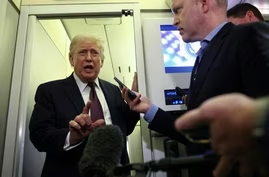
NewTrump demands NATO allies help reopen Strait of Hormuz
Video has Closed Captions
Clip: 3/16/2026 | 4m 43s | As Israel launches Lebanon ground operation, Trump asks allies to help reopen oil route (4m 43s)
 New
NewWhat Trump said about oil prices in call with PBS News
Video has Closed Captions
Clip: 3/16/2026 | 2m 59s | What Trump said about Iran's infrastructure and oil prices in call with PBS News (2m 59s)
Providing Support for PBS.org
Learn Moreabout PBS online sponsorship
- News and Public Affairs

FRONTLINE is investigative journalism that questions, explains and changes our world.

- News and Public Affairs

Amanpour and Company features conversations with leaders and decision makers.












Support for PBS provided by:
Major corporate funding for the PBS News Hour is provided by BDO, BNSF, Consumer Cellular, American Cruise Lines, and Raymond James. Funding for the PBS NewsHour Weekend is provided by...