
July 6, 2024 - PBS News Weekend full episode
7/6/2024 | 26m 44sVideo has Closed Captions
July 6, 2024 - PBS News Weekend full episode
Saturday on PBS News Weekend, President Biden dismisses concerns over his age and performance as calls grow for him to drop out of the race. Then, as Iran elects its first reformist presidential candidate in two decades, what his victory means for the Islamic Republic’s future. Plus, former astronaut Cady Coleman on overcoming obstacles during more than two decades with NASA.
Problems playing video? | Closed Captioning Feedback
Problems playing video? | Closed Captioning Feedback
Major corporate funding for the PBS News Hour is provided by BDO, BNSF, Consumer Cellular, American Cruise Lines, and Raymond James. Funding for the PBS NewsHour Weekend is provided by...
Support provided by:

July 6, 2024 - PBS News Weekend full episode
7/6/2024 | 26m 44sVideo has Closed Captions
Saturday on PBS News Weekend, President Biden dismisses concerns over his age and performance as calls grow for him to drop out of the race. Then, as Iran elects its first reformist presidential candidate in two decades, what his victory means for the Islamic Republic’s future. Plus, former astronaut Cady Coleman on overcoming obstacles during more than two decades with NASA.
Problems playing video? | Closed Captioning Feedback
How to Watch PBS News Hour
PBS News Hour is available to stream on pbs.org and the free PBS App, available on iPhone, Apple TV, Android TV, Android smartphones, Amazon Fire TV, Amazon Fire Tablet, Roku, Samsung Smart TV, and Vizio.
Providing Support for PBS.org
Learn Moreabout PBS online sponsorshipLISA DESJARDINS: Tonight on PBS News Weekend, President Biden dismisses concerns over his age and performance as calls grow for him to drop out of the presidential race look.
JOE BIDEN, U.S. PRESIDENT: Look.
I mean, if the Lord Almighty came down and said, "Joe, get outta the race," I'd get outta the race, LISA DESJARDINS: Then Iran elects its first reformist candidate in two decades, what his victory means for the Islamic Republic's future.
And former astronaut Cady Coleman on overcoming obstacles during more than two decades with NASA.
(BREAK) LISA DESJARDINS: Good evening.
I'm Lisa Desjardins.
John Yang is away.
President Biden is facing more calls for him to jump out of the 2024 race following a disappointing debate performance last week.
Today, moderate Democratic Congresswoman Angie Craig publicly declare that Biden should step aside as the party's nominee citing the debate and his words since saying she does not believe he can win against Donald Trump.
PBS News has spoken with major democratic donors and members of Congress today who are privately signaling the same call this despite Biden sitting down yesterday for a television interview to address those concerns.
The President told ABC George Stephanopoulos he thinks he can win and does not plan on dropping out.
Domenico Montanaro is NPR Senior Political Editor and correspondent and Kadia Goba, political reporter for Semafor and my good colleagues who know politics so well.
I want to first talk about who we've I've talked to today to members of Congress and a major donor today who praised Biden to me but said sadly, Time for Plan B.
This even after Biden went to such lengths to try and explain what happened at the debate.
BIDEN: I was having a bad night when I realized that he and I was answering a question even they turned his mic off.
He was still shouting.
And I let it distract me.
I'm not blaming.
But I realized that I just wasn't in control.
LISA DESJARDINS: Kadia, I know it drives voters crazy when we use these anonymous sources.
But this is a very delicate moment the White House is trying to reassure Democrats, but what's your reporting on how much of the momentum may be moving the other way?
KADIA GOBA, Political Reporter, Semafor: Yeah, Lisa, it is delicate.
I think the problem that Biden is facing is that members of Congress who were considering or contemplating whether or not they would ask him to step down from running, weren't convinced after that last interview.
When I spoke to some of my sources, they say they weren't surprised that Angie Craig came out.
And they expect the floodgates to open once members of Congress return next week.
So I think we'll hear more members come out and say the same thing.
DOMENICO MONTANARO, Senior Political Editor and Correspondent, NPR: I think it does depend on what they do hear from their constituents.
But to be honest with you, it's been a week of this right and Joe Biden is in control of his own destiny, if he wants to run, he's going to run.
Now he did say we heard that clip where he said, you know, if the Lord Almighty came down and told me, Joe, you shouldn't run, then I won't run.
But the others who are a bit more in control of this process.
Also, it appears are the Democratic leaders in Congress that Joe Biden trusts people like Nancy Pelosi, the former House Speaker Hakeem Jeffries, Minority Leader Jim Clyburn, who really all that helped Joe Biden win the South Carolina prime primary and propelled him to the 2020 nomination, but all of them so far are supportive of Joe Biden.
If they're not going to push to have him out, then he's not going to get out of this race.
And at certain point, it'll feel like overkill and the Democratic Party is going to have to figure out how they're going to kind of coalesce back together to be able to beat Donald Trump.
LISA DESJARDINS: Well, my report and you guys may be hearing also, as we know that Democrats have called a call together tomorrow night House Democrats for some of their ranking members, their leadership, and whatever where you're in publicly, it is different privately.
One thing I want to get to is a key question.
It's not just about Biden's ability right now.
But what will his ability be like two years, three years from now?
And here's how Stephanopoulos brought that up.
GEORGE STEPHANOPOULOS, ABC News Anchor: Do you have the mental and physical capacity to do it for another four years?
BIDEN: I'm pleased I wouldn't be run if I didn't think I did.
I have a cognitive test every single day.
Every day I have a test.
Everything I do.
You know, not only am I campaign him, I'm running the world.
LISA DESJARDINS: But he's not agreeing to submit to some kind of specific cognitive test.
Domenico, you wrote that a key factor here about Biden, it can go either way, depending if you support are not him is that he's stubborn?
DOMENICO MONTANARO: That clearly.
I mean, look, Joe Biden has had obstacles throughout his life, right.
And he's had lots of naysayers.
People tell him that he's not supposed to run people, telling him that, you know, he's not the best candidate to defer to others.
And this happened in 2015, when President -- former President Obama basically got him to step aside to allow Hillary Clinton to run.
And they look at that the Biden folks and say, look, you were wrong then, you're wrong now, because they feel the Biden name can still win.
You know, it's a difficult thing.
This is a conversation, frankly, though, that the Democratic Party should have probably had two years ago, as opposed to four months until Election Day.
LISA DESJARDINS: I hear that so much.
We've been talking about lawmakers.
But Kadia, you've got some reporting about donors.
And I'm also here donors, not just hesitant, but moving away.
How significant is the donor message to the Biden campaign right now?
KADIA GOBA: I would say it's pretty imperil, you know, donors look at this a little more black and white than lawmakers, right.
They're not thinking about constituents.
They're thinking, this is an investment that I made to a candidate who I thought would be the best kept Democratic candidate and who would probably win against Donald Trump.
That is not happening with polling with the botched report or the botched debate.
And you know, just recently, this interview, what I thought was more stunning on the phone call is people's -- LISA DESJARDINS: You were on a phone call with Biden donors -- KADIA GOBA: Yeah.
LISA DESJARDINS: -- and the Biden campaign.
KADIA GOBA: And I thought -- what I thought was stunning was, well, more advocates for political strategists was people donors ready to move on at this point.
It wasn't a matter of Hamilton Hall, and it was just, hey, he is not going to win.
How do we convince the Biden campaign that we need someone at someone else at the top of the ticket, and to me that was incredible.
This close to an election to hear that from big donors.
LISA DESJARDINS: There were strong words on that call.
I'd have to one of the donors that was on that call that said they actually were sort of offended because the advocates were saying, we don't really think you have a just cause here.
And then also other Democrats say the White House just isn't listening.
But Domenico, can the White House turn this around now?
It's really gone quite far.
DOMENICO MONTANARO: Well, there's clearly a huge antipathy for Donald Trump in this country.
I mean, let's remember that, you know, there's probably more than half the country that does not want Donald Trump to be president.
We've seen repeatedly Donald Trump's unfavorable ratings above 50 percent.
He didn't get above 47 percent in either of the last two elections.
And if you were a betting person, you'd say he's not going to get above 47 percent.
This time, either there are third parties is probably going to be lower than 47 percent.
So certainly, there is the appetite to not have Trump as president.
And we're spending all this time talking about Biden, but clearly there are things that Donald -- LISA DESJARDINS: But that what's driving this too.
There's a there's a fear from Democrats that they can beat Trump.
DOMENICO MONTANARO: Absolutely because they want to win, right.
LISA DESJARDINS: Right.
DOMENICO MONTANARO: When we talk about in the media and like some of the stuff that came out of that debate.
When you look just on paper at what Donald Trump has said and done.
There are -- really spells out the difference between the Democratic and Republican parties for why we're seeing this kind of cry out for Joe Biden potentially step aside because we're not talking about Joe Biden's conduct or character.
We're talking about his age as opposed to Donald Trump, where people have real serious problems with some of the some of his conduct and character.
LISA DESJARDINS: His capability, at least in our last few seconds, Kadia.
Is this week make or break?
As you said, Congress comes back on Monday.
KADIA GOBA: Yeah, I don't know if anything will change Joe Biden's mind.
But I do think a flurry of Democrats will come out ask him to step down, even if it's for the benefit of their own constituents and something they need to prove in those swing districts that, you know, Trump won.
DOMENICO MONTANARO: Surprise you might -- didn't do more to promote Kamala Harris, by the way in that interview.
LISA DESJARDINS: A topic I think we're going to get back to at some point, so Domenico Montanaro, Kadia Goba, but thank you so much.
KADIA GOBA: Thank you, Lisa.
DOMENICO MONTANARO: Thanks.
LISA DESJARDINS: Iran has a new president elect after a runoff between a reformist candidate and a well-known hardliner.
The reform minded Masoud Pezeshkian won by nearly 10 percentage points in an election that saw record low turnout during the first round of voting.
Although his win has brought hope to some Iranians.
Others remain skeptical of the president elects ability to change underlying problems.
WOMAN (through translator): Our life is getting worse every day.
It is true the salaries increase a bit but at the same time, living expenses have increased.
LISA DESJARDINS: Among his promises Pezeshkian bow to reach out to the West and ease restrictions on the country's headscarf mandate for women.
We'll discuss what the election means for Iran's future later in the program.
In Northern Ukraine, Russian drone attacks hit a vital energy facility overnight, cutting off thousands of homes from power and water.
Crews are working to repair the damage and restore power, according to Ukrainian officials.
The drone attacks are part of Russia's strategy to target key infrastructure.
Some new hope for a possible ceasefire in Gaza.
The Associated Press reports that Hamas has initially signed off on a U.S. backed ceasefire and has dropped its demand that Israel pledged to end the war.
That's been a key sticking point in negotiations.
The announcement comes as the Gaza Health Ministry announced an airstrike killed 16 people and wounded dozens more at a refugee camp.
Israel says it found terrorists in the area and tried to avoid civilians.
After a springtime low, Coronavirus cases in the U.S. are taking up.
New data from the Centers for Disease Control show COVID is on the rise, especially in the West.
Nationwide there's been a 23 percent.
jump in ER visits.
The CDC says it is able to predict spikes in cases due to wastewater testing.
Still to come on PBS News Weekend, a look at Iran's future as they elect their next president and former astronaut Cady Coleman on the joys and challenges of life in space.
(BREAK) LISA DESJARDINS: Reformist Masoud Pezeshkian will ascend to the Iranian presidency in a delicate moment for the Islamic Republic, both on the world stage and within its borders.
He faces a government still largely controlled by hardline clerics tension with the West over Iran's nuclear program and domestic frustrations with the regime.
Ali Rogin has more.
ALI ROGIN: To discuss what this means for Iran, the U.S. and other stakeholders.
I'm joined by Suzanne Maloney.
She's the Vice President and Director of the Foreign Policy Program at the Brookings Institution.
Suzanne, thank you so much for being here.
Tell us a little bit more about Masoud Pezeshkian?
What did he campaign on?
SUZANNE MALONEY, Brookings Institute: Masoud Pezeshkian is a 70-year-old longtime member of the parliament who served also as the health minister during the second administration of President Mohammad Khatami, who was Iran's first reformist president.
He has kept a relatively low profile.
Up until this campaign, he did register previous rounds of Iranian elections back in 2013.
And then again in 2021, when he was in fact prohibited from running by the Guardians Council, which vets all the candidates.
This time around, it was a little bit of a surprise that he made it through in part because he wasn't terribly well known.
But of course, all of the elements about this election were very improvisational, because it came in the wake of the unexpected death of the prior president, Ebrahim Raisi.
ALI ROGIN: And Pezeshkian had fashioned himself a reformer, what sort of campaign did he run?
What kind of message was he putting out there?
SUZANNE MALONEY: Well Pezeshkian is a longtime member of the Reformist Party that has largely fallen out of favor due to the fact that President Khatami its standard bearer, and others were really unable to affect meaningful change for the Iranian people.
And yet it has remained a part of the Iranian political system and Pezeshkian when he was selected to run title his came, Baraye Iran or For Iran, it was really meant, I think, to talk about the theme of Pezeshkian's campaign, one of being pro Iran, very much nondisruptive very much in favor of the current clerical lead system, but one in which he wanted to see Iran, more engaged with the world and less confrontational and hostile to the world.
ALI ROGIN: Iranian officials have long pointed to relatively high turnout levels in Iranian elections as a sign of legitimacy behind the regime.
But this time around, there were two rounds of voting, and both of them had relatively low turnout numbers compared to previous years.
What does this year's turnout say about the feelings among the Iranian voting public?
SUZANNE MALONEY: I think it's been clear for many years that much of the population is incredibly disenchanted with the Islamic Republic and the clerical theocratic regime that runs Iran, but they haven't really had a way to demonstrate that dissatisfaction.
The fact that only 40 percent turned out in the first round of this election was really a startling number.
In past elections, it's run as high as 70 and 80 percent of the voting population that has in fact voted, in part because there are requirements for individuals to vote.
And so there's so many risks that requirement to stay at home was a real concern for the regime.
And I think it was part of the reason why the election went to a runoff and in fact, why the clerical establishment is quite happy to have someone like Pezeshkian in this position now.
ALI ROGIN: Where does this deep frustration with Iran's ruling class come from?
And how might the presidency of Pezeshkian impact that?
SUZANNE MALONEY: Well, Iran has an incredibly young population, most of the population has been born not just since the revolution, but since the end of the Iran Iraq war in 1988.
And they have seen various attempts to try to normalize the regime, varied efforts to try to promote some real liberalization of both politics and society, as well as some expansion of Iran's ties with the world.
But none have really succeeded in part because of the very hardline stance of Iran's ultimate authority, Supreme Leader Ali Khamenei.
And so they become very disgruntled, very much disillusioned with even the modest efforts of the system to try to give them some kind of political participation.
They've also been very dissatisfied with the state of the economy, which has been subject to both very heavy American sanctions, but also to considerable mismanagement by the clerical system.
It's really unclear that Pezeshkian's presidency will make a meaningful difference.
He is someone who's quite loyal to the system itself.
But he will bring about a kinder, gentler Islamic Republic to some extent, and that at a time of considerable tensions on the regional scene, and considerable dissatisfaction at home might just be a benefit for both the population and for the leadership.
ALI ROGIN: There is, of course, the Iranian nuclear program, which is the source of so much tension between Iran and the West and of course, rising tensions with Israel that we've seen play out since the October 7 attack.
How do you think this election may affect Iran's approach to all of those issues?
SUZANNE MALONEY: I expect the Pezeshkian election will have very little impact on Iran's foreign or regional policies, he will have limited bandwidth, or engagement with the nucleophile.
The same is true for Iran's relationships with its proxies across the region.
It is possible though that Pezeshkian can inject a note of caution a note of prudence, which seems to have been both his style and his message on the campaign trail.
ALI ROGIN: Suzanne Maloney with the Brookings Institution thank you so much for joining us.
SUZANNE MALONEY: Thank you.
LISA DESJARDINS: Fewer than 300 Human beings have visited the International Space Station, even fewer than that has spent more than 150 days living there.
And as NASA plans to de-orbit the space station and 2030 the chance to see Earth from the ISS Cupola is getting slimmer.
John Yang recently spoke with one of those few astronauts about the joys and challenges of life in space.
JOHN YANG: Cady Coleman is one of only about 670 people on Earth who spent time not on Earth.
She's a former NASA astronaut, a veteran of two space shuttle missions, and have a six-month mission on the International Space Station.
She writes about all of this and how she succeeded in the system not designed with women in mind in a new book, "Sharing Space: An Astronauts Guide to Mission, Wonder and Making Change."
Cady Coleman, thanks so much for being with us today.
Select Group have been in space, but even a more select group who spent six months in space in a zero G environment.
What's that, like?
CADY COLEMAN, Author, "Sharing Space": I loved it.
People feel bad for us.
They're like, Oh, six months, that must have been awful.
And I literally didn't want to come home.
There's a lot of work and stressful but the fact that like we think about floating up there, but it's about flying, like if you want to go somewhere, you just give yourself a little tiny push and you will fly across the whole station.
So it's a whole new way of life.
And I like what my colleague Don Pettit said he said, If I could bring my family with me, there's just no reason to come home.
JOHN YANG: Many astronauts like to be tethered to the wall and their sleeping bag and in their sleeping chamber.
Not you.
You wanted to float free as you slept.
We'll talk about that.
CADY COLEMAN: I think you experience zero gravity during the day and you're working and you're going in you're doing but we get to live there.
It's there all the time.
And I just wanted to like have it be part of sleeping, too.
Now I'm not floating around the whole space station, which had like a cabin.
And often I would kind of wake up you know, upside down or you kind of wonder where I am where you are.
But I literally would wake up just thinking wow, I'm still here.
JOHN YANG: Did spending time in space change your view or vision of life on Earth and our relationship with Earth?
CADY COLEMAN: I'm somebody that's always thought that if we could just connect with each other a little bit better or a little bit more people together.
We'd be better off we'd have more solutions and handle situations better.
And yes, seeing the Earth from 250 miles above they still felt at home and I looked down and I just was like off only people could realize that we're all from the same place.
And I think that when we go to Mars, you know, nobody's going to be having bumper stickers that say their country that it's all going to be E for Earth.
JOHN YANG: You write about it in the book about spending so much time away from your family, talk a little bit about that.
CADY COLEMAN: It is really hard, it's hard, we've made a big decision that I would go on this Space Station mission, which meant a couple of years of training around the world, as well as that six months up on the Space Station.
It is a long time to be away.
There is this element of that it's dangerous.
And I think the going up for launching and the coming home, are the times that that we just can't ignore that.
But actually up in space, I think that they just felt like mom was working someplace else.
JOHN YANG: Being in a system that wasn't designed for women.
The spacesuits for instance, not designed for women, some of the workspaces not designed for people with shorter arms, talk a little bit about how you navigated that.
CADY COLEMAN: Everybody's going to do it differently.
And, you know, you can come up with a situation where they're sort of like, you know, I don't know if we need people like you here.
And you can say, but you know, you picked me, or you can be on the end of which is really where I kind of tend to work, which is how can I explain to these people who don't see that I belong here, not because they don't like me, but because they just don't have that vision yet.
There was a time in the mid-90s when they decided for the space station, which would start in mid 2000s, they would not have the smaller spacesuits.
And if you could not qualify in that space suit, for us in a medium space suit, which is actually quite large for us, then you could not live and work on the space station.
I did qualify in the medium.
But if I hadn't, I would actually still be waiting since 2010, when I launched to be able to go.
And there's so many implications, you know, in terms of management and experience and being somebody's, you know, can really go out there and bring what they want to the mission.
And I think that because it's a physical thing, it helps people understand that sometimes there are less tangible things where you walk in a room and people are surprised to see you or they're surprised by your lifestyle, or by the way you communicate.
And in those situations, there's lots of people that try to they can see people who aren't quite seen, and also relate well to management, and bring them together and literally introduce them.
Hey, you want Cady as a Capcom because she talks.
JOHN YANG: Among your many other achievements, you play the flute, and you had what I believe is probably the first and maybe only extraterrestrial flute duet with Ian Anderson of Jethro Tull no less.
How did that come about?
CADY COLEMAN: So a friend of mine is a DJ in Houston, Dana Steele.
And she like Dana, you must know how to know how to get ahold of Jethro Tull.
And so she got ahold of him, wrote him a nice letter.
And I was able to bring his flute up to space.
And we couldn't figure out what to do, until I looked at our calendars.
And on April 11, of 2011, Ian Anderson was playing a concert in Russia, in the city of Perm, and I was living on the International Space Station.
And it's a special day because that is the 50th anniversary of human spaceflight.
The first person to leave the planet, it's not about a certain country, it's about a person left our planet.
And so for us to do a duet between Earth and Space seems quite appropriate, and very scary for me.
JOHN YANG: The challenges you faced in the Astronaut Corps aren't limited to the Astronaut Corps, there are a lot of people going through the same things in their careers.
Who you hoping would be motivated by this book would read this book and say, o, this is how I can do this?
CADY COLEMAN: I think this book will appeal to people who know they have something inside of them that the world needs.
And you can't always be the most confident about that.
I mean, I'm not.
But I -- this book is designed so they can read that some of these things happen to me in the space program.
And if it could happen in a space program, it can happen anywhere.
And it does.
And just realize that, you know, you're in a group, you're part of a group, get that group to help you and may not seem fair, but you have to speak up about who you are and what you bring.
JOHN YANG: A lot of the lessons you learn were big to talk about how to leverage insecurity to performance.
Some of them were small, talk about wiggling your toes, so you don't tense up.
What are the biggest lessons that you learned and want to impart?
CADY COLEMAN: The biggest, most important lessons for, I think, for all of us are the teamwork once because, you know, there's stories about, I mean the magic of space of all the things the possibilities that we have.
But we're not going to have those possibilities on this planet if we don't solve some of our challenges.
And you know, sports coaches like to say that, you know, it's all about the team and not the individual.
And that's true in terms of the bigger mission.
But the individual and what they bring is really paramount.
But just as paramount is that you on the team, either understand what people bring or realize when they can't bring it themselves and you need to help them.
JOHN YANG: Cady Coleman, thank you very much.
CADY COLEMAN: Thank you for having me.
LISA DESJARDINS: And that's our program for tonight.
I'm Lisa Desjardins.
For all of my colleagues, thank you for joining us.
We'll see you tomorrow.
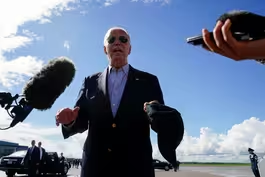
Big donors signal desire for Biden to leave the 2024 race
Video has Closed Captions
Big donors signal desire for Biden to leave the race as he doubles down on staying in (7m 37s)

Cady Coleman on the joys and challenges of life in space
Video has Closed Captions
Former NASA astronaut Cady Coleman on the joys and challenges of life in space (8m 10s)
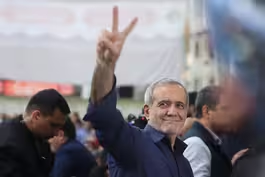
What’s next for Iran after electing its new president?
Video has Closed Captions
Iran just elected its first reformist president in two decades. What’s next? (5m 49s)
Providing Support for PBS.org
Learn Moreabout PBS online sponsorship
- News and Public Affairs

FRONTLINE is investigative journalism that questions, explains and changes our world.

- News and Public Affairs

Amanpour and Company features conversations with leaders and decision makers.












Support for PBS provided by:
Major corporate funding for the PBS News Hour is provided by BDO, BNSF, Consumer Cellular, American Cruise Lines, and Raymond James. Funding for the PBS NewsHour Weekend is provided by...