
June 26, 2026 - PBS News Hour full episode
6/26/2026 | 56m 46sVideo has Closed Captions
June 26, 2026 - PBS News Hour full episode
June 26, 2026 - PBS News Hour full episode
Problems playing video? | Closed Captioning Feedback
Problems playing video? | Closed Captioning Feedback
Major corporate funding for the PBS News Hour is provided by BDO, BNSF, Consumer Cellular, American Cruise Lines, and Raymond James. Funding for the PBS NewsHour Weekend is provided by...
June 26, 2026 - PBS News Hour full episode
6/26/2026 | 56m 46sVideo has Closed Captions
June 26, 2026 - PBS News Hour full episode
Problems playing video? | Closed Captioning Feedback
Where to Watch PBS News Hour
PBS News Hour is available to stream on pbs.org and the PBS app.
Providing Support for PBS.org
Learn Moreabout PBS online sponsorshipGEOFF BENNETT: Good evening.
I'm Geoff Bennett.
AMNA NAWAZ: And I'm Amna Nawaz.
On the "NewsHour" tonight: Emergency# workers and civilian.. survivors in the rubble a day after two# devastating earthquakes hit Venezuela.
GEOFF BENNETT: We speak with# Republican Governor Mike DeWine,## who's criticized the Supreme Court ruling# allowing the Trump administration to end## Temporary Protected Status# for thousands of migrants.
AMNA NAWAZ: And a new opera# in Cincinnati celebrates## the resilience and richness of the Black# American experience for a new generation.
MORRIS ROBINSON, Artistic Adviser, Cincinnati# Opera: When are we going to have something in## the operatic world that has the same impact on the# op.. industry?
And that's the idea that kind of started# the ball rolling on the Black Opera Project.
(BREAK) AMNA NAWAZ: Welcome to the "News Hour."
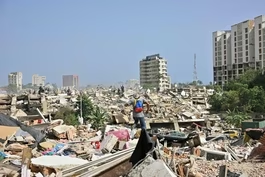
A day after two of the deadliest# earthquakes in Venezuela's history,## the race to save lives is becoming a race# against time.
Rescue crews are digging## through mountains of rubble, searching# for survivors believed to be trapped.
GEOFF BENNETT: More than 900 people are# now confirmed dead, and tens of thousands## remain missing.
As international aid# teams rush into the disaster zone,## the true scale of this unfolding# crisis is only starting to emerge.
Our Nick Schifrin starts our coverage tonight.
NICK SCHIFRIN: Today in Venezuela, the destruction# is debilitating.
Rescue workers drill through## the damage to find the living still pinned# down two days later.
But, in this tragedy,## so many did not survive.
The dead now line# the road because the hospital morgue is full.
The number of missing is overwhelming.# Family members write the name of loved## ones on a hospital door.
And the missing are# also listed online.
This Web site includes## more than 50,000 names, 83-year-old# Ivan Martinez, siblings Crixander,## Elvismar, and Antonella, Jahelys and her# two children, Jorgelis and her son Jadiel.
The grief and desperation feels# insurmountable.
Nazareth Jimenez's## brother and his entire family are# somewhere under their now-pancaked home.
NAZARETH JIMENEZ, La Guaira, Venezuela,# Resident (through translator): My brother,## my sister-in-law, my niece, my.. and friends are in there.
I got here# yesterday at 4:00 in the afternoon,## and nothing has happened.
They haven't cleared# anything.
Where's the help?
I don't see it.
NICK SCHIFRIN: Others have lost everything.# Omar Reyes walks through the devastation## and calls out for his missing wife# and children.
There is no response.## And as he walks on the rubble in his# sandals, there is no home left either.
OMAR REYES, La Guaira, Venezuela, Resident# (through translator): More than 20 of## my relatives have died.
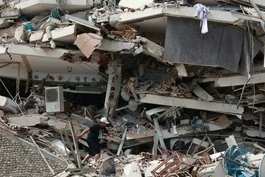
I have been left# practicall.. NICK SCHIFRIN: It is Venezuela's worst natural# disaster in more than a century, twin 7.2## and 7.5 earthquakes that crumbled buildings, the# scenes from the capital, Caracas, apocalyptic,## and the most damage to La Guaira north to# Caracas.
Entire blocks look like they have## been blown apart, entire buildings collapsed,# the state now placed under military control.
The damage appears worst closest to the# coast.
It looks like the city's been bombed,## buildings blown open.
The toll# is immense.
Caracas' hospitals## are now overflowing.
Many patients# are being treated in the courtyard.
BEATRIZ OCHOA, Norwegian Refugee Council:# I grew up in Mexico alongside the Pacific## Ocean.
And I grew up with earthquakes.
And this# was something I have never experienced before,## the magnitude, but also the length.
NICK SCHIFRIN: Beatriz Ochoa is the Norwegian# Refugee Council's Latin America he.. BEATRIZ OCHOA: We just went under the frame of## our bedroom.
It was not stopping.# And I just felt like, this is it.
NICK SCHIFRIN: Already, before the# earthquake, nearly eight million Venezuelans,## or more than one-quarter of the country,# depended on humanitarian assistance,## including food, water, and health.# Now people are sleeping on the street,## either because they're homeless# or too scared to sleep inside.
BEATRIZ OCHOA: People need a safe place# to sleep.
People will need clean water.## We don't want diseases to be spread.
People# need at this moment hot meals, and, of course,## children particularly will need to# recover and to have a sense of normality.
NICK SCHIFRIN: How much need is there right now# in the immediate aftermath of the earthquakes?
BEATRIZ OCHOA: There is a lot of need.
The country## was already struggling.
Recovering will# be hard.
And that's why we need support## from all over the world so that people# can recover sooner, rather than later.
NICK SCHIFRIN: That support is beginning to# show up.
Search-and-rescue teams from Spain,## as well as the United States and# a handful of other countries,## arrived today.
And the U.S.
military# is beginning to deliver $150 million## worth of humanitarian assistance# overseen by a two-star Marine general.
DONALD TRUMP, President of the United# States: We're helping Venezuela.
They## had a tremendous earthquake,# a lot of people killed and## unbelievable, right in Caracas.
And we# have a lot of people over there helping.
NICK SCHIFRIN: State TV showed acting# President Delcy Rodriguez handing out## local aid.
But the needs are great.# Many places have received no help,## and Venezuelans are overwhelmed# by a wave of devastation.
For the "PBS News Hour," I'm Nick Schifrin.
GEOFF BENNETT: For more on# the devastation in Venezuela,## we're joined now from Caracas by Feature# Story News reporter Andreina Fermin,## who has been covering the# disaster from the ground there.
So, you are in Caracas, as we said, as# this disaster continues to unfold.
Give## us a sense of what you have seen# and heard on the ground today.
ANDREINA FERMIN, Feature Story News: I have seen# the people on the street trying to find supplies,## trying to find water, trying to find# food.
So they are expecting more help.
That is because Caracas and La# Guaira has received help right now,## but the other states need it the most, because# they haven't received a few help until now.
GEOFF BENNETT: The U.S.
has deployed# elite search-and-rescue teams as part## of the international response.
What impact# is that support having or expected to have?
ANDREINA FERMIN: Well, the people in Venezuela# is really grateful for all the assistance.
We expect from the U.S.
all the help that they can# do, because we need it the most at this moment.## It's no -- it's a reality for Venezuela that# we have been suffering from an economic crisis,## a social crisis, a political crisis that has hit# the country before -- even before this earthquake,## and now the situation is even# worse after the earthquake.
GEOFF BENNETT: How have those challenges,# the economic crisis, the political upheaval,## how have those challenges affected Venezuela's# ability to respond to this current disaster?
ANDREINA FERMIN: It has been really difficult for# Venezuelans to respond to this disaster, because## we have a health care system that has been hit# very hard for the economic crisis in Venezuela.
We have lost doctors who have left the country.# We have to remember that the crisis in Venezuela## is really hard, and now they have to recover# after all this without work or without money## or without savings or without a house to# continue in this -- after this crisis.
GEOFF BENNETT: Feature Story# News reporter Andreina Fermin## reporting tonight from Caracas, Venezuela.
Andreina, thank you for your time.
ANDREINA FERMIN: Thanks, you guys.
AMNA NAWAZ:## A Supreme Court ruling this week cleared the way## for the Trump administration to end Temporary# Protected Status for Haitians and Syrians,## leaving thousands of refugees suddenly# without legal immigration status.
One of the states that could# face the biggest impact is Ohio,## where more than 10,000 Haitian migrants# have settled.
The state's Republican## Governor Mike DeWine has called# the move -- quote -- "a mistake."
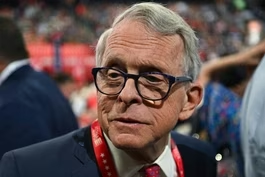
For more on the ruling and what it# means for communities in his state,## I am joined now by Governor Mike DeWine.
Governor, welcome back to the# "News Hour."
Thanks for joining us.
GOV.
MIKE DEWINE (R-OH): Good# to be back.
Thank you very much.
AMNA NAWAZ: So, as you know, revoking TPS# is a big part of the Tru.. immigration crackdown.
A court now says# they do have the authority to do that.## Why do you think that's a mistake?
GOV.
MIKE DEWINE: Well, I think the## policy is wrong.
The policy is wrong.
What I'm seeing specifically in Springfield and# in Ohio, you talked about a number of Haitians## who have come in.
You're seeing in Springfield a# city that is coming back.
It's been coming back## for the last few years.
And, frankly, one of# the reasons it's come back is because of the## Haitians who have been there to fill jobs# that were simply not being filled at all.
And that's what the employers will tell you.# That's what the mayor -- the mayor issued another## statement yesterday, and he's consistently# said that these Haitians are buying homes,## they're opening businesses, they're# working, and they're trying to -- some## of them raised raise their family there.# They're contributing to the community.
That's what the mayor of Springfield# is saying.
And my observation is,## he's absolutely right.
So when all of these# individuals who are there with TPS -- now,## not all the Haitians.
Some of# them have other legal status,## but a significant number of them are under the# TPS, which, of course, means, with this ruling,## of course -- now, and I don't -- look, I# don't argue with the Supreme Court's decision.
They were interpreting a statute that was# written by Congress, which basically says that## the courts cannot interfere with# that decision, that designation,## such as the administration made.
My point is# about policy.
And I have consistently said this.
This is bad for Ohio.
This is# a job killer for Ohio.
It's a## job killer for Springfield.# It's not good for our state.
AMNA NAWAZ: Can I put to you, Governor, what# we have heard from the administration on this,## which is something we heard Stephen Miller# of the White House say yesterday when asked## about whether or not it is safe for Haitians# to go back to Haiti.
Here's what he said.
STEPHEN MILLER, White House Deputy Chief of Staff:## The fact that there might be pockets of.. guess what?
There's pockets of Chicago with crime# rates just as high, right?
There's pockets of## cities like St.
Louis with crime just as high,# pockets of Los Angeles crime just as high.
It has never been the case that# having communities that have high## crime rates is a basis for asylum.# Never has been.
It never will be.
AMNA NAWAZ: So, Governor, the White House says# it's safe for Haitians to go back.
And they also## say this was meant to be a temporary status.# It's in the name and it's been in some cases## extended for years and years.
What's# your response to what they're saying?
GOV.
MIKE DEWINE: Well, to say it's# safe to go to Haiti is absurd.
And to## say compare it to Chicago I think is# -- it doesn't make any sense at all.
Look, I have a lot of contacts in Haiti.
We work# with people in Haiti.
We have a school down there,## my wife and I do.
And we have# traveled there 20, 25 times,## and we have a lot of contact there.
It is# worse today in Haiti than it's ever been.
It never was very good.
The only time, frankly,## it was good is when the U.S.
Marines were# down there, and they did a phenomenal,## absolutely phenomenal job.
But the situation# is just absolutely terrible.
People are## killed every single day.
The gangs run --# basically run a good part of the country.
And we're talking now in Port-au-Prince.
We're# talking about the Capitol.
You cannot fly into## Port-au-Prince with a U.S.
carrier because a U.S.# carrier will not go into Port-au-Prince.
Why?## Because the gangs shoot at the planes when they# come in.
No, it's a horrible, horrible situation.
So nobody who knows anything about Haiti can# say that the situation is improved.
In fact,## it's gotten a lot worse.
Good evidence of that is# the Haitians who I have talked to who knew that## they would have to leave or thought they might# have to leave.
There wasn't anybody I have talked## to that said they were going back to Haiti.# They're going to try to find some -- anyplace## else to go to where they can work and support# their family, but they're not going back there.
AMNA NAWAZ: Governor, if I can ask# you as well, you mentioned the mayor## in Springfield.
My colleague William Brangham# was on the ground there a little over a year## ago speaking to folks in the community.
He# met with Haitians who had settled there.
He talked to some companies who said they# were very happy to have people fill the jobs## and to fill communities that had been# somewhat abandoned.
But the mayor also## said at the time that services were being# taxed, right?
People needed some support,## language translation services in the# schools and the hospitals and the clinics.
And he said it was stretching resources.# So what's the balance there to you?
GOV.
MIKE DEWINE: Well, look, that's true.# It was a big influx within a relatively## short period of time.
And we have worked# with the mayor to try to try to help them.
So, certainly, schools have Haitian children# in there, and that is an additional cost if## they don't speak the language.
But the# interesting thing about the employers,## despite the fact that there was a language# barrier, despite the fact there's a culture## barrier, employers were hiring them, and they# were hiring them because they had jobs to fill.
And there's a multiplier effect.
Some of these# companies told me, we were able to put on a second## shift because of the Haitians.
Some had told me# that we're able to take on bigger projects, sell## more goods, whatever it is that they were selling.# That has a multiplier effect in the economy.
Because of that economic activity, other# people will get jobs because of that.
So,## yes, it is a challenge that the city of# Springfield has taken on.
They've done a very,## very good job.
But I think if# you ask the businesspeople,## if you ask the mayor what is going to happen,# the answer is, when these individuals who no## longer have TPS status, when they don't# have TPS status, they cannot be employed.
So, they're not -- they're going to be unemployed,## and many of them have already left.
Some# of them the -- rest of them will have to## leave at some point and try to find some# country where they can actually work.
I mean, the big picture for Ohio is this.# We are a red-hot state.
We are bringing in## companies all the time to Ohio.
The real# question today is, do we have the people## to fill them?
So we've put a great deal# of effort on education, on job training.
We have put a great deal of effort on career# tech, as well as focusing on colleges,## because they need all of the above.# But without immigrants coming in,## it's going to be hard.
It's going to be harder# for us to fill these jobs.
If you look at the## increase in population in Ohio -- and we are now# going up for the first time in a number of years.
If you look at that, probably three-fourths of## that is a direct result of immigrants.
If# you look at some of the people who are... AMNA NAWAZ: Governor, well, there's so# much more to talk about around this.
GOV.
MIKE DEWINE: Yes, I'm sorry.
AMNA NAWAZ: No, I really appreciate your time.
GOV.
MIKE DEWINE: Yes.
AMNA NAWAZ: And I hope you'll come bac.. us as we follow the impact.
We'll# have to leave it there.. That is Republican Governor Mike# DeWine of Ohio joining us tonight.
Thank you, sir.
GOV.
MIKE DEWINE: Thank you.
GEOFF BENNETT: Our Nick Schifrin is back with# us n.. where the U.S.
conducted new strikes in response## to what President Trump said was# Iran's violation of the cease-fire.
Nick, what more can you tell us?
NICK SCHIFRIN: Geoff, a U.S.# official tells me toni.. six U.S.
aircraft attacked four Iranian# targets, Iranian radar installations,## as well as missile and drone storage# in Sirik on the Strait of Hormuz.
Now, the military calls the strikes a response to# an Iranian attack yesterday on the container ship## Ever Lovely south of Sirik off Oman's coast.# You see it, the red dot right there.
And now,## tonight, Iran vowing another response that# in their words would be swift and decisive.
GEOFF BENNETT: So does this threaten to# derail the effort at U.S.
and Iran diplomacy?
NICK SCHIFRIN: I mean, the memorandum# of understanding says hostilities will## stop.
So the more military action you get,# clearly, the more that challenges diplomacy.
Iran called tonight's action a reckless# violation of the cease-fire.
The U.S.## says Iran violated the cease-fire by attacking# that ship.
But there's a bigger problem here,## Geoff.
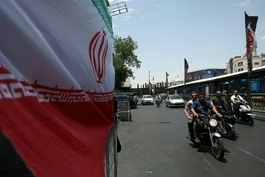
Iran is trying to maintain its choke# hold on the strait, not only by attacking that## ship yesterday, but also demanding that other# ships use a route through the strait close to## its border in the north, that's in orange there,# instead of the route the U.S.
wants near Oman.
That route is in yellow.
So President# Trump's trying to use these military## strikes tonight to convince Iran to# open the strait once and for all,## as President Trump warned that he would.
But# it is not clear if it's enough.
It's not clear## if Iran is even interested in giving up the# leverage that it has gained during the war,## which is that -- its ability to open# and close the strait whenever it wants.
Tonight, just now, Vice President Vance sent a# message, look, if Iran has a problem -- quote## -- "Pick up the phone," but -- quote --# "Violence will be met with more violence."
GEOFF BENNETT: All right, Nick# Schifrin, thanks, as always.
NICK SCHIFRIN: Thank you.
AMNA NAWAZ: In the day's other headlines:# Former U.S.
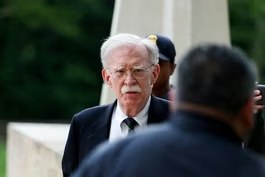
National Security Adviser John## Bolton pleaded guilty today to a single count# of illegally retaining classified information.
The former Trump administration# official turned Trump critic## appeared at a federal court in Maryland# and said he was sorry for his actions.## Bolton faced 18 counts related to his# handling of classified information,## including accusations that he shared notes# with family members while writing a memoir.
Outside the courthouse, prosecutors said,## Bolton -- quote -- "put our# national security at grave risk."
KELLY O. HAYES, U.S.
Attorney For the# District of Maryland: No one is above## the law.
And I hope that this prosecution# sends a clea.. investigate and prosecute individuals# who violate our national security laws.
AMNA NAWAZ: As part of the deal, Bolton will# pay more than two million dollars in fines and## could face up to five years in prison.# His sentencing is set for October 28.
The House Oversight Committee has served# subpoenas to billionaire investor Leon## Black after he refused to answer some# questions during voluntary testimony## today about his ties to Jeffrey Epstein.# The former head of Apollo Global Management## denied any criminal wrongdoing, saying# he was deceived by the late sex offender.
Black maintained a years-long relationship# with Epstein and paid him a reported $158## million in fees between 2012 and 2017.
But in his# opening statement, Black said he was unaware of## Epstein's nefarious activity until later, saying# -- quote -- "I knew Jekyll.
I didn't know Hyde."
Israel and Lebanon signed a framework agreement# today aimed at ending the fighting between the## Israelis and Hezbollah.
No details were# made public, but an Israeli official told## the Associated Press that talks have addressed# a redeployment of Israeli forces inside Lebanon## after the territory is cleared of Hezbollah# infrastructure and the militant group is disarmed.
Flanked by the Israeli and Lebanese ambassadors# in Washington today, Secretary of State Marco## Rubio called the new document a first step# toward peace.
Israel's representative agreed.
YECHIEL LEITER, Israeli Ambassador to the# United States: In this performance-based## trilateral framework agreement,# Iran is out, Hezbollah is out,## and the road to peace between# Israel and Lebanon is in.
AMNA NAWAZ: Earlier in the day, plumes of smoke# could be seen near the Lebanese city of Nabatieh## after the latest Israeli airstrikes there.
That# is in spite of a cease-fire with Hezbollah.## The Iran-backed group has not been a# party to the U.S.-mediated talks and## has said it will not agree to any plan that# would include its disarmament or removal.
Russia's military says it intercepted# more than 600 Ukrainian drones overnight,## as Kyiv launched one of its largest attacks since# the start of the war.
Drones targeted more than a## dozen regions and Russian-occupied Crimea seen in# this footage released by the Ukrainian military.## Russian officials in Crimea declared a state# of emergency amid a rise in Ukrainian attacks.
In the meantime, in Eastern Ukraine, local# officials say a Russian attack injured at## least seven people and damaged several# buildings in Zaporizhzhia.
Also today,## there were scenes of joy and relief, as# the latest prisoner swap saw 160 service## members head home from each side.# President Volodymyr Zelensky says## almost all of the Ukrainian prisoners# had been in captivity since 2022.
The heat wave sweeping Europe this week is# the most severe and widespread ever recorded.## That's according to a study published today# by the World Weather Attribution Group made## up of scientists and climate experts.# The U.N.
'S weather agency says the## deadly heat wave will move east this weekend,# carrying more record-breaking temperatures.
CLARE NULLIS, Spokesperson, World Meteorological# Organization: Just to remind you, we're in June.## We are in June.
We're seeing heat levels which# would be more typical of late July, of August.
AMNA NAWAZ: And the records keep falling, with# the U.K.
breaking its June temperature record## for the third strait day.
Spain also saw# new all-time June highs this week.
Health## authorities there estimate more than 300 deaths# could be attributed to heat.
The Netherlands## closed many schools and some government# operations to avoid unnecessary heat exposure.
And at Rome's famous Colosseum,## local authorities are using mist to# try to bring some relief to visitors.
In World Cup action, all three host nations,# Canada, Mexico, and the U.S., are advancing## to the knockout round, even though Team USA# lost to Turkiye late last night.
France and## Norway are also moving forward.
They played each# other this afternoon, with France winning 4-1.
Also today, Senegal easily defeated Iraq# 5 goals to none to stay in the running for## a place in the Round of 32.
The knockout# stage of the tournament starts on Sunday.
On Wall Street today, stocks ended slightly# lower, as A.I.
shares continue to weigh on the## markets.
The Dow Jones industrial average slipped# just over 40 points.
The Nasdaq fell 60 points,## or about a quarter of 1 percent.
The S&P 500# also closed out the week just to touch lower.
Still to come on the "News Hour": more public# school districts across the country limit screen## time for students; David Brooks and Jonathan# Capehart weigh in on the week's political## headlines; and the WNBA suspends a player# for a foul against league star Caitlin Clark.
GEOFF BENNETT: This week, the nation's second# largest school district, Los Angeles Unified,## imposed strict new limits on screen# time for its roughly 400,000 students.
As William Brangham reports, it's# just the latest example of a growing## backlash against technology in# classrooms across the country.
WILLIAM BRANGHAM: That's right, Geoff.
L.A., for -- like many districts, for years# worked aggressiv.. the hands of students to get Chromebooks and# iPads into the classrooms.
But this new policy,## one of the most aggressive in the# country, marks a dramatic shift.
No screen time will be allowed before# second grade, and older students will## see sharp limits, six hours per week# for middle schoolers and 10 hours,## including homework time, for high schoolers.
So to help understand these new rules and the# rationale behind them, we are joined by Nick## Melvoin.
He's a member of the Los Angeles School# Board, and he sponsored this new screen time rule.
Nick, thank you so much for being here.
Just a decade ago, Los Angeles was spending# hundreds of millions of dollars to get## technology into the classrooms.
And now there is# this abrupt shift.
How did we get to this point?
NICK MELVOIN, Board Member, Los Angeles Unified# School District: Well, thanks for having me.
And I think, as policymakers, particularly when# it comes to students' educations and livelihoods,## we have an opportunity when we know better# to do better.
And like you mentioned,## L.A.
was a real pioneer when it came to trying## to bridge the digital divide with# laptops and devices and Internet.
And it was a blessing that we were, because,# during COVID, of course, that was a lifeline## for the hundreds of thousands of students who rely# -- who relied on those in L.A.
for any education.
But since we returned to school in person,# and I spend time every week in classrooms,## I was struck by kind of the overreliance# we had on technology in schools.
First,## students who were on their cell phones, I# brought the resolution to ban smartphones## in L.A.
Unified a couple years ago, and# we just actually had the results of a## survey of our teachers that came back this# week that said over 90 percent of teachers## report that engagement is up, mental health# challenges are down when it came to cell phones.
But I still was seeing so many kids# on screens for hours a day.
And so## I just thought it was important for us to# recalibrate and reset students' relationship## with technology as we return to school# and as we think about the next 10 years.
WILLIAM BRANGHAM: So, how will# these limits work in practice?## Are teachers going to keep a stopwatch# of how much screen time is going to## happen for the young students?# How are they going to do this?
NICK MELVOIN: Well, so the idea, not unlike# our cell phone policy, is not to start with## the punitive, but really the instructive and# try to win hearts and minds, if you will.
And this was developed with educators in# mind.
You know, we are a first mover here.## It was after my resolution came out that# the surgeon general's office had suggested## screen time limits.
But other than that, there's# really no district that has a policy like this.
And so it was an iterative process# with our teachers.
And, again,## the idea is not to be punitive, but# to recalibrate and revert back to## not technology being the default, but# being an instructional tool, just that.
And so, at elementary school, it is# more restrictive.
In high school,## it presumes the fact that you're# going to have certain classes,## like a computer science or graphic# design, that may require more## screen time.
But the idea is that teachers just# need to think about that more holistically.
And if they're assigning research# that's going to be online for homework,## they should limit the amount of time that kids# are on screens during the day.
There's not a## punitive piece in place like a teacher log.
We# want to respect educators are professionals.
This is about the amount of time that kids are# sitting with a screen, knowing how much screen## time they may be getting outside of the school# day.
We want to make sure that we take a -- put## a stake in the ground in how much they should be# sitting in front of screens during the school day.
WILLIAM BRANGHAM: I mean, some of your# critics have argued that this doesn't## make a clear distinction between harmful# screen time, playing games or apps or## things that are not educational, and# screen time use that is educational.
And it goes back to this original# question.
Do you worry that this could## exacerbate the digital divide# between wealthier districts,## where kids could have access to screens# more often at home, and poorer districts?
NICK MELVOIN: Well, what I was responding to# -- and my teaching career began in South L.A.,## where we saw this digital divide.# And I should be clear that this## policy still encourages families who# need devices and Internet to opt in.
The district will continue providing that# for families who need it, but it won't be## the default option.
And what we see is that# students from lower-income backgrounds,## because their parents are working multiple jobs,## they're the ones who are, outside of the school# day, actually spending more time on screens.
They get home and there's a lot of# whether that's TV time or iPads or## devices.
And so there's an irony here,# because, from an equity perspective,## it's actually those students who are seeing the# deleterious effects of screens throughout the day.
And so I think this policy strikes the# right balance between saying we still## want to make sure that students who need# it have access to devices and Internet,## but we know that those students in need are# the ones who actually will benefit the most## from a new renewed focus on hands-on learning,# less time in front of a screen, going outdoors,## at the elementary school level, in# particular, more play-based learning.
That was my hope of this.
WILLIAM BRANGHAM: More than a dozen# states have been following your lead## here.
The previous surgeon general warned# against screen time for young people.
Do you think this is the beginning of a vanguard,# of a pushback against technology in classes?
NICK MELVOIN: I do.
I think, like I said at the .. I think that L.A.
Unified is leading what# will be a nationwide, if not global charge## to recalibrate and think differently about# the promise of ed tech and focus on that## tactile hands-on learning and the mental health# benefits for kids when they're off of screens.
WILLIAM BRANGHAM: All right, that is Nick Melvoin# of the Los Angeles Unified School District.
Thank you so much for being here.
NICK MELVOIN: Thanks for having me.
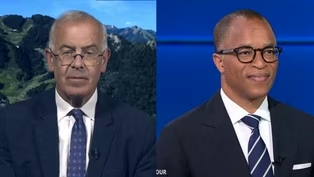
GEOFF BENNETT:## President Trump once again upends# the GOP's agenda in Congress,## and progressive Democrats swept the# Democratic primaries in New York.
To discuss that and more,## we turn tonight to Brooks and Capehart# .
That's "The Atlant.. who joins us tonight from the Aspen Institute's# Ideas Festival, and Jonathan Capehart of MS NOW.
It's great to see you both.
So, Congress passed the most significan.. overwhelming bipartisan support in the House# and Senate.
President Trump abruptly cancels## the ceremonial bill signing because he's upset# that Congress won't embrace his elections bill.
With affordability being the defining issue# of both parties heading into November, what is## it -- what do you make of this president walking# away from what could have been a victory lap?
JONATHAN CAPEHART: And let's not forget just# how big the vote was for this housing bill in## the Senate, 85-5.
When was the last time# you heard of any bill passing the Senate,## especially the configuration# of this Senate, by that much?
This was something Republicans desperately# wanted.
It was something that they would be## able to run on in the midterms.
Some were# already crowing about it on social media,## and then the president lowers the hammer over a# fit of pique over whatever it was in that moment.
And now they all have to run away from it.# There's -- we don't even know if the speaker## has or when he's going to transmit the bill# to the White House so that the 10-day clock## can start ticking.
This, to me -- I# can't remember who I heard say this.## But they said it seems that the president doesn't# care that much about a Republican majority.
What he cares about is dominance# over the Republican Party,## whatever the size of it is.
And if that's# the case, he very well might get his wish.
GEOFF BENNETT: David, what about that, the# president really being focused on being## the dominant player here, trying to use# this refusal to sign the housing bill as## leverage for this voter I.D.
bill that# is stalled in a Republican-led Senate?
DAVID BROOKS: Are you asking me if# Donald Trump is concerned about himself?
GEOFF BENNETT: Yes.
(LAUGHTER) DA.. I have been trying to go back through# history and think of a time where## somebody who -- an impulsive narcissist# got less chaotic or less impulsive as he## aged.
And I can't think of any times in# history.
The course of the behavior is## toward decay, and Trump is moving from# impulsivity to just chaos on that day.
And I think it's part of just the natural# process of the psychological deterioration## that happens to a lot of presidents.
But it's# also part of what's happened over the last## six months.
I don't think, that day, that# day when he canceled the signing ceremony## with like 90 minutes before it was supposed# to happen, when he ran off -- went off on a## tear about the things he's obsessed with,# I don't think it it's unrelated to Iran.
I think he understands, as everybody# within the administration must understand,## that this was one of the big defeats of# the last many decades.
Republicans know## it.
Democrats know it.
People in# the White House know it.
And so he## senses things sliding away from him, his# power weakening, his stature humiliated.
And I think it's leading him to behave in## much more obsessive ways than# even he has the last decade.
GEOFF BENNETT: Well, let's shift our focus# to the outcome of the New York primaries,## because the candidates who were backed# by New York's Mayor Zohran Mamdani## ousted two sitting House Democrats, to include# the chair of the Congressional Hispanic Caucus.
And the House Democratic leader, Hakeem# Jeffries, he campaigned aggressively against## Mamdani's candidates and ended up losing.
So,# Jonathan, is this a genuine realignment of## the Democratic Party, or is this in many# ways specific to New York City politics?
JONATHAN CAPEHART: I think it's very specific# to New York City politics.
And let's have the## realignment conversation once we get# through the November general election.
But, even then, let's keep in mind, this# -- we're talking about congressional seats.## We're talking about seats within the five# boroughs of New York City.
If anything,## this shows that, yes, Mayor Mamdani is a# political force in New York City.
But is## Mayor Mamdani a political force outside# of the five boroughs of New York City?
Is he a political force in, say Maine or Iowa# or Michigan, Minnesota, in a purple district?## If a Democratic socialist wins in a non-blue# majority district or a purple district or even## in a red state, then let's have the conversation# about a realignment of the Democratic Party.
But this could -- this makes me think Speaker# Tip O'Neill's -- I think it was Speaker Tip## O'Neill who said all politics is local.
If# you are a politician right now in New York## City and you have got DSA behind your# name, your chances of getting elected## are much greater than they were when# I lived there 20-something years ago.
GEOFF BENNETT: And let's talk# about that label DSA, because,## David, for a generation, a socialist was# the attack that Republicans hoped that## Democrats would walk into.
And now you have a# generation of Democrats, progressive Democrats,## who are claiming this title, this# Democratic socialist title outright.
They're declaring it with no apologies.
What# do you make of that generational split here?
DAVID BROOKS: Yes, I think there's# somewhat of a realignment going on.
The Democratic Party's heart and soul used# to be the labor movement.
It used to be the## unions.
It's not anymore.
The heart and soul# of the Democratic Party is the universities## and especially the elite universities.
And# so the candidate who won in New York 13,## Darializa Avila Chevalier, went to# Columbia, was an activist in the## Gaza protests.
She is a sociology Ph.D.,# or I think she's trying to get her Ph.D.
And she grows out of that place.
And# if you look at all the candidates## that -- the DSA candidates, where they# did well, they did very well in the## more affluent, the whiter and the better# educated parts of New York City.
And the## traditional candidates did well in the poorer# and more multiracial parts of New York City.
And so the faculty lounge has become# a strong part of the Democratic Party## and faculty lounge politics have become a# strong part of the Democratic Party.
And## that I think extends somewhat beyond New York# City.
You have Democratic socialist candidates## in Washington, D.C., mayoral race, around# the country.
You have other DSA candidates.
I don't think it's going to totally realign# the party.
There just aren't that many people## with sociology doctorates and people who respond# to this faculty lounge politics.
But there are## enough.
And I think one of the things that will# shift within the Democratic Party as a whole## is I think Israel will become a flash point# for whoever wants to be the nominee in 2028.
I think the Democratic Party is# really shifting strongly on that one,## I think on some of the economic issues.# Where I'm curious to see, if we go back to## no fund of police.
Avila Chevalier is a prison# abolitionist, and she's been asked repeatedly,## do you think murderers should serve time in# jail?
And she refuses to answer that question.
Democrats did very poorly a couple of years# ago because of the defund the police.
That## just seemed out of touch to a lot of people,# including a lot of Democrats.
And will the## party make that mistake again because the# -- where the energy is in the party is in## the DSA wing?
But hope for the long-term# elections is the traditional parts of the## party somehow getting some mojo and some# energy to match what they're up against.
GEOFF BENNETT: Well, as you have got some# Democrats embracing the socialist title## and far left policies, you have got# J.D.
Vance embracing Richard Nixon.## He said this past week that# if Watergate happened today,## it would be a 12-hour news story and that# the idea it took down a presidency is crazy.
Listen to this.
J.D.
VANCE, Vice President of the United# States: I think that his historical legacy## is enjoying a bit of a renaissance, but I think# deservedly so.
As I joked with Robert backstage,## if Watergate happened tomorrow,# it would be like a 12-hour news## story.
The idea that it would have# taken down a presidency is crazy.
GEOFF BENNETT: Thoughts?
JONATHAN CAPEHART: So many, we don't# have an we don't.. Look, this isn't -- Nixon did not# fall because of the deep state,## which is what he said in another part of# that answer.
His presidency fell because## he had the one thing that Donald Trump has# never had, and that's a sense of shame.
When fellow Republicans went to President Nixon# and said, because of all the stuff you did,## bugging the DNC and all these criminal# acts, we are going to impeach you,## and rather than President Nixon suffering# the shame of being at the time what would## have been the first president impeached# in a very long time, he decided to resign.
That's not what we're dealing with here# with President Trump.
And certainly Vice## President Vance wrapping his arms around# Nixon is a very curious thing to do.
GEOFF BENNETT: Well, he also# drew an explicit parallel## between himself and Richard# Nixon.
Here's another clip.
J.D.
VANCE: At a personal level,# OK,young senator, vice president,## writes some bestselling books, is hated by# the media, it kind of sounds like J.D.
Vance.## So I'm a little -- I have always liked# -- I have always liked Richard Nixon.
GEOFF BENNETT: David, in the minute we have left.
DAVID BROOKS: They both have a 5:00 shadow.
I -- first, Watergate was a serious criminal# business.
Dozens of people went to jail,## Haldeman and Erlichman, the two top White# House aides, John Mitchell, John Dean,## Jeb Stuart Magruder.
Dozen -- more than a dozen# people went to jail.
It was a criminal enterprise.
But having said that, J.D.
Vance is absolutely# right.
It would be a one-day story today,## because you define deviancy down.
The standards# of the entire country have been deteriorating## because of what we have had lived through# over the last decade.
And for that reason,## the Republicans would not do what Republicans# did in 1974, which was to tell him you got to go.
And so it would -- he is right.
It would be an# absolute one-day story, and we would all move on.
GEOFF BENNETT: David Brooks joining# us from the Aspen Ideas Festival,## Jonathan Capehart joining us from# this very desk, thank you both.
JONATHAN CAPEHART: I was just wondering,# is Vice President Vance a bestselling## author?
I don't know.
I would# just throw that out there too.
(LAUGHTER) JONATHAN CAPEHART: Sorry, Geoff.
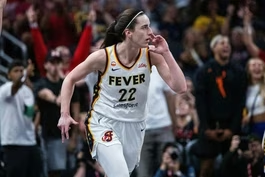
AMNA NAWAZ: A couple of heated# games and some rough plays this## week have sparked a new controversy in# the WNBA around superstar Caitlin Clark.
On Monday, her Indiana Fever played the Phoenix# Mercury in a game with six technical fouls,## including one for Clark and an ejection.
Their# second meeting on Wednesday brought this moment,## when the Mercury's Alyssa Thomas pressed her# fist into Clark's neck during a loose ball,## and no foul was called.
Clark left# the game early with a back injury.
After the game, fever coach Stephanie# White called it unacceptable.
STEPHANIE WHITE, Head Coach, Indiana Fever: We# have a generational talent and a WNBA superstar## who had two cheap shots right there that# weren't called.
We spent all off-season## looking at officiating, all off-season.
And# I still say the one thing that we keep asking## for is consistency.
She is not called# the same way everybody else is called.
AMNA NAWAZ: A day later, the league# retroactively gave Thomas a flagrant## foul and suspended her for one# game.
But the questions around## Clark's treatment and the WNBA's# officiating have not quieted.
For more, we're joined by Seerat# Sohi.
She covers the WNBA, NBA,## and women's college basketball for The# Ringer and she hosts their WNBA podcast.
Seerat, welcome to the "News# Hour."
Thanks for joining us.
SEERAT SOHI, The Ringer:# Thanks for having me, Amna.
AMNA NAWAZ: So why do you think the reaction# to that foul a.. why has it been as fiery as we have seen it?
SEERAT SOHI: Well, I think because# fans are starting to see a pattern## where there have been cheap shots against# Caitlin Clark that have gone uncalled.
Forget a flagrant foul.
We have seen some of# these cheap shots not even get a regular foul.## Fans will remember, in 2024, Chennedy Carter# hip-checked Caitlin Clark on an out-of-bounds## play where she didn't even have the ball# in her hands, and it wasn't called a foul.
The WNBA, I think, needs to reckon with# its history of inconsistent refereeing,## and it hasn't up to this point.# So now, when these things happen,## they hearken back pre to previous instances,# and at this point I think fans are just fed up.
AMNA NAWAZ: There's a lot of# complicated narratives at play## here.
You outline them really well# in your latest piece for The Ringer.
And you put it this way.
You say: "Outside# the arena, the league is filtered through two## polarized narratives, both of them unflattering.# One, the league is stacked against Clark.
Players## resent her, referees won't protect her, and league# leadership has been reluctant to acknowledge her## obvious mistreatment.
And, two, the league is# a hotbed of racism, homophobia, and misogyny."
So let's just take those one at a time here,## Seerat.
The narrative that Clark is treated# differently and unfairly, is there truth to that?
SEERAT SOHI: I do think that there are stars,# because of the magnitude of Caitlin Clark stardom,## that were questioning her entry into the# league and why she had such a big spotlight.
At the same time, I do think that refereeing# issues are consistently bad across the WNBA.## I don't think that the WNBA really has a# standard for or a vision for how they want## the game to look.
They are very reactionary.
I# think that's why you saw this flagrant foul and## suspension issued after the game, when the public# pressure was really starting to get to them.
You can see that with previous instances# with really every crisis the WNBA has## dealt with.
I think the best way to# look at it is that Caitlin Clark is## a magnifying glass to a lot of issues that# have been plaguing the WNBA for a long time.
A lot of mainstream sports fans# are just now finding out about## things that have bothered players# for quite a while.
And, to me,## really, a lot of it just comes# down to the league's leadership.
AMNA NAWAZ: There's a second point you# raise here, which brings together a lot## of very difficult topics, which is the fact# that Clark is a straight white woman in a## league that was built largely on the backs# of Black women, many of them queer and out.
How is all of that playing into the# conversation and the way it's being looked at?
SEERAT SOHI: Well, I think there# are a number of nuances here.
The WNBA has had white straight stars# before.
They have never had a white## straight star with this magnitude of fame,# and who has come in to the WNBA at a time## where social media is very prevalent and in a# very charged political moment in this country.
So there have been people who have# used Caitlin Clark as an avatar to## express their racial grievances, their# homophobia, and often the WNBA players## that she is faced against are the targets of# those attacks.
So, you can understand from the## perspective of those stars why they would, of# course, take issue with something like that.
AMNA NAWAZ: There was a lot of controversy too# I'm sure you saw with this new poster the league## revealed, their 30th anniversary celebration,# and Caitlin Clark is not on the poster.
Do you feel like that controversy was warranted?## Is the league fumbling how they're# handling one of its biggest stars?
SEERAT SOHI: Well, the reality with# that controversy is actually that## the group that made that poster# actually just does not have the## licensing rights to Caitlin# Clark's image and likeness.
For most organizations that aren't# the WNBA or Nike, they only have## the rights to her name and number.
Now,# you could say, why didn't the WNBA go to## a different organization to do this?# I think that's a very fair question,## especially for -- when you're trying to# celebrate the 30th anniversary of the league.
There are also prominent Black players# that weren't on this list as well,## such as Tamika Catchings and Candace Parker, two# of the biggest legends in the game.
And, again,## it just to me goes back to the WNBA's leadership.# This is a rocket ship that has a bad captain.
It's an airplane flying in the sky,## and there's a ton of turbulence, and# they do not know how to navi.. AMNA NAWAZ: What does all this mean for# the fans?
I mean, yourself, you cover this,## but you're also a fan.
What does it mean for# the people who love the game and the league?
SEERAT SOHI: It's incredibly frustrating.
I think that most fans would like to# celebrate great basketball alongside## all of the other things that the WNBA brings# to the table that, frankly, don't necessarily## exist in other sports.
The WNBA is a -- it's a# cheaper ticket with a more connected fan base## that from my experience has had a# genuine impact on my life as far## as creating community at a time when I# think a lot of people are seeking that.
So there's so many beautiful things# about the WNBA as it stands right now,## but the frustrating thing is that# the mainstream stories that come out## about the league often have to do with# racial strife and incompetence, truly.
And that I think has just been a frustrating# dynamic for the last three years.
AMNA NAWAZ: Seerat Sohi of The Ringer,## thank you so much for joining us# tonight.
Real pleasure to talk to you.
SEERAT SOHI: Thank you for having me.
GEOFF BENNETT: Imagine a world 400 years in# the future where a young woman is forced into## exile after discovering she carries a rare gene# linked to extraordinary power and immortality.
That is the premise of a new opera# opening in Cincinnati next month.## PBS stations CET and ThinkTV take us behind# the scenes for a look at the project and the## new direction it's taking opera for# our arts and culture series, Canvas.
MORRIS ROBINSON, Artistic Adviser, Cincinnati# Opera: Well, the Black Opera Project was birthed## out of necessity.
I was here in Cincinnati Opera# starring as Porgy in "Porgy and Bess.. always loved what "Porgy and Bess" has done for# our community.
And this is not an attack on it,## but it's also just to notice that traditionally it# has been an opportunity for African Americans to## get on operatic stages at a time where we weren't# allowed to sing the traditional opera canon.
We were afforded the opportunity to see "Porgy# and Bess."
But as proud as I was to do that,## with all the greats that have gone# before me that I honor and treasure,## it bothered me that that was the# only thing that was considered a## Black opera.
It wasn't even composed by# a Black person.
But it's what we had.
And we had a meeting to discuss how we# all felt about being on this stage and## being in its production.
And I raised# a question.
And it was basically,## when are we going to have something in# the operatic world that has the same## impact on the opera world that "Black# Panther" had on the movie industry?
And that's the idea that kind of started# the ball rolling on the Black Opera## Project.
We're going to do three operas# in three consecutive seasons composed by,## directed by, libretto written# by all African American artists.
The stage designs will be# by African American artists.## Costuming will be designed by African# American artists.
First one out of## the gate is entitled "Lalovavi," which# stands for love in the language of Tut.
KEVIN DAY, Composer, "Lalovavi": This# opera is really, it's an epic journey,## and I don't use that word lightly, because it is.# We're going on a journey, postapocalyptic world.
TIFARA BROWN, Librettist, "Lalovavi" is# an Afrofuturist opera set 400 years in the## future in a city that was formerly known# as Atlanta, but now it's called Atlas.
So## this opera is centered on a central# character.
Her name is Persephone.
She is the daughter of the leader of Atlas, a# man known as Titan.
And in Atlas, there is a## caste system.
And power and wealth is divvied# out based on one factor.
It's a genetic code## known as the Syndica gene.
And the more Syndica# you have, the higher in Atlas' society you are.
Titan has been on a mission to find this one# variation of the Syndica gene known as the## Tree of Life gene.
And he plans on extracting# this gene to make himself immortal.
It turns## out that Persephone is the only one in the# world that has this variation of Syndica.
So -- and she has to run for her life.
Most# of the opera is in English, but we -- there## are sections and songs, especially# when we talk about the rebel nation,## which is called Nunewaks.
Tut is their language.
Tut is a living language.
It's indigenous to# Black American slaves in the Deep South.
So## this language was a secret language, and it# was a code used to teach enslaved people how## to speak English and how to read and write# English, at a time where that was illegal.
To our knowledge, there has# never been a media production## in history that incorporates the Tut language.## In our story, there is a resistance# movement that is pushing up against## the Atlas regime.
And this is exactly how# Tut was used to push against enslavement.
KEVIN DAY: When I think of Afrofuturism, a# lot of my research and work has been mostly## on the jazz side of things.
Having all# the crazy eccentric costumes and music## that was also very eccentric and more# based in technology and free improv,## I thought that's where we# were going with this concept.
But as I began to get the libretto and# begin to see what's going to be happening,## this -- from the page, it read like# a movie.
And so that's what kind of## shifted my approach to keeping the elements of# Afrofuturism in terms of, like, the costumes,## in terms of the place, in terms of the themes# of liberation and freedom and all of that.
But the sound world of this opera was shifted# into one that is meant to feel like a movie.
MORRIS ROBINSON: We can't keep trying to# feed the younger generation the older menu.
KEVIN DAY: I think it's a chance, as we're# pushing the boundaries of the medium,## as we're writing these new works, to# bring people who would not necessarily## go to an opera concert normally to# feel welcomed to come into this place,## again, for like three hours to hear# something they have never heard before.
(CHEERING) TV journalist, educator, and civil rights# advocate.
His family announced his passing today.
GEOFF BENNETT: He was perhaps best known# as the host and executive producer of "Tony## Brown's Journal," recognized as a landmark# long-running PBS public affairs program.
Brown was also an author, speaker, and# media entrepreneur.
His family said he## died peacefully last week at his home in Newport# News, Virginia.
Tony Brown was 93 years old.
And that is the "News Hour"# for tonight.
I'm Geoff Bennett.
AMNA NAWAZ: And I'm Amna Nawaz.
On behalf of the entire "News Hour" team,# than..
 New
NewBlack Opera Project celebrates resilience a new generation
Video has Closed Captions
Black Opera Project celebrates resilience and richness of the Black American experience (5m 57s)
 New
NewBrooks and Capehart on progressive Democrats winning
Video has Closed Captions
Brooks and Capehart on progressive Democrats winning primaries (10m 29s)
 New
NewCrews search for survivors in rubble after Venezuela quakes
Video has Closed Captions
Crews race to find survivors in mountains of rubble after Venezuela earthquakes (4m 46s)
 New
NewHeated games and rough plays spark controversy in WNBA
Video has Closed Captions
Heated games and rough foul against Caitlin Clark spark controversy in WNBA (6m 59s)
 New
NewNews Wrap: Bolton pleads guilty in classified info case
Video has Closed Captions
News Wrap: Bolton pleads guilty to retaining classified informationNEWS WRAP (5m 47s)
 New
NewReporter in Caracas describes devastation in Venezuela
Video has Closed Captions
Reporter in Caracas describes earthquake destruction and response in Venezuela (2m 18s)
 New
NewTrump's TPS policy is a 'job killer,' Ohio Gov. DeWine says
Video has Closed Captions
Trump's TPS policy is a 'job killer' and bad for Ohio, Gov. DeWine says (7m 55s)
 New
NewU.S. strikes Iran after drones target cargo ship in strait
Video has Closed Captions
U.S. strikes Iran after drones target cargo ship in Strait of Hormuz (1m 49s)
 New
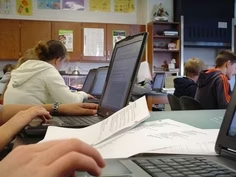
NewWhy school districts are limiting screen time for students
Video has Closed Captions
Why more school districts are limiting screen time for students (6m 5s)
Providing Support for PBS.org
Learn Moreabout PBS online sponsorship New Episode
- News and Public Affairs

Today's top journalists discuss Washington's current political events and public affairs.
 New Episode
- News and Public Affairs

FRONTLINE is investigative journalism that questions, explains and changes our world.

 New Episode
 New Episode
 New Episode
 New Episode

 New Episode
 New Episode
 New Episode
 New Episode
Support for PBS provided by:
Major corporate funding for the PBS News Hour is provided by BDO, BNSF, Consumer Cellular, American Cruise Lines, and Raymond James. Funding for the PBS NewsHour Weekend is provided by...