
June 5, 2024 - PBS NewsHour full episode
6/5/2024 | 57m 46sVideo has Closed Captions
June 5, 2024 - PBS NewsHour full episode
June 5, 2024 - PBS NewsHour full episode
Problems playing video? | Closed Captioning Feedback
Problems playing video? | Closed Captioning Feedback
Major corporate funding for the PBS News Hour is provided by BDO, BNSF, Consumer Cellular, American Cruise Lines, and Raymond James. Funding for the PBS NewsHour Weekend is provided by...
Support provided by:

June 5, 2024 - PBS NewsHour full episode
6/5/2024 | 57m 46sVideo has Closed Captions
June 5, 2024 - PBS NewsHour full episode
Problems playing video? | Closed Captioning Feedback
How to Watch PBS News Hour
PBS News Hour is available to stream on pbs.org and the free PBS App, available on iPhone, Apple TV, Android TV, Android smartphones, Amazon Fire TV, Amazon Fire Tablet, Roku, Samsung Smart TV, and Vizio.
Providing Support for PBS.org
Learn Moreabout PBS online sponsorshipGEOFF BENNETT: Good evening.
I'm Geoff Bennett.
AMNA NAWAZ: And I'm Amna Nawaz.
On the "NewsHour" tonight: Former President Trump and President Biden close in on their parties' nominations, despite voter concerns about a 2020 rematch.
GEOFF BENNETT: The long-delayed Boeing Starliner finally lifts off from Cape Canaveral, beginning a new era of crewed spaceflight.
AMNA NAWAZ: And we travel to France to meet veterans of D-Day as they prepare to mark the 80th anniversary of the Allied invasion of Normandy.
BILL WRIGHT, British Army Veteran: We'd known for some time, of course, what was going to happen, and we knew that we were making history.
(BREAK) GEOFF BENNETT: Welcome to the "NewsHour."
There was a dramatic shoot-out at the U.S. Embassy in Beirut today.
The Lebanese military says a gunman fired shots at the facility.
He was then wounded during an exchange of gunfire with troops, and taken to a hospital for treatment.
AMNA NAWAZ: The army described him as a Syrian national.
Lebanese officials believe he was acting alone.
A guard was also wounded in the shooting.
Troops were deployed to secure the area and set up checkpoints.
And witnesses said that gunfire lasted for nearly half-an-hour.
JOE ABDO, Lebanon Resident (through translator): We were at work.
We heard gunfire.
It didn't take a lot of time, but we heard around 15 to 20 rounds of gunfire.
We ran here to see what's happening, and, suddenly, the army blocked us from going up.
AMNA NAWAZ: Officials say that the gunman's motives are not clear.
But Lebanese media have published photos that appear to show a suspect wearing a black vest with the words "Islamic State" written in Arabic and the English initials I and S. The State Department says the embassy will reopen for business tomorrow.
Thousands of ultranationalist Israelis took part in an annual parade in Jerusalem today to mark Israel's capture of the city in 1967.
Massive crowds marched through a Palestinian area of Jerusalem, some chanting anti-Arab slogans.
Some clashes between demonstrators and police broke out.
Authorities say 18 marchers were arrested.
In the meantime, Prime Minister Benjamin Netanyahu visited Israel's northern border with Lebanon.
That comes a day after Hezbollah rocket attacks sparked large brushfires in the area.
During a tour of a military base, Netanyahu addressed calls to ramp up Israel's response.
BENJAMIN NETANYAHU, Israeli Prime Minister (through translator): Yesterday, the land was burning here, but the ground was also on fire in Lebanon.
Whoever thinks that he will hurt us and we will sit idly by is making a big mistake.
We are prepared for a very strong action in the north.
One way or another, we will restore security here.
AMNA NAWAZ: Israel and Hezbollah have been exchanging fire for months.
The fighting has displaced tens of thousands of people on both sides of the border.
Hunter Biden's ex-wife and his former girlfriend took the stand at his criminal trial in Delaware today.
They testified to their experiences, witnessing drug use by the president's son, including the moment his then-wife found a crack pipe in an ashtray at their family's home.
Hunter Biden faces three felony charges related to his buying a gun in 2018 while using drugs.
First lady Jill Biden has attended every day of the trial so far, but she will travel to meet the president in France later today.
Separately, House Republicans sent criminal referrals to the Justice Department today accusing Hunter Biden and the president's brother James Biden of making false statements to Congress.
This is part of a broader impeachment inquiry trying to tie the president to his son's business dealings.
So far, Republicans have presented no evidence of wrongdoing.
On Capitol Hill, the Senate rejected a bill this afternoon aimed at protecting women's access to contraception.
The Right to Contraception Act fell short of the 60 votes needed to pass, with just 51 for and 39 against.
Regardless of the outcome, Senate Democrats were keen to put their Republican colleagues on the record when it comes to reproductive rights ahead of the November election.
Majority Leader Chuck Schumer said the vote achieved that goal.
SEN. CHUCK SCHUMER (D-NY): Today was not a show vote.
This was a show us who you are vote.
And Senate Republicans showed the American people exactly who they are.
AMNA NAWAZ: A similar vote over protecting access to in vitro fertilization is expected as soon as next week.
The planet is on a 12-month streak of setting new heat records.
Every month for the last year has been the hottest month ever recorded.
That's according to the European Union's climate monitoring service.
That comes as the U.N. secretary-general, Antonio Guterres, says that a target of -- quote -- "limiting long-term global warming to 1.5 degrees Celsius is hanging by a thread."
ANTONIO GUTERRES, United Nations Secretary-General: We are playing Russian roulette with our planet, and we need an exit ramp off the highway to climate health.
AMNA NAWAZ: Guterres took particular aim at fossil fuel companies, calling for a so-called windfall tax on the industry's profits.
He referred to them as the -- quote -- "godfathers of climate chaos."
And on Wall Street today, stocks rose across the board on growing hopes that the Federal Reserve will cut interest rates later this year.
The Dow Jones industrial average gained 96 points to close at 38807.
The Nasdaq jumped 330 points to close above 17000.
The S&P 500 added 62 points, closing at a new record.
And the first bank notes featuring King Charles III entered circulation in the U.K. today.
People queued up outside the Bank of England's headquarters in London today -- yes, I said queued -- to be among the first to get their hands on the notes.
The portrait of the king will appear on all five, 10, 20 and 50-pound notes.
He's only the second British monarch to appear on Britain's currency.
The first, of course, was his mother, Queen Elizabeth II, who died in September of 2022.
Still to come on the "NewsHour": current and former employees warn OpenAI isn't doing enough to prevent its systems from becoming a danger to humanity; veteran negotiator Mickey Bergman discusses his new book on the shadowy world of international hostage rescue; and an airline attendant gives his Brief But Spectacular take on the miracle of flight.
While Joe Biden and Donald Trump earned enough delegates to win their respective party nominations months ago, the primary season is only now officially coming to a close.
The two men swept the handful of states that voted yesterday, but both still saw some opposition from primary voters.
We now turn to our regular contributors Democratic strategist Faiz Shakir and Republican strategist Kevin Madden.
Great to see you both, as always.
Thanks for being here.
Let's talk a little bit about what we can take away from these contests last night and what matters to voters right now.
If you look at the results from just one state in New Mexico, on the Republican side, this is two weeks after Nikki Haley said that she would support Trump.
We are still seeing her pull votes in primaries.
You see Mr. Trump there with 84 percent of the vote, Nikki Haley with 9, and uncommitted getting 3 percent.
Meanwhile, for the Democrats, Mr. Biden with, yes, an overwhelming win there, 84 percent, but uncommitted getting 10 percent of the votes, and Marianne Williamson getting 7 percent.
Kevin, what does this say to you right now about the level of discontent with these two major party candidates and whether or not that's going to change come early voting?
KEVIN MADDEN, Republican Strategist: Yes.
I think, well, one of the things that the deciders of this election are coming down to the double haters.
The candidates are -- I think the voters out there who really just don't like either one of these candidates.
But I think the other thing that we have learned is that there's still a lot of unfinished business.
Joe Biden definitely still has a problem with his base.
He has a lot of younger voters, a lot of disaffected progressive voters that have not yet come home.
Donald Trump, on the other hand, still has a Nikki Haley voter problem.
Here he is probably three months after the Republican nomination has essentially been decided, and he still has a hard time uniting the party.
And if those voters stay home in November, that's going to make or break whether or not Donald Trump is able to win the election.
So these candidates have very clear challenges ahead, but neither one of them have really come up with a strategy or a message to confront and solve those problems yet.
So that's what the next couple of months are going to be all about.
AMNA NAWAZ: How do you see it, Faiz?
FAIZ SHAKIR, Democratic Strategist: Picking up on that point that Kevin raises, I think that I see Joe Biden trying to address what he knows to be concerns within his base.
So if you look at the efforts of the last week or two, saying to Black voters, specifically Morehouse and then an event in Philadelphia with Kamala Harris to say, hey, I need Black voters to stay with me, and here's the problems with Donald Trump.
On Gaza, I'm going to go out there and talk about Israel.
We need to end this war.
Here's the plan.
Here's how we're going to do it.
He's making efforts.
So he's not unaware that he's got a problem.
You can see, though, that the uncommitted vote is down from Michigan and Minnesota from before.
You can see a bit of the consolidation.
He needs that number amongst Democrats to be well up over 90 percent if he's going to win this general election.
That is to say, that base has got to come in very strongly.
The number of voters that are going to show up in a general election way outnumber than the ones in the primary.
But if he can fix this primary problem, it suggests that he can also try to bring back the enthusiasm he needs to win a general election.
AMNA NAWAZ: Let's take a closer look at some of the key races we have results from that will help decide control of the Senate this fall.
In New Jersey after last night, Democratic Congressman Andy Kim is officially the Democratic candidate there.
But the incumbent Democratic Senator Bob Menendez, who's now in the middle of his corruption trial, is now running as an independent, making it a three-way race there between Kim, you see the Republican candidate, Curtis Bashaw, and Menendez.
So, Faiz, how should Democrats be handling this right now?
FAIZ SHAKIR: Well, I think Menendez, his independent campaign is really just an effort to maintain his legal defense costs.
I don't think he's running a real campaign.
There's no staff.
There's no real effort.
AMNA NAWAZ: Could he still siphon votes, though?
FAIZ SHAKIR: If he stayed on the ballot, which is an open question.
I mean, he's got to go through a defense and see whether he can resolve that in the period of time.
Then he has to decide whether he wants to be on the ballot line or not and collect the necessary signatures and go through that whole process.
That said, I think Andy Kim's going to win this race.
And he will be adding to the -- contributing to a kind of pretty diverse class if you see Democrats coming in.
I think Angela Alsobrooks in Maryland I think has a good chance to win.
Lisa Blunt Rochester right up the road in Delaware has a good chance to win, both African American women, Ruben Gallego in Arizona, Latino male, and Andy Kim, Asian American male.
So that's what you would look forward to in a Democratic class in the Senate.
AMNA NAWAZ: Kevin, how do you see that?
KEVIN MADDEN: Well, I think it's a strong Democratic state with a pretty conventionally strong nominee right now.
AMNA NAWAZ: New Jersey, you're talking about, right?
KEVIN MADDEN: In New Jersey, yes.
(CROSSTALK) AMNA NAWAZ: I mean, they haven't sent a Republican to the Senate in, what, 50 years?
KEVIN MADDEN: Right.
And, look, this is -- the Republican nominee that emerged last night, somewhat unknown.
He has some time to get known and some money that's going to help him get known.
But he's still running up against, I think, a strong New Jersey Democratic machine.
And he's running that -- I think Andy Kim is running against two inferior brands in the sense that Republicans in New Jersey are not as well organized as they need to be, and the Menendez brand, which is essentially an indicted -- somebody who is under indictment right now, like, those provide a pretty good contrast for Andy Kim.
AMNA NAWAZ: So what about Montana?
Let me ask you about this.
So you take a look at the results from last night.
Republicans now have their nominee to face Senator Jon Tester.
There's a Trump-endorse candidate there, entrepreneur, former Navy SEAL Tim Sheehy.
Kevin, Tester is the last Democrat standing in a deep red, getting redder state.
Is Sheehy the right candidate to unseat him?
KEVIN MADDEN: Sheehy is a very strong candidate, handpicked by Steve Daines, the other senator from Montana, who also happens to run the National Republican Senatorial Committee.
He's going to make sure that Sheehy has all the Montana Republican support and the monies and resources, the money and resources to take on a pretty well-entrenched incumbent Democrat in Tester.
Tester is running the -- one of the problems for Tester has as an incumbent, he's actually below 50 percent.
Any time you're an incumbent running for reelection and you're below 50 percent, you're very vulnerable.
That's Sheehy's best opportunity right now.
AMNA NAWAZ: Tester is outrunning Biden, though, at this point in time.
But are there enough split-ticket voters to make a difference for him in Montana?
FAIZ SHAKIR: If anyone can pull it off, Jon Tester can.
He's one of the most populist and popular Democrats in the Senate.
He's a very good campaigner.
If you look, it's interesting to watch how he campaigns.
He's talking about postal consolidation, right to repair, independent farmers who are getting screwed by China owning farmland in America.
The kinds of issues he's talking about should send a message to a lot of other people about how do you appeal to conservatives and Trump-aligned voters and get them to potentially look at you.
And the messages for people like Jacky Rosen and Tammy Baldwin and Bob Casey, all running in places where they're going to need to win Trump-style voters to try to win in the general is interesting to watch him do it pretty well.
AMNA NAWAZ: There's still months to go.
Obviously, a lot can change between now and when early voting begins.
But in the minute or so we have left, just give me your big picture takeaway in terms of, at this point, when you look at the races, which party is better positioned to take control of Washington this fall, Kevin?
KEVIN MADDEN: Well, I think -- for sure, I think the Senate right now, I feel bullish about the Republicans' chances.
I think they're going to have -- they have the fund-raising in place.
Trump, I think in many of these states where the margins are really going to matter, Trump is running sometimes 20, 15 points ahead of Biden.
And those type of coattails, I think, are going to be very helpful for a lot of Republicans.
AMNA NAWAZ: Faiz?
FAIZ SHAKIR: I'm uneasy with the politics of the moment.
That said, I remember Kevin and many other people saying red wave of 2022.
And when it came down to it in November, commonsense voters with decency and character on the ballot understood it's Joe Biden and the Democrats who offer a better direction for this country.
I think that will be the case again in November.
AMNA NAWAZ: As we have all learned, the politics of the moment not necessarily the politics of the future.
We will have you back and talk about it some more.
Kevin Madden, Faiz Shakir, always great to see you.
Thanks.
KEVIN MADDEN: Good to be with you.
FAIZ SHAKIR: Thank you.
GEOFF BENNETT: It was a picture perfect morning for a space launch.
WOMAN: And liftoff of Starliner and Atlas 5 carrying two American heroes drawing a line to the stars for all of us.
GEOFF BENNETT: Boeing today successfully launched its new Starliner space capsule carrying two astronauts, marking only the sixth inaugural journey of a crewed spacecraft in U.S. history.
The launch comes after several delays due to technical issues.
Yet today's launch occurred smoothly and on time and it comes four years after Elon Musk's rival SpaceX launched its first mission with astronauts into orbit.
The Starliner will dock at the International Space Station tomorrow morning.
And NASA astronauts Barry "Butch" Wilmore and Sunita Williams will spend a week before returning home.
For the latest on all of this, we're joined again by our science correspondent, Miles O'Brien.
Always great to see you, Miles.
So tell us more about these veteran NASA astronauts Butch Wilmore and Suni Williams and what their primary goal is.
MILES O'BRIEN: Yes, veterans indeed.
They both have a lot of time in space, Butch about 178 days on one long space station mission, Suni 322 days over two long stints on the space station, both of them Naval aviators, Suni a proud graduate of the Naval Academy, test pilots through and through, good people to have an mission like this because they're wringing this vehicle out.
They will be testing the thrusters, the control systems, the space suits themselves, the docking capability.
They will try to fly it manually.
They will do everything they can to see where the bugs might be in this craft.
And there's been a lot of bugs along the way, so it's probably likely they will find a few as well.
They also have some important cargo on board, Geoff.
The urine processing system on the space station, which converts urine into drinking water - - yes, folks, that's what they do up there.
I have tried it.
It really is how they drink their water, how they get their water.
It has failed.
And so they are carrying the spare part to fix it.
So I guess you could say that's their number one priority.
(LAUGHTER) GEOFF BENNETT: Miles O'Brien.
OK.
So, the Starliner program, it's been beset by technical problems, delays, as we mentioned, cost overruns.
Why?
What happened?
What accounts for all of that.
MILES O'BRIEN: It's hard to say.
Now, it is a Boeing product.
And we have been talking a lot about Boeing, you and I.
This is a separate division of Boeing, its space systems.
Whether there is some commonality between what's happening with the airliner enterprise and the space enterprise, hard to say from the outside looking in.
But it's been quite a scenario starting in 2019 with software failures that caused the thruster fires to fire so long, didn't have enough gas to get to the space station.
It was really kind of a medium black eye for Boeing.
But, hey, today, they're in space and they're on their way to the space station.
GEOFF BENNETT: And this Starliner mission is a test flight required by NASA before NASA can certify Starliner for routine astronaut missions.
As we mentioned, there's this.
There's also the SpaceX program.
Why is NASA basically funding and supporting these two space missions by two different contractors?
MILES O'BRIEN: Yes, SpaceX has kind of lapped them.
They have done a dozen flights.
They have flown 51 people to and from the space station.
The program has gone much more smoothly than the Starliner program.
But I will remind you there was a nine-year gap between the last shuttle flight and the first flight of a Dragon crewed flight to the International Space Station, nine years.
And what did we do during that period of time?
That is to say, what did NASA do?
It bought flights from Russia.
And in today's geopolitical environment, the idea of reengaging with Russia on a new set of contracts to purchase Soyuz rockets flights for NASA astronauts does not seem very tenable.
So it's about redundancy.
If one of those rocket systems fails in some way, if there's some sort of problem that grounds it, NASA will not have any means of getting to the International Space Station.
So, like any good space program, they like to have redundancy.
GEOFF BENNETT: That's a good point.
You mentioned Russia.
Let's talk about China as well, because they're very active in space too.
Where are they up to on the moon?
MILES O'BRIEN: Yes, it's very exciting that China, of course, flew to the far side of the moon and just 24 hours or so ago launched from it after scooping up some samples and rocks.
That spacecraft is on its way back to Earth.
It will land in Mongolia on or about June 25.
No people on board, but China has expressed clearly its goal to do so, to plant footprints and flags on the moon by 2030.
NASA Administrator Bill Nelson has been very vocal in the past months, saying that the U.S. is now engaged in a space race with China and that the Chinese program is militaristic at its core.
And, as a point of fact, the military does in fact run the Chinese space program, but there is a close alignment between the U.S. military and NASA as well on many levels.
After all, the two test pilots flying to the space station right now are both Navy veterans.
So -- but it is heating up a little bit.
I will say this.
Space races generally are good for funding of space programs.
So when you hear this rhetoric, keep that in mind.
GEOFF BENNETT: All right, that is Miles O'Brien, our science correspondent, also an amateur comedian.
(LAUGHTER) GEOFF BENNETT: Miles, thanks so much for being with us.
MILES O'BRIEN: Here all week.
(LAUGHTER) AMNA NAWAZ: Eighty years ago tomorrow, the liberation of Europe from the horrors of the Nazis began with Operation Overlord, the Allied invasion of Normandy.
Nearly 200,000 soldiers, principally Americans, Brits and Canadians, landed on June 6 of 1944 across five beach sectors, Utah, Omaha, Gold, Juno, and Sword.
Malcolm Brabant is in Northern France and met some of the veterans of D-Day, now all around 100 years old, to begin our coverage of this 80th anniversary.
CHIEF MASTER SGT.
MEL JENNER (RET)., U.S. Army Air Corps: The bodies in the water, they looked like logs floating in the water.
MALCOLM BRABANT: Sergeant Mel Jenner had perhaps the best view of D-Day, flying in a top secret mission, photographing the invasion.
CHIEF MASTER SGT.
MEL JENNER (RET).
: I couldn't believe that all of all those young guys down in that water would give their life for their country and the world, to be exact.
MALCOLM BRABANT: East of Omaha, British beaches also have their ghosts.
BILL WRIGHT, British Army Veteran: One of the great things about the war was the comradeship.
You were really comrades with your mates.
MALCOLM BRABANT: Bill Wright on the far right, and his Sherman tank crew came ashore at Sword Beach near where a Norwegian destroyer was sunk on D-Day.
BILL WRIGHT: We'd known for some time, of course, what was going to happen, and we knew that we were making history.
And that was a terrific boost to morale, as you could imagine.
REAR ADM. JOHN ROBERTS (RET.
), Royal Navy Veteran: I was just 20 years old.
At that age, young man don't want to miss out on anything.
I was so pleased that I was there.
MALCOLM BRABANT: Sublieutenant John Roberts had already seen action escorting convoys across the North Atlantic.
On D-Day, his ship's big guns battered German defenses.
REAR ADM. JOHN ROBERTS (RET.
): The noise was quite fantastic.
There must have been 100 warships bombarding the coast.
NARRATOR: From the skies, hundreds of planes provided air cover for the seaborne invasion below.
JIM KUNKLE, U.S. Army Corps Veteran: I was flying P-38 Lightnings.
And we were given the mission to protect all the shipping from England to Normandy.
There were 5,000 boats out there, and we expected the Luftwaffe to really hit them.
What an opportunity.
And we didn't see one.
I mean, it was actually a boring sort of mission for us.
MALCOLM BRABANT: Jim Kunkle still possesses a certain all-American swagger that, sometimes during the war, aggravated the less flamboyant British.
How old are you, sir?
JIM KUNKLE: A hundred and one, shooting for 102 in October.
MALCOLM BRABANT: What does it mean to you to be back here?
JIM KUNKLE: Well, it's lots of memories.
You never forget.
MALCOLM BRABANT: Paratrooper Henry Langrehr was among the first into action, aged 19.
HENRY LANGREHR, U.S. 82nd Airborne Veteran: We took a shell off the corner of our wing, and shrapnel came through the plane and killed one man on one side of me and he on the other side.
So, there was a lot, a lot of flak, just like the Fourth of July.
MALCOLM BRABANT: And how glad were you to get out of the airplane?
HENRY LANGREHR: I wanted to get out right away.
Didn't want to be in that plane no more.
MALCOLM BRABANT: The 82nd Airborne's target, the Nazi-occupied town of Sainte Mere Eglise, where Private John Steele is immortalized.
After his chute snagged on the spire, Steele played dead for two hours until the Germans captured him.
HENRY LANGREHR: John was taken prisoner, and we took the city and we freed all of those guys.
MALCOLM BRABANT: Sainte Mere Eglise is a shrine for paratroopers like Sergeant Andrew Kadick.
SGT.
ANDREW KADICK, U.S. 171st Airborne: There's a reason why in the United States we call that generation the Greatest Generation.
The idea of jumping out of an aircraft with all of your equipment just to land under hostile fire, and then put your own weapon into action to fight the enemy, an experienced and seasoned enemy in a foreign land, is something truly remarkable.
MALCOLM BRABANT: But there's a warning from Claire Horton, who leads Britain's Commonwealth War Graves Commission, after a survey revealed that less than half of all young people know what happened on D-Day.
CLAIRE HORTON, Director General, Commonwealth War Graves Commission: It's a worry if we have young people who are just not understanding why things happened and the fact that we all live actually pretty free lives here.
There's a problem that history might repeat itself.
MALCOLM BRABANT: If anyone symbolizes the purpose of D-Day, it's 86-year-old Leon Malmed from California, now back in his native France, traveling with U.S. veterans.
LEON MALMED, France: I feel that I owe my life 100-plus percent to America.
MALCOLM BRABANT: Five-year-old Leon and his older sister Rachel (ph) lived in the town of Compiegne with mother Hannah (ph) and father Saul (ph), when, in 1942, their parents were taken away by the Nazis because they were Jews.
At great personal risk, neighbors Suzanne (ph) and Henri Ribouleau (ph) stepped into the breach.
LEON MALMED: So at that time, Henri Ribouleau said: "Do not worry, Mr. and Mrs. Malmed, we will take care of your children until you come back," not knowing that they would be gone forever.
So that was the -- that was the last time that we would see our parents.
MALCOLM BRABANT: Three months after landing in Normandy... NARRATOR: Our beachhead to Berlin was established.
MALCOLM BRABANT: ... American troops liberated Leon's hometown, ending three years of terror.
LEON MALMED: But the windows of the street were just covered with flags.
And people were absolutely -- it was the best day of my life, for sure.
MALCOLM BRABANT: This anniversary is tinged with mixed emotions, pride, respect, and that often misused word awe, that so many veterans have returned to the beaches that were part of what history acknowledges as the longest day.
But there's also sadness that, in all probability, this will be their last big hurrah.
CHIEF MASTER SGT.
MEL JENNER (RET).
: When anybody wants to talk about somebody being a hero, I always tell them the heroes are still over there.
MALCOLM BRABANT: Naval cadet Bridget Sheridan paid tribute, taking hallowed sand and offering a silent prayer.
BRIDGET SHERIDAN, Naval Cadet: I come from a military family, so just being here with the veterans and everyone here, it's a blessing, an absolute honor.
I have no words.
MALCOLM BRABANT: Because their deeds speak for themselves.
For the "PBS NewsHour," I'm Malcolm Brabant in New York.
GEOFF BENNETT: A group of current and former OpenAI employees has issued a public letter warning that the company and its rivals are building artificial intelligence with undue risk and without sufficient oversight.
They're calling on leading artificial intelligence companies to be more transparent and provide stronger protections for whistle-blowers.
It comes after OpenAI disbanded its team focused on long term A.I.
risks and two leaders of that group have resigned.
We're joined now by NPR technology correspondent Bobby Allyn, who's been covering all of these developments and more.
Bobby, thanks for being with us.
So tell us more about who is behind this open letter and what specifically they're asking for.
BOBBY ALLYN, Business and Technology Reporter, NPR: Yes it's a number of current and former OpenAI employees.
I actually spoke to one of them just today.
And what they're saying is really loud and clear.
They think OpenAI is too aggressively in search of profits and market share and that they are not focused on responsibly developing A.I.
products.
And, remember, this is really important, Geoff because OpenAI started as a nonprofit research lab that was -- its aim when it was founded was to develop A.I.
products, different than, say, Meta or Microsoft or Amazon, which are these huge publicly traded companies that are competing with one another, right?
OpenAI was supposed to be a nonprofit answer to big tech.
And these employees say, look, it looks like you're operating just like big tech.
You're pushing out products too quickly and society just isn't ready for them.
GEOFF BENNETT: The letter lays out a number of risks and warnings, including -- quote -- "the loss of control of autonomous A.I.
systems, potentially resulting in human extinction."
Human extinction.
What do these folks know that we don't?
(LAUGHTER) GEOFF BENNETT: And how seriously should we take this concern?
BOBBY ALLYN: It sounds pretty dire, doesn't it?
And it goes back to this kind of nerdy phrase that A.I.
researchers like citing known as P(doom), P meaning what's the probability and doom being - - well, we know what doom means.
And they like bringing this up because the theory is, if A.I.
gets really smart, if it becomes super intelligent and can exceed the skills and brainpower of humanity, maybe one day it will turn on us.
Now, again, this is kind of a theoretical academic exercise at this point, that these sort of killer robots would be marching around cities and at war with humanity.
I don't think we're anywhere near that.
But they are underscoring this, because, look, that's sort of a hypothetical risk.
But we're seeing real risks play out every single day, whether it's the rise of deepfakes, whether it's A.I.
being used to impersonate people, whether it's A.I.
being used to supercharge dangerous misinformation around the Web.
There are real risks that, according to these former employees, OpenAI doesn't care enough about and isn't doing much to mitigate.
GEOFF BENNETT: Well, in other OpenAI news, the media world seems to be split over whether to partner with the company.
The company recently announced paid deals with the Associated Press, "The Atlantic," Vox Media, which allows them to gain access to these media outlets' content to help train their A.I.
models.
Meantime, you got The New York Times suing OpenAI over copyright infringement.
How do you see this all shaking out and what are the arguments on both sides of this debate over whether to actually work with OpenAI?
BOBBY ALLYN: Yes, OpenAI has publishers by the scruff of their neck.
OpenAI systems were trained on the corpus of the entire Internet, and that includes every large broadcaster and newspaper you can think of.
And there, as you mentioned, are two camps emerging now.
In the one camp are the publishers who say, you know what, let's strike licensing deals, let's try to bring some revenue in, let's play nice with OpenAI, because we have no choice.
This is the future.
OpenAI is going ruthlessly towards this direction.
Let's try to make some money here.
And then you have newspapers like The New York Times who are in the other camp and have chose the other direction, which is, no, no, no, OpenAI.
You took all of our articles without consent, without payment.
Now you're making lots of money off of the knowledge and reporting and original work that goes into, say, a New York Times article.
We don't want to strike a licensing deal with us.
In fact, your systems are based on material that was stolen from us, so you owe us a lot of money and we do not want to play nice.
So, the way it's really going to shake out, I think, is, you know, some publishers are striking these deals.
Others will join The New York Times' crusade to go after OpenAI.
But it's a really, really interesting time, because, no matter what, they have this material, right, Geoff?
I mean, ChatGPT, every time you ask it a question, it is spitting out answers that are based in part on New York Times' articles, Associated Press articles, NPR articles, you name it.
So that's just the future.
So the question is, do you strike a deal or do you take them to court?
And we're just seeing different sort of strategies here.
GEOFF BENNETT: That is NPR technology correspondent Bobby Allyn.
Bobby, thanks so much for being with us.
BOBBY ALLYN: Thanks, Geoff.
AMNA NAWAZ: Today, a Russian court sentenced a Russian American to three-and-a-half years in prison.
He was charged with rehabilitating Nazism and showing disrespect for society.
And he's part of a worrying trend.
Over the past decade, there have been an historic number of U.S. nationals detained by foreign governments abroad.
One of the leading negotiators for detained Americans who usually works in the shadows has now stepped into the limelight and written a book.
Nick Schifrin has that story.
NICK SCHIFRIN: Nearly 60 Americans are believed to be held overseas, some 90 percent of them labeled wrongfully detained by the State Department.
Their possible release is handled by countless American government officials.
But, sometimes, when hostage families want another advocate or the relevant government might not be communicating particularly well with the U.S. government officially, Mickey Bergman, alongside the late Governor Bill Richardson and their team, answered the call in North Korea, Myanmar, Moscow.
Bergman has helped bring Americans home, including Brittney Griner.
And now he's written a book, "In the Shadows: True Stories of High-Stakes Negotiations to Free Americans Captured Abroad."
And Mickey Bergman joins me now.
Mickey, thanks very much.
Welcome to the "NewsHour."
MICKEY BERGMAN, Author, "In the Shadows: True Stories of High-Stakes Negotiations to Free Americans Captured Abroad": Thank you for having me.
NICK SCHIFRIN: You call yourself a fringe diplomat.
How does a fringe diplomat bring Americans home?
MICKEY BERGMAN: Well, I think, like, French diplomacy is made of two separate types of actions or activities.
The first is engagement.
The second one is intervention.
And intervention is -- basically ends up in my world being the negotiation, the release of political prisoner or hostage.
And intervention is great.
It's quick, it's tangible, it's sexy, and you get a special on TV for it.
But the real work, you cannot succeed in intervention unless you spend time and invested in engagement.
And the way we do it is that we engage with the local population and the local community and leadership, ask them, what is their priorities, what are their -- what is their vision for their community?
NICK SCHIFRIN: A little empathy.
MICKEY BERGMAN: Yes, and -- yes, exactly right.
NICK SCHIFRIN: I want to go through some of your achievements over the many years you have been doing this, but I first want to ask you about the possible hostage deal that we're talking about in the news right now.
Why do you think President Biden made details of a possible deal between Israel and Hamas public?
Why do you think he made that step?
MICKEY BERGMAN: I think President Biden realized that there's a double-talk going on, what people - - what the Israeli prime minister is telling him privately and then what he says publicly.
And at least one time we know last month, that cost us the deal.
When everybody was ready to sign -- there's a saying, if you're a negotiator and you want a negotiation to succeed, publicly, you talk about what is common.
Netanyahu publicly is talking about what are the gaps.
So that means that he actually was trying to derail the process.
And I think, by outing it, President Biden is pushing him into a corner, making sure that, if Hamas -- and we're all waiting to see.
If Hamas accepts those terms, then it will be up to Netanyahu.
If he walks back from it, there should be a plan B in which President Biden and the administration is seeking through the mediators to say, can we have a humanitarian indirect channel that will address humanitarian aid and will address the release of the American citizens that are kidnapped?
NICK SCHIFRIN: You have got some history with the Israeli government, multiple Israeli governments.
MICKEY BERGMAN: Yes.
NICK SCHIFRIN: You're also a former Israeli soldier, as you point out in the book.
In 2006, you conducted some of your first back-channel diplomacy.
MICKEY BERGMAN: Yes.
NICK SCHIFRIN: You tried to end the war between Israel and Lebanon back then.
You also helped establish the parameters of the deal between Hamas and the Israeli government that would leave to release of Gilad Shalit in exchange for more than 1,000 Palestinian prisoners in 2011.
Do you think there's something unique about how Israel approaches hostage negotiations?
MICKEY BERGMAN: I think there's a mismatch.
And that's -- my work on the Gilad Shalit negotiations in 2007-2008 taught me a lot about how Hamas thinks.
Hamas doesn't negotiate the way Israel does.
For Israel, it's about the transaction.
What is the actual exchange that takes place?
For Hamas, it's about the end picture.
Hamas early on has basically established a certain picture of what it looks like at the end of this deal for them, when all the Israeli hostages are back home, the IDF is outside of Gaza, and they have the Palestinian prisoners released.
Israel is looking at it, oh, OK. Well, let's see.
If we apply more pressure and we take more pieces of Gaza or we make some conditions harder, we can definitely make the price lower.
But all you did, you added to the list of demands in order to get to the end picture.
NICK SCHIFRIN: Let's talk about Brittney Griner.
In the months leading up to the hostage deal between Brittney Griner for convicted armed smuggler Viktor Bout, you describe how you, Mickey Bergman, were the first presented the name of a second Russian detainee who would have been swapped for Paul Whelan.
And you deliver that name to Jon Finer, the deputy national security adviser, and he says, why you, Mickey?
Why did you get the name?
And so I ask you, why do you get that name?
MICKEY BERGMAN: It is sometimes awkward for people in government to understand why we're able to actually get some of these deals articulated to us.
And there's a lot of skepticism.
When it came to Brittney Griner, when the Russians also gave us two options, one for one or two for two, we actually told the Russians, we're not going to deliver the one-for-one option, because we also work on Paul Whelan.
So when I delivered that message to Jon in that breakfast, it was a two-for-two message.
Unfortunately -- and I know that he tried really, really hard to get that.
Just didn't work.
NICK SCHIFRIN: You describe three occasions where... MICKEY BERGMAN: Yes.
NICK SCHIFRIN: ... Paul Whelan was left behind.
MICKEY BERGMAN: Was left.
NICK SCHIFRIN: Why do you think Paul Whelan is still behind bars?
MICKEY BERGMAN: First of all, let me say that the person who's holding him behind bars is the president of Russia.
I think there were several miscalculations in the United States.
There are two cardinal truths that I know -- I have been doing this for 18 years -- about hostages and political prisoners.
The first one is, the deals never get better over time.
We always think they might, but they never do.
And the second rule is that time never plays well for the hostages or the prisoners themselves.
And so, when we stepped into this, before there was Trevor Reed, before there was Brittney Griner, there was only Paul Whelan, we actually worked with the Russians, a little bit of a tit for tat kind of thing.
If you have Konstantin Yaroshenko released for medical reasons, humanitarian release because of the pandemic, it will be reciprocated.
And we passed it to the Trump White House.
There was no interest.
Then Trevor Reed was taken.
And there's an argument always, oh, when you make those deals, you incentivize the taking of more Americans.
I argued that what we have seen in Russia was exactly the opposite.
Our refusal to negotiate led to more Americans being taken.
NICK SCHIFRIN: What do you say to the critique that negotiating hostage swaps leads to more hostages being taken?
MICKEY BERGMAN: Yes.
I believe it's intellectually lazy and morally bankrupt, intellectually lazy because there's no data that suggests at all that there's a correlation between how we resolve cases and how many Americans are taken after that.
The moral bankruptcy part of it is that it is true that we have to do deterrence as a country.
We have to solve this problem.
But doing it on the back of the people who are being held is morally bankrupt, because we're strong enough to do what is needed in order to bring them home.
NICK SCHIFRIN: At one point, you admit in the book that your work and your schedule -- quote -- "almost destroyed your family."
MICKEY BERGMAN: Yes.
NICK SCHIFRIN: Why has this work been worth it?
MICKEY BERGMAN: My work doesn't impact millions of people.
It doesn't impact hundreds of thousands of people.
But the people that it does impact, when it works, the 10 people around the immediate family that you know -- and it's funny, by the way, Nick.
I very rarely know the prisoner, only after they come back.
But I know their family.
Their family becomes part of my family.
The same empathy that I apply to the captors when I do the negotiations, see, that's my M.O.
I apply the same thing with the family.
Every time I spend time with them, meeting with them on the phone, I take on that pain for myself, because that's what motivates me.
So it's very, very personal work.
NICK SCHIFRIN: Mickey Bergman.
The book is called "In the Shadows: True Stories of High-Stakes Negotiations to Free Americans Captured Abroad."
Thanks very much.
MICKEY BERGMAN: Thank you, Nick.
GEOFF BENNETT: And we will be back shortly with an airline attendant's Brief But Spectacular take on the miracle of flight.
AMNA NAWAZ: But, first, take a moment to hear from your local PBS station.
It's a chance to offer your support, which helps keep programs like ours on the air.
GEOFF BENNETT: For those of you staying with us, special correspondent Fred de Sam Lazaro has the story of an effort in Minnesota to remember the Holocaust by preserving and honoring the music performed by prisoners in concentration camp orchestras.
His encore report is part of our arts and culture series, Canvas.
KENNETH FREED, The Isles Ensemble: This is a concert about music and Jewish identity, in particular, my own.
FRED DE SAM LAZARO: An unlikely theme perhaps in a Minneapolis Lutheran church, but coming just days after October 7, as violence erupted in the Middle East, violist Kenneth Freed said a timely one.
KENNETH FREED: This is a particularly painful and perilous time for all of us.
FRED DE SAM LAZARO: The works performed by the Minnesota-based Isles Ensemble ranged widely, a viola and piano duet of the prayerful Kol Nidre and various works highlighting Jewish experience and musical influence, this string quartet by Felix Mendelssohn for instance, with a classic Jewish folk song embedded.
Then there was one medley that didn't quite fit in, or did it?
Here's how it was introduced.
KENNETH FREED: This music you're going to hear is utterly shocking in its banality.
Heads-up, it's charming cafe music.
FRED DE SAM LAZARO: Banal, he added, until you realize that it was arranged by members of the orchestra at Auschwitz, performed by prisoners for the entertainment of Nazi S.S. guards at the camp, guards apparently briefly setting aside their loathing of the prisoner musicians.
KENNETH FREED: I can't even imagine.
Let's put it aside for a Sunday afternoon and we will pretend that we have this relationship that isn't based on ethnic cleansing.
FRED DE SAM LAZARO: Equally jarring, the cheerful, upbeat tempo and titles of these pieces.
This tango was called "A Dream of Haiti" (ph).
To provide more context or perspective during their performance, it was punctuated by testimonies from the diaries of the prisoners.
This entry was read by cellist Laura Sewell.
LAURA SEWELL, Musician: "The smoke from the crematorium really annoyed my colleagues.
It was polluting the air, and it was hard to see the notes."
KENNETH FREED: It's unimaginable, some of those quotes.
I can't see the notes, but at least I get to play.
I mean, I get to live another day, right?
FRED DE SAM LAZARO: And the reason I can't see those notes.
KENNETH FREED: And the reason I can't see them, because the crematorium is bellowing smoke from dead Jews.
FRED DE SAM LAZARO: The original manuscripts, the musical arrangements used by the Minnesota ensemble, reside permanently in the museum at Auschwitz today.
But they were first brought out into the world a few years ago here at the University of Michigan School of Music.
PATRICIA HALL, University of Michigan School of Music: I mean, I personally could not write a manuscript that is as neat as these are.
FRED DE SAM LAZARO: Patricia Hall is a professor of music theory.
In 2018, she discovered hundreds of manuscripts at the Auschwitz Museum, popular German songs of the '30s and '40s arranged and adapted by prisoners for the camp orchestras.
PATRICIA HALL: This prisoner took the time to create this symbol of a bird out of musical symbols.
FRED DE SAM LAZARO: In Nazi death camps, being selected to play music was a much preferred assignment, an alternative to backbreaking labor.
Still, it was a precarious existence.
PATRICIA HALL: There was a particularly sadistic guard at the camp who would take prisoners out of the orchestra and take them to Block 11 and shoot them.
So there's one anecdote of one of the musicians estimating that up to 50 musicians were executed in this way.
FRED DE SAM LAZARO: Just on a whim of the guard watching them?
PATRICIA HALL: Yes, just a whim.
You see this number, 5665.
And through that number, we have this photograph.
This is Antony Gargul (ph).
FRED DE SAM LAZARO: Hall selected a representative sample of 10, foxtrots tangos, and waltzes, some with vocals, to reproduce from modern-day performance, trying to stay faithful to how they would have sounded in the camp.
With the university ensemble under conductor Oriol Sans, the music was performed and recorded here in Ann Arbor.
PATRICIA HALL: I was extremely careful about retaining exactly the instrumentation.
I thought these pieces were going to sound really quirky.
I couldn't believe how beautiful they sounded.
I was completely surprised.
FRED DE SAM LAZARO: Another surprise, audience reaction.
She'd originally planned to simply archive these recordings in the university's music library, figuring they'd be too painful to hear.
But Hall says there was strong interest at subsequent concerts, including one at New York's Museum of Jewish Heritage.
And it piqued the interest of musicians like Ken Freed and The Isles Ensemble.
A lot of people, I think, were almost reluctant to applaud, in a sense.
KENNETH FREED: I felt that too until we stood up.
And it was like, I guess we should.
But what are we clapping for here?
FRED DE SAM LAZARO: In the church basement post-concert, Freed saw how the music had taken the audience, as he put it, to a new dimension.
WOMAN: I don't cry.
And that stuff in the camps had me in tears.
WOMAN: I just have chills.
Playing the music would have been one thing, but really putting those quotes in it, so you really did imagine yourself as in the camp.
KENNETH FREED: That's kind of the reason I did today's concert.
It was to provide context to -- because you feel music before you start to think about it.
FRED DE SAM LAZARO: Music drawn for this concert from the historical breadth of Jewish tradition, he said, offered as medicine in a world wracked by conflict.
For the "PBS NewsHour," I'm Fred de Sam Lazaro in Minneapolis.
AMNA NAWAZ: Derrick Fennell is an entrepreneur, an author, and, for more than 14 years, a flight attendant.
Many of his passengers know Derrick for his in-flight poems reflecting on his time in the skies.
Tonight, in an encore broadcast, Derrick shares one of his poems and his Brief But Spectacular take on the miracle of flight.
DERRICK FENNELL, Entrepreneur and Author: I've been a flight attendant for 14 years.
We're all used to the flight attendant, make sure that you have all your bags underneath the chair in front of you.
Make sure your seat belt as buckle, make sure your seat back is up right.
How many times have you heard a poem at 36,000 feet?
Today again, we fly.
We enjoy the energy of the people at the port the hustle and bustle and excitement of going without thought.
Moving from city to city amongst the skies, observing the beauty of nature as we fly.
People from all around the world we meet, sharing unique and interesting conversations as we speak.
See in your smiles again, without a mask, you begin to realize just how much COVID-19 has put us all through a task.
Today again, we fly, clear to close and ready to go we shout as we bring the world together without a doubt.
Up, up and away we go as the mighty jet engines begin to roar.
Today again, we fly, cruising at 36,000 feet in our office with wings as special guests such as you can't be beat.
Yeah, that's right.
36,000 feet with air spin.
And only for those who can handle the heat.
Today again, we fly.
I usually say this point as we're making our final descent.
The enjoyment that I get from the humanity of sharing that poem with everyone is when they break out into an applause.
It's just an amazing feeling.
Just define it.
People really appreciate it that much.
If all I do is serve you a drink you had a really good flight because what I'm training for, you don't want to see.
My name is Derrick Fennell.
And this is my Brief But Spectacular take on the miracle of flight.
And you can watch more Brief But Spectacular videos online at PBS.org/NewsHour/Brief.
AMNA NAWAZ: Join us back here again tomorrow night for a special report from the beaches of Normandy, where world leaders are converging to mark the 80th anniversary of D-Day.
And that is the "NewsHour" for tonight.
I'm Amna Nawaz.
GEOFF BENNETT: And I'm Geoff Bennett.
For all of us here at the "PBS NewsHour," thanks for spending part of your evening with us.

Boeing's Starliner lifts off after delays and cost overruns
Video has Closed Captions
Boeing's Starliner finally lifts off after years of delays and cost overruns (5m 54s)

Current, former employees call for OpenAI transparency
Video has Closed Captions
Current, former OpenAI employees warn company not doing enough control dangers of AI (5m 11s)
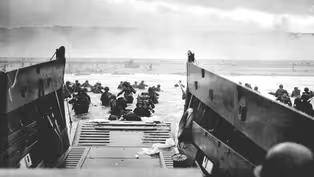
D-Day veterans reflect on 80th anniversary of invasion
Video has Closed Captions
D-Day veterans return to Normandy for 80th anniversary of Allied invasion (7m 56s)

Democratic, GOP strategists on concerns of undecided voters
Video has Closed Captions
Democratic, GOP strategists on problems Biden and Trump face with undecided voters (7m 32s)
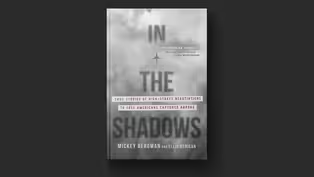
Negotiator reveals shadowy world of hostage rescue in book
Video has Closed Captions
Negotiator reveals shadowy world of hostage rescue in new book, 'In the Shadows' (8m 41s)
Providing Support for PBS.org
Learn Moreabout PBS online sponsorship
- News and Public Affairs

FRONTLINE is investigative journalism that questions, explains and changes our world.

- News and Public Affairs

Amanpour and Company features conversations with leaders and decision makers.












Support for PBS provided by:
Major corporate funding for the PBS News Hour is provided by BDO, BNSF, Consumer Cellular, American Cruise Lines, and Raymond James. Funding for the PBS NewsHour Weekend is provided by...