
Mars: Exploring Mars
Special | 6m 4sVideo has Closed Captions
When did we first start exploring Mars?
We first saw pictures of the surface of Mars in 1965. Since then, we have tried lots of different ways to explore the Red Planet. Learn the history of our Mars exploration and find out some of what we have learned.
Problems playing video? | Closed Captioning Feedback
Problems playing video? | Closed Captioning Feedback
Science Trek is a local public television program presented by IdahoPTV
Major funding for Science Trek is made possible by the Laura Moore Cunningham Foundation, with additional funding provided by the Idaho National Laboratory, and by contributions to the Friends of Idaho Public Television from viewers like you, thank you.
Mars: Exploring Mars
Special | 6m 4sVideo has Closed Captions
We first saw pictures of the surface of Mars in 1965. Since then, we have tried lots of different ways to explore the Red Planet. Learn the history of our Mars exploration and find out some of what we have learned.
Problems playing video? | Closed Captioning Feedback
Where to Watch Science Trek
Science Trek is available to stream on pbs.org and the PBS app.
Science Trek
Science Trek is a place where parents, kids, and educators can watch short, educational videos on a variety of science topics. Every Monday Science Trek releases a new video that introduces children to math, science, technology, engineering, and math (STEM) career potentials in a fun, informative way.More from This Collection
Ever since human first looked up in the night sky and wondered what was out there, we have been trying learn more about outer space. Explore the planets. Study asteroids and comets and find out what it is like to train to be an astronaut.
Video has Closed Captions
Where in the galaxy do we live? Find out. (7m 28s)
Video has Closed Captions
Asteroids and comets can teach us about the beginnings of the universe. (6m 20s)

Exoplanets: Finding Life With the JWST
Video has Closed Captions
Will biosignatures help us find life on exoplanets? (5m 26s)
Video has Closed Captions
Learn what astronomers learned through the ages. (5m 52s)
Video has Closed Captions
The James Webb Space Telescope could bring amazing discoveries. (6m 53s)
Satellites: The Story of Satellites
Video has Closed Captions
What is a satellite and how do human-made satellites study the Earth and the Universe. (5m 32s)
Satellites: Using Satellites to Find Treasure
Video has Closed Captions
GPS satellites help us navigate around the world and can help us find treasure. Learn how. (6m 22s)

Planets: What Exactly is a Planet?
Video has Closed Captions
How do you decide what a planet actually is? (5m 29s)
Planets: Tour the Solar Neighborhood
Video has Closed Captions
Take a tour of our Solar System and learn about planets and much more. (6m 3s)
Video has Closed Captions
Learn more about the Earth's only natural satellite. (5m 15s)
The Moon: Can You Visit the Moon in Idaho?
Video has Closed Captions
Why did the Apollo astronauts train in Idaho? (6m 7s)
Providing Support for PBS.org
Learn Moreabout PBS online sponsorshipJoan Cartan-Hansen, Host: Humans didn't know what Mars was really like until about 1965.
That's when we began to explore Mars close-up.
Come with me and find out more about the spacecrafts that visited Mars and what they discovered.
Science Trek is next!
[MUSIC] We didn't have a close-up photograph of Mars until 1965.
A few years earlier, NASA's Jet Propulsion Laboratory designed and built 10 spacecrafts named Mariner to explore Mercury, Venus, and Mars.
On July 14, 1965, Mariner IV flew by Mars and the scientists on Earth hoped it would send back the first digital pictures of the red planet.
>>"We got something here.
[computer clicks] >>Hey, here we go.
>>There she goes, that's data."
Cartan-Hansen: The data came back in a series of ones and twos.
Scientists were so excited they didn't want to wait the hours it would take for the computer to process the data, so they did a sort of paint-by-numbers version.
When finally processed, those first pictures of Mars showed a cratered surface more like that of the Moon.
But, in 1971, Mariner 9 changed the way we thought Mars looked.
After waiting out a dust storm, Mariner 9 took pictures of dormant volcanoes and a huge rift.
Mars wasn't just like the Moon.it had a varied and diverse geology.
The first spacecrafts to touch the surface of Mars were landers from Viking 1 and 2.
Viking 1 touched down on July 20, 1976 and Viking 2 arrived on September 3, 1976.
They looked for signs of life on Mars and studied Martian weather.
This is the first picture of the surface of Mars, taken by Viking I shortly after landing.
The Mars Pathfinder mission landed the Sojourner rover on the surface on July 4, 1997.
This craft was designed to show that a lower-cost vehicle could land on Mars.
The Odyssey orbiter made it to Mars in October of 2001.
Its mapping helped scientists find vast amounts of water ice in the polar regions buried just beneath the surface.
It still helps facilitate communication with other Mars spacecrafts and it holds the record for the longest-serving spacecraft at Mars.
The Spirit and Opportunity rovers lifted off in 2003 and arrived on Mars in 2004.
They showed water once flowed on Mars.
And Opportunity has driven more than 26 miles on the surface, taking pictures and studying rocks and soils.
In 2012, the Curiosity rover arrived on Mars to see if Mars had ever had an environment that could have supported small life forms like microbes.
Curiosity carried a chemical laboratory called SAM, which stands for Sample Analysis at Mars.
FLORENCE TAN, SAMPLE ANALYSIS FOR MARS: "SAM will be running some great science experiments on Mars.
We will be analyzing some soil samples.
To make the soil samples go down, we had to program it to vibrate at various frequencies.
When we're introducing a sample into SAM, it will go through a resonance and it will sound like this."
[Sound increasing in frequency] Cartan-Hansen: Curiosity detected methane and found organic compounds considered to be the building blocks of life.
With help from SAM, Curiosity did something else, playing probably the first song ever heard on Mars to celebrate its birthday.
[Computer Beeps Happy Birthday Song] Maven went into orbit around Mars in 2014 and studies the Martian atmosphere.
Scientists want to learn why Mars went from a once warm, wet planet to the cold, dry place we see today.
And in 2018, InSight landed on Mars to study the deep interior of the planet to see why Mars evolved so differently from Earth.
Tom Hoffman, InSight Project Manager: We know that the Earth is habitable, and we know that Mars is not.
There might be something that we find out in terms of the structure of Mars versus the structure of Earth that maybe can help us understand why that is.
Cartan-Hansen: InSight will study Mars quakes with a special seismograph.
It will record the planet's temperature and will find out how the poles on Mars wobble as the planet rotates.
This will all helps scientists better understand the red planet's structure.
And why have we been exploring Mars for more than 50 years?
Mars shares a lot of characteristics with Earth.
Both have a diverse and complex geology, and both climates have changed over time.
So, understanding what happened to Mars may help us protect our own planet.
And maybe, someday, we'll know enough to send the first humans to explore our red-soiled next-door neighbor.
If you want to learn more, check out the Science Trek website.
You'll find it at ScienceTrek.org [MUSIC] Announcer: Major funding for Science Trek is made possible by the Laura Moore Cunningham Foundation, helping Idahoans reach new heights for generations; additional funding provided by the Idaho National Laboratory, mentoring talent and finding solutions for energy and security challenges; and by contributions to the Friends of Idaho Public Television from viewers like you, thank you.
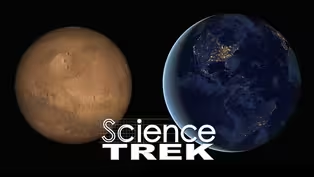
Mars: Mars and Earth, How Do They Compare?
Video has Closed Captions
Clip: Special | 1m 4s | Compare Earth and Mars. (1m 4s)
Video has Closed Captions
Clip: Special | 1m 4s | Will Mars' moons survive? (1m 4s)
Providing Support for PBS.org
Learn Moreabout PBS online sponsorship
- Science and Nature

Explore scientific discoveries on television's most acclaimed science documentary series.



 New Season
 New Season






Support for PBS provided by:
Science Trek is a local public television program presented by IdahoPTV
Major funding for Science Trek is made possible by the Laura Moore Cunningham Foundation, with additional funding provided by the Idaho National Laboratory, and by contributions to the Friends of Idaho Public Television from viewers like you, thank you.