
November 23, 2023 - PBS NewsHour full episode
11/23/2023 | 57m 46sVideo has Closed Captions
November 23, 2023 - PBS NewsHour full episode
Thursday on the NewsHour, Israel and Hamas prepare to pause fighting and exchange hostages for prisoners as the war continues to take a heavy toll on civilians. The labor movement notches major recent wins but challenges remain for organizing workers. Plus, Southeast Asia struggles to control the flood of imported plastic waste meant for recycling.
Problems playing video? | Closed Captioning Feedback
Problems playing video? | Closed Captioning Feedback
Major corporate funding for the PBS News Hour is provided by BDO, BNSF, Consumer Cellular, American Cruise Lines, and Raymond James. Funding for the PBS NewsHour Weekend is provided by...
Support provided by:

November 23, 2023 - PBS NewsHour full episode
11/23/2023 | 57m 46sVideo has Closed Captions
Thursday on the NewsHour, Israel and Hamas prepare to pause fighting and exchange hostages for prisoners as the war continues to take a heavy toll on civilians. The labor movement notches major recent wins but challenges remain for organizing workers. Plus, Southeast Asia struggles to control the flood of imported plastic waste meant for recycling.
Problems playing video? | Closed Captioning Feedback
How to Watch PBS News Hour
PBS News Hour is available to stream on pbs.org and the free PBS App, available on iPhone, Apple TV, Android TV, Android smartphones, Amazon Fire TV, Amazon Fire Tablet, Roku, Samsung Smart TV, and Vizio.
Providing Support for PBS.org
Learn Moreabout PBS online sponsorshipNICK SCHIFRIN: Good evening.
I'm Nick Schifrin.# Geoff Bennett and Amna Nawaz are away.
On the "NewsHour" tonight: Israel# and Hamas prepare to pause fighting## and exchange hostages for prisoners at a# pivotal moment after seven weeks of war.
Taking stock of the labor movement following# major recent wins, but still facing challenges.
And Southeast Asia struggles to control the## flood of imported plastic waste# that's supposed VARAWUT SILPA-ARCHA, Former Thai Former# Minister of Natural Resources: pl ease deal with your mess.
Don't dump it# on s it's not just us that's going to# be affected.
It's you as well.
(BREAK) NICK SCHIFRIN: Welcome to the "NewsHour."
After 48 days of war, 48 day final hours before the guns are scheduled to go# silent in Gaza.
At midnight Eastern time tonight,## Israel has committed to pause its military# campaign.
And, tomorrow, at 9:00 a.m. Eastern,## Hamas is committed to release 13 hostages it# kidnapped during the October 7 terrorist attack.
Until then, the war continues.
In the hours before the gun cease,# the tanks and the military bulldozers## roll on.
Israeli soldiers continue their# ground invasion today in Northern Gaza's## residential neighborhoods that Hamas# uses to fight and store its weapons.
Israel's top soldier,# Lieutenant General Herzi Halevi,## said military pressure had helped# force Hamas to release hostages.
LT. GEN. HERZI HALEVI, Chief of Staff, Israeli# Defense Forces (through translator): We are not## endi NICK SCHIFRIN: Hamas uses residential# neighborhoods to fight block to block.## It released this video showing attacks on Israeli## troops.
Israel's air campaign continued# as well, with The IDF released black-and-white videos of its# targeting senior Hamas commanders.
On the ground,## Palestinians picked through the# rubble of what they say was a## residential building.
This is Rafah in# the south, where man BOY (through translator): What# is there to say?
They destroyed## the building on top of us.
What is there to say?
NICK SCHIFRIN: They desperately searched for## the living, but mostly p Israel's offensive is set to# stop at 7:00 a.m. local tomorrow,## when it will also allow more humanitarian# aid trucks to reach Gaza.
At 4:00 p Hamas vows to release 13 women# and children.
Releases and the## military pause will continue for four days,# until 50 children and women are released.
And for each additional 10 children# and women that Hamas releases, Israel## would hold fire for an additional# day.
It was mediated by Qatar,## which hopes the four-day plan# becomes a permanent cease-fire.
MAJED AL-ANSARI, Qatari Foreign# Ministry Spokesman: We are hoping## th further and more deep negotiations# towards an end to this violence.
NICK SCHIFRIN: The violence began# in kibbutzim such as Be'eri,## visited today by British Foreign Secretary# and former Prime The neighborhood is still burned out# and abandoned, after residents were## massacred and kidnapped 48 days ago.
With# the first hostage released just hours away,# the Gonen family anxiously hopes to# be reunited with 23-year-old Romi.
Her## parents, Eitan and Meirav, spend time in her empty# bedroom.
Right now, all they have are pictures.
EITAN GONEN, Father of Suspected Hamas# Hostage: We worry a lot about Romi.
We## miss Romi a lot.
I miss Romi a lot.# Romi has a free spirit.
She needs## to be free all the time.
Every# kid, every child should be free.
NICK SCHIFRIN: In Tel Aviv# today, demonstrators prayed## that tomorrow's release would# lead to all ho Nili Bresler is an English# teacher of one of the hostages.
NILI BRESLER, Teacher of Suspected Hamas Hostage:# I just want to see all of them to come back.
But the first group# of children will start breathing again, I think.
NICK SCHIFRIN: And so it is in Gaza,## where the Al Salawat family is ce ase-fire.
They fled from their home, then to a# U.N.-school-turned-shelter, and now to this tent.
OMAR AL SALAWAT, Internally Displaced Palestinian# (through translator): want a complete cease-fire.## We don't want a four-day truce.
ch ildren safe and sound.
Take us back# home and implement a full cease-fire.
NICK SCHIFRIN: As part of the# deal, Israel will also release## 150 Palestinians it currently holds in det For more on the pause and# what it means for the region,## I turn to Jordan's for more on former# Foreign Minist Marwan Muasher, thank you very much.# Welcome back to the "NewsHour."
How important is this moment, not# only for the war, but for the MA RWAN MUASHER, Former Jordanian Foreign Minister:# It is an important moment for Gaza is in desperate need for troops# to be able to bring in food, medicine,## fuel to the strip.
But it's more important# also, in that people hope that this is,## yes, a four-day truce, but one that# hopefully might turn into a permanent one.
And there are many efforts by# several people in the region,## including King Abdullah of Jordan and# President Sisi of Egypt, who met yesterday,## precisely to talk about diplomatic efforts aimed# at converting this truce into a permanent one.
NICK SCHIFRIN: We heard that# from the Qataris as well,## but Israel vows to continue its# op the complete destruction of Hamas# both militarily and politically.
U.S. officials support the idea of Israel's# goals as well, but U.S. officials char the deal as incentivizing Hamas to release# more hostages.
Could subsequent hostage deals## be possible, or are they going to be,# in fact, more difficult than this one?
MARWAN MUASHER: I think it's entirely# possible, and Hamas has already said that,## that there will be more deals to release hostages.
But I think, with every phase, with every deal,# things are going to get more difficult.
Remember,## Hamas does not have an interest in# releasing all hostages.
This is a## negotiating card.
If they do that, then# they are prone to more bombing by Israel.
NICK SCHIFRIN: The hostage situation is# also difficult by the fact that Hamas## has admitted to Qatari negotiators that# it does not have control o all 90 or so women and children# that are being held inside Gaza.
How complicated is the effort overall to release,# at the very least, these 90 women and children?
MARWAN MUASHER: Well, I hope that all# women and children will be released,## and, frankly, on both sides.
One did not also know that Israel is holding# a lot of people under 19 yea mostly people who have been throwing rocks,# nothing serious.
But I think that I hope## for a deal in which all hostages# will be released on both sides.
NICK SCHIFRIN: Israel has two different# categories of detainees it has,## both administrative detainees and# those it has arrested.
And there## are hundreds who are on the list# to be possibly released tonight.
In terms of the region, last weekend, Jordan's# King Abdullah warned the conflict could expand## if the operation in Gaza continues.
How# high is that concern for regional expansion?
MARWAN MUASHER: Look, there# are two areas of concern, Nick.
One is that the conflict might extend# into Lebanon.
And we are already se escalations on the Lebanese border,# although I still remain hopeful that## there are enough indications to suggest that# the conflict will not extend to Lebanon.
The## United States does not want it to extend,# does not want it extended into Lebanon.
And I think it is exerting real pressure on# Israel not to escalate.
Iran and Hezbollah,## on the other side, also have no interest in# expanding the conflict there.
I'm more worried## about expanding the conflict to the West Bank,# frankly.
We are already seeing groups of settlers## supported by the Israeli forces that are going# into Palestinian villages and kicking people out.
I'm very worried.
Jordan is worried,# and Egypt is worried also, that we are## seeing what might be an Israeli attempt# to have a mass transfer of Palestinians## from Gaza to Egypt and from the West Bank# to Jordan.
I think that is the worry.
And## U.S. administration have already privately# admitted that Jordan and Egypt are justified## in these concerns and have publicly warned# Israel not to engage in any such operations.
NICK SCHIFRIN: What you just suggested# is not official Israeli policy.
The intelligence minister in Israel, who is not a# member of the Cabinet, did recently suggest t instead of bringing the Palestinian# Authority to Gaza, Israel should advocate## for -- quote -- "the voluntary resettlement# of Palestinians in Gaza outside the strip."
Again, not official policy, but is that where# Jordanian and Egyptian concerns come from?
MARWAN MUASHER: Look, logically, if Israel does# not want to end the occupation and establish a## Palestinian state on Palestinian territory, and# if it also does not want a Palestinian majority,## something it already has in areas# under its control, then, logically,## Israel is going to attempt a mass transfer# of Palestinians out of Palestinian territory.
And, yes, it is that very concerned by Jordan# and Egypt that Israel might attempt to empty## the West Bank and Gaza of Palestinian# population.
Fortunately, until now,## the Palestinians have learned their lesson# from 1948, when they were expelled because## of the war and were never allowed to go back,# even though there were many U.N. resolutions.
And so we are not seeing so far a Palestinian# movement.
Despite the heavy bombing, we have## not seen Palestinians crowd on the Egyptian# border, for example.
They do want to stay on## their land.
And Jordan and Egypt are helping# them do that by indicating to the Israelis,## to everyone, indeed, that the border# will be closed, because opening the## borders is going to help Israel empty the# Palestinian territories of its population.
NICK SCHIFRIN: And, again, it is not# Israeli policy to do exactly that,## empty these territories, we should say,# and the government specifically says that.
Let's look forward on the day after.# Jordan and Egypt have both publicly## refused U.S. requests to involve Arab# troops into some kind of day-after plan## for Gaza.
Do you think they could be# persuaded otherwise?
And do you think,## ultimately, the Palestinian Authority# will be part of ruling Gaza the day after?
MARWAN MUASHER: Nick, the emphasis# by Arab states, by Jordan and Egypt,## certainly, is not just on who is# going to rule Gaza on the day after.
We need to understand that things after October# 7 cannot be the same as before October 7,## that the root goals should be the end of the# occupation, not who rules Gaza, and then we go## back to business as usual.
Any political process# that the United States initiates cannot be an## open-ended process in which negotiations# take place forever with no end in sight.
And the endgame is the end# of the occupation.
And then,## once that endgame is defined, we can# reverse-engineer a process and talk## about the steps needed to get us there.
But# to talk about a political process once again## that is open-ended means that we have not# learned any lesson from what has happened.
NICK SCHIFRIN: Secretary of State Antony# Blinken released a series of no's,## things that it did not want Israel to do# after the war, including reoccupy Gaza.
President Biden has repeatedly talked about the## two-state solution in recent days# and weeks.
MARWAN MUASHER: Well, the United States# and the international community has talked## about two states forever, for about 30# years, since the Oslo process began.
If we are serious about the two-state# solution, then we have to, again,## work for steps to end the occupation.
A# Palestinian state on the West Bank and## Gaza cannot emerge if the occupation is there.# And so any political process has to have at its## objective first an end to the occupation# in order to establish a Palestinian state.
NICK SCHIFRIN: Marwan Muasher, former foreign# minister of Jordan, thank you very much.
MARWAN MUASHER: Thank you.
NICK SCHIFRIN: In the day's other headlines: The# fire is out in a small Eastern Kentucky town,## and, today, residents are returning home after# a CSX train wreck derailed Thanksgiving there.
The train caught fire and spilled molten# sulfur on Wednesday.
Officials urged the## roughly 200 people in Livingston to leave# while they tested for sulfur dioxide,## which can cause breathing problems.# Some of the evacuees sheltered in a## school.
CSX said it would reimburse them,# including with a Thanksgiving dinner.
Police in Niagara Falls, New York, spent this# day investigating Wednesday's explosion at a## border crossing with Canada.
In this# slowed-down security camera footage,## a speeding car vaults into the air at# the Rainbow Bridge.
A witness captured## the fiery aftermath.
The couple in the car# were killed.
Three other border crossings## closed briefly as a precaution, but federal# investigators have ruled out terrorism.
New York City Mayor Eric Adams is denying# that he sexually assaulted a woman in 1993## when he worked for the police department.# A civil summons filed Wednesday in state## court asked for a trial and $5 million# in damages.
The mayor responded today.
ERIC ADAMS (D), Mayor of New York:# My career speaks for itself and just## really something absolutely that has# never happened.
And I don't even r ever meeting the person who made the# -- this allegation.
But I have a city## to run.
And I'm focused.
And I have to# make sure that we continue to do so.
NICK SCHIFRIN: The court filing# says the plaintiff also worked for## the city at the time of the alleged# assault, but g Police raids in Germany today targeted members and# supporters of Hamas.
In Berlin, officers wea face masks removed bags and large containers from# apartments.
Germany bans even public statements## supporting Hamas.
The interior minister said# Islamists and antisemites must not feel safe.
NANCY FAESER, German Interior Minister# (through translator): Those who want to## be a part of our society cannot at the same# time question Israel's rig We will continue to fight the battle against# antisemitism with full force and determination,## especially where it shows itself# as Islamists ready to use violence.
NICK SCHIFRIN: Germany's crackdown began# earlier this month.
Officials estimate## there are about 450 Hamas members across the# country helping finance the In Nepal, protesters came out# in the tens of thousands today## demanding the monarchy be restored.# Riot police stood face-to-face with## demonstrators blocking them from downtown# Katmandu.
Some in the crowd threw stones,## and officers beat them with bamboo batons# and fired tear gas.
Nepal's monarchy was## abolished in 2008 after protests forced# an end to the king's authoritarian rule.
There's word that former President Trump will# visit Argentina to meet with the country's## new president-elect.
Javier Milei's office says# the two men made the plans in a phone call last## night, but gave no date.
The libertarian# populist is often compared to Mr. Trump.
And back at home, Americans celebrated this# Thanksgiving with all the usual trimmings,## feasts, football, flashy parades.
Tom Turkey# helmed the annual Macy's Parade in New York,## known for its inflatable characters.
This year,## they included Baby Yoda of Star Wars# floating among Manha And in Philadelphia, revelers gathered for the## nation's original Thanksgiving# Day Parade.
That d Still to come on the "NewsHour": we speak with the# youngest NCAA Division I coach about her team's## national championship; an editor at "Food & Wine"# offers recommendation what to pour tonight and## the future of the wine industry; finding Fido, how# drones can help rescue lost dogs; plus much more.
This has been the season of# organized labor's discontent,## but also big labor gains from Hollywood to the# United Auto Workers.
And picket line including hundreds of Macy employees# planning to strike in Washington state## tomorrow, on Black Friday, and the ongoing# teachers union strike in Portland Oregon.
John Yang examines what it all means.
JOHN YANG: There have been a number of# high-profile strikes this year, autoworker Hollywood writers and actors and health care# workers, and other work actions have b averted by last-minute deals, UPS drivers# and Las Vegas hotel workers, for instance.
All of them resulted in major# gains for members of those unions.
Lauren Kaori Gurley covers# labor for The Washington Post.
Lauren, why do you think the unions are on such a# winning streak at the bargaining t LAUREN KAORI GURLEY, The Washington# Post: There are a lot of different## reasons this is happening.
I# One is that we have historically a very tight# labor market r pandemic, there have for much of the past few# years been two job openings available for every## unemployed worker.
And this means that workers# have a lot of leverage with their employers right## now, which makes it more likely that they feel# willing at this moment to sort of take risks,## to demand more, because they know, if they get# fired, that they can go out and get another job.
At the same time, you also have inflation,# which has been scorching hot over the past## few years.
And so workers are really feeling# sort of the pinch on their pocketbooks.
Their## earnings aren't going as far.
And so that's one# reason why we have seen a lot of labor activity.
I would say the other thing started before# the pandemic, which is that there has just## been really broad, positive popular support for# unions.
Popular support for unions an all-time low during the Great Recession,# and it's been on the rise subtly since then.## And I think there's just this heightened# awareness about inequality in this country.
So, now, like, you have about 67 percent# of Americans saying they support unions.## And in a lot of the major labor disputes this# summer, UAW, the Hollywood union, Americans sai a vast majority of Americans said in a Gallup poll# that they support workers in these labor disputes.
JOHN YANG: You say that workers# seem more willing to take risks.
I think we have seen new tactics from the unions# on thi they'd never done before.
You're also hearing# them being a little more strident.
Do you think## there's a new generation of union leader and# that this is sort of reflecting their new role?
LAUREN KAORI GURLEY: Totally.
So, unions.
There was all -- there were many# decades throughout the '90s and 2000s,## where the sort of style of union leadership# was a little bit more chummy with big business.
I think we have seen workers sort of oust the# old leadership and bring in these new leaders,## especially at the Teamsters and the# United Auto Workers.
They have elected## these new leaders who are a lot more# aggressive.
They're making way more ambitious demands.
And they're also involving# the workers a lot more in thei These aren't sort of behind-the-scenes# deals.
These are deals that workers are## very much involved in for the first time.
And# workers' expectations are very high.
And so,# when workers have very high expectations,# union leaders do not want to disappoint.## So they take workers out on strike, and they# sort of just don't back down until they get## much higher wage increases and victories into# their contracts than they had in the past.
JOHN YANG: And these companies who've# been on the losing side of this,## what do they say about these new contracts# they have ag affect their bottom lines?
How is it going# to affect the prices they charge consumers?
LAUREN KAORI GURLEY: Yes, so I think# prices are going to go up.
We know## that's true in Hollywood.
I believe# it's also true with the auto in Executives have threatened that, with these really# strong new contracts, they might -- workers might## start to see fewer jobs.
They could have jobs# sent overseas.
They could see more workplaces## close down.
We haven't seen that yet, and# it's yet to be seen.
But I think this is## sort of the way that business has sort of been# describing the situation from their perspective.
They also say, coming out of the pandemic, there# have been severe supply chain shortages and labor## shortages, and they're already grappling# with that, as well as a lot of industry## transformations.
Hollywood has transformed# massively with the rise of streaming platforms.## The auto industry is trying to deal with# sort of the transition to electric vehicles.
There are a lot of moving parts# for the companies as well.
JOHN YANG: And while these# unions seem to be doing ot her workers are having trouble# organizing, for Amazon.
What are the hurdles they're facing# that they're having a hard time LAUREN KAORI GURLEY: Yes, so I would# say that it's very important to remember## that a lot of these unions, like the# Teamsters, the United Auto Workers,## the union that represents Hollywood, those# unions have been around for close to 100 years.
You're seeing a lot more difficulty# with that, Amazon and Starbucks,## because those are nascent unions, right?# Those are two massive American employers## that historically have not been# unionized, that are very anti-union,## that are sort of pulling all the shots to# sort of crush unionization at their And so that process takes a lot longer to# unionize all of their work forces.
I mean,## they have barely even started.
And so# I think that there's a lot more to go,## and it's yet to actually be seen whether workers# will be able to organize Amazon and JOHN YANG: As you said earlier, public support# for unions has been growing, but the proportion## of workers who belong to unions has been going# down steadily for the past several decades.
How do you reconcile those two things?
LAUREN KAORI GURLEY: Yes, it seems# sort of like right?
Labor unions are extremely popular,# I think, last year, union membership in# the United States fell to a historic low## at 10.1 percent.
And that's only actually 6# percent of workers in the private sector.
That,## like you said, has been in decline since the# 1980s.
And I think the process, like we're## seeing at Starbucks and Amazon, of organizing# workers into unions is totally different now.
Workers who are already in unions going on# strike were already very organized.
But those## are two separate things.
And so what will be# extremely interesting, I think, to see here,## whether the labor movement can capitalize on# this moment and actually bring new workers## into unions and sort of rebuild what they# have lost over the years since the 1980s.
JOHN YANG: Lauren Kaori Gurley of The# Washington Post, thank you very much.
LAUREN KAORI GURLEY: Thank you so much.
NICK SCHIFRIN: Last year, the U.S. exported# more than 950 million tons of plastic waste## meant for recycling, and a significant# portion of that ended up in Southeast Asia.
The region has been inundated after China## blocked all but the cleanest# plastic waste impo Special correspondent Fred de Sam# Lazaro looks at how one country,## Thailand, is dealing with the problem.
FRED DE SAM LAZARO: Plastic is everywhere in# Thailand, used by street vendors for curries,## soups and sauces, in fruit and vegetable markets,# grocery stores and everywhere in between.
About two million tons of plastic# waste were generated every year## in Thailand over the past decade.# Sittipong Lerdveelawut, and his wife,## Supreta Lukshampad (ph), built their# family business around recycling plastic.
SITTIPONG LERDVEELAWUT, Sunee Recycle 59 Group# (through translator): We buy recycled plastic,## then grind it down into little part wash it again.
The end product turns out into# some fine particle, kind of like sugar.
And,## basically, that is used for other factories# to make recycled plastic products in Thailand.
FRED DE SAM LAZARO: It's tedious and far from# straightforward.
There are thousands of different## types of plastic with different additives, and# they cannot be melted down together.
The highest## premium is on cleaner stuff.
At this East Bangkok plant, a worker spends# his day peeling labels off pi bottles.
And, overall, only a small# fraction of plastic is repurposed,## according to Wijarn Simachaya, president# of the Thailand Environment Institute.
WIJARN SIMACHAYA, President,# Thailand Environment Institute: Only## 25 percent, and the rest g FRED DE SAM LAZARO: Seventy to 80 percent# of the land-based plastic waste... WIJARN SIMACHAYA: Yes, go to the canal, and# then to the river, and then to the ocea FRED DE SAM LAZARO: OK, so that's a# significant amount of plastic pollution.
WIJARN SIMACHAYA: Yes.
FRED DE SAM LAZA after China, a major importer of# used plastic, banned the practice,## sending the business of plastic waste into# Southeast Asian countries like Thailand.
Estimates range from 150,000 to more than 550,000# tons, but actual figures could be even higher.
PUNYATHORN JEUNGSMARN, Ecological Alert# and Recovery Thailand: And that's when the## plastic waste impo FRED DE SAM LAZARO: Environmentalist Punyathorn# Jeungsmarn says ne sprung up to take on the new glut, with# little regulation.
He works with EARTH,## a Thai group that documents the# impacts of industrial pollution.
PUNYATHORN JEUNGSMARN: And we were# also seeing a lot more communities## that are affected by dirty recycling# factories and plasti WATCHAREE SAMANGIN, Community Health Volunteer# (through translator): They hire some people to## separate the dif would be gathered into a pile# and burned in an open area.
FRED DE SAM LAZARO: Watcharee Samangin is a# community health volunteer in a rural area## of Chon Buri province about 65 miles# east of Bangkok.
She says people she## served began to notice health impacts they# blamed on a nearby plastic recycling plant.
WATCHAREE SAMANGIN (through translator):# People living near where they burned the## plastic waste experienced it's worse at night, so it causes a lot# of disturbance and other health issues.
FRED DE SAM LAZARO: Following complaints# and protests, the plant was shot down.
PUNYATHORN JEUNGSMARN: We have found that# in Chon Buri province, in particular,## there are smaller facilities dealing with# plastic waste, a FRED DE SAM LAZARO: We visited That Thong,# where a large plant owned by a company called## Ken United continues to operate.
It's guarded by# high walls and cameras, closed off Local residents worry not only about the# health impacts, but the environment in## an area dependent on agriculture.
Some 20 to# 30 families who live in the area surrounding## the Ken United factory have complained# to environmental groups and to local## authorities about health consequences they# have suffered since the factory came online.
But when we visited, no one was# willing to share their stories on## camera in this community.
It could be# a consequence of a defamation lawsuit## that's been filed by the company# against one family who spoke out.
Our attempts to reach the company, which# is owned by international investors,## were not successful.
Meantime, the flood of# imported plastic waste has depressed pr severely affecting the lives# of informal waste pickers,## who are key to collecting plastics for recycling.# They are some of this country's PUNYATHORN JEUNGSMARN: So,# when the plastic -- the price## of plastic waste goes down,there's less# ince FRED DE SAM LAZARO: Informal workers# like 66-year-old Thongsri Kaewkalong,## whose only wages are what she# receives for the scrap she collects.
THONGSRI KAEWKALONG, Waste Collector (through# translator): Before, my daily earnings were about## $27.
Now they shrunk to $8.40 FR ED DE SAM LAZARO: Her meager# earnings are based on how much## they can carry.
It's often a job of last# re Bunthom Fangrith is 72.
BUNTHOM FANGRITH, Waste Collector# (through translator): I was laid## off fr support myself and my daughters.
My# daily profit now is just 100 baht.
FRED DE SAM LAZARO: That's less than $3.
VARAWUT SILPA-ARCHA, Former Thai Former# is FRED DE SAM LAZARO: Varawut Silpa-archa is a## former minister of natural# VA RAWUT SILPA-ARCHA: We have had quite a# few cases where I have kindly requ concerned authorities to shut a container# and return it to its rightful owner.
FRED DE SAM LAZARO: Thailand announced# it will restrict plastic waste imports## starting next year and completely ban# the shipments starting in enforcement is a challenge.
Shipments can be# mislabeled or simply smuggled past a customs## system that isn't fully transparent and# not equipped to inspect all containers.
PUNYATHORN JEUNGSMARN: It's possible to# import certain waste as paper.
We have## seen plastic waste falsely# declared as paper before.
FRED DE SAM LAZARO: And it's harder to enforce at# the local level, according to Wijarn Simachaya WIJARN SIMACHAYA: Some decision-makers don't care## about environmental issues# like garbage, wast FRED DE SAM LAZARO: The decision-makers,# the local politicians... WIJARN SIMACHAYA: The local politicians.
FRED DE FRED DE SAM LAZARO: It's estimated# that the Chao Phraya Riv about 4,000 tons of plastic waste# into the Gulf of Thailand each year.
Former Minister Varawut has a message to rich# nations, from where much of it comes: You own it.
VARAWUT SILPA-ARCHA: For those who produces# all these rubbish and try to dump it somewhere,## I must say, please, deal with your own# mess.
Don't dump it on someone else's,## because, eventually,it's not just us that's# going to be affected.
It's you as well.
When Mother Nature kind of takes back her balance,## mankind will be affected.
So, please,# stop doing what you are doing.
FRED DE SAM LAZARO: Plastic waste exports have# steadily declined over the past decade, in part## because of China's ban.
Still, in 2021, the U.S.# exported some 1.2 billion pounds of scrap plastic.
For the "PBS NewsHour," I'm Fred# de Sam Lazaro in Bangkok, Thailand.
NICK SCHIFRIN: Fred's reporting is a partnership## with the Under-Told Stories Th e youngest coach in NCAA Division I sports# this year just took home a national championship.
Amna Nawaz spoke earlier this week with the# rookie head coach of the Tar Heels field hockey## team about the victory that redefines# what a player-turned-coach can achieve.
AMNA NAWAZ: As a player on the University of North# Carolina's field hockey team, Erin Matson made## history.
She was a three-time national player of# the year and a four-time national champion.
Then,## two months after graduating in 2022, Matson# was named head coach of that same team.
Now 23 years old, in her first season at the# helm, the NCAA's youngest Division I coach led## the Tar Heels to yet another national title,# defeating Northwestern in double overtime.
And coach Erin Matson joins me now.
Coach, welcome to the# "NewsHour," and congratulati ERIN MATSON, Head Coach, University of North# Carolina Field Hockey Team: Th you.
I l AMNA NAWAZ: So we believe you are now# the youngest championship-winning coach## in NCAA Division I history.
How does that feel?
ERIN MATSON: Insane.
It still does not# feel real.
I was talking, obviously,## with the staff today, with the girls.# Everyone is still in just utter di And it's just been a blur, a whirlwind,## but a beautiful one.
So proud.# It's been quite the season,## and there's no group that's more deserving.# So, it's, yes, hard to put it into words.
AMNA NAWAZ: Fair to say it was a bit# of a nail-biter at the end there,## went into double overtime, came down# to pen How different was it to be a coach# on the sidelines in that moment,## as opposed to a player on the field?
ERIN MATSON: Oh, my goodness.
Yes, I would just get anxious and wanted to get# going and let's st And now you're giving the control# away.
I can motivate and prepare them,## but once that whistle blows, they're# the ones doing it.
And we have total## belief in them every single day,# every single game.
But, yes,## the nail-biters are definitely a lot more# intense and the emotions are way higher.
AMNA NAWAZ: But do you have to keep yourself from,## like, running ERIN MATSON: Yes.
And we know you want to put to play this time.
There's all the jokes.
They# know it's hard for me.
But at it's -- I had my time.
I had my fun.
And I'm lucky# I get to do it in a different way and help them.
But they make it a good time.
AMNA NAWAZ: So, when you got this job, it meant# you were taking over basically, right?
You helped lead the team as# a player to four consecutive national titles.
Some say, just like Michael# Jordan is the GOAT of basketball,## that Erin Matson is the field hockey# GOAT.
There are these great pictures## comparing the two of you side by side.
But# it also meant that you would be coaching## athletes you had been playing with just# last season, people you had lived with.
What was that adjustment like?# What was the hardest part?
ERIN MATSON: It's different.
The first talk I had with the team, I look, we're not going to pretend like# th is isn't unique.
It's part of it.
But from# the start, it was, one, naming it.
And I fortunate to have their support throughout the# interview process and applying and everything.
So it's not like it was -- it totally caught# them off guard.
But it's obviously different,## yes, when your former teammate walks in# the room and announced as your head coach.
From the beginning, we were transparent# about it.
We over-communicated.
I believe## in the power of communication.
They knew# my standards and expectations.
They knew## how I was as a player and as a captain# as a teammate.
And I'm not any different## now.
So it really was a team effort this# season and that's the only way it worked.
AMNA NAWAZ: I should also mention, I believe# you're also the only NCAA head coach to have## lived through the name, image and likeness# era as a player, otherwise known as NIL.
How has that changed how you advocate for# your players, how you view recruiting,## I mean, especially when you look at# the opportunities that women athletes## get these days, as compared to some of the# bigger money sports that m ERIN MATSON: Right, yes, definitely.
I mean, NIL is d out here like football players and basketball# players and everything you see all over the## place.
But it's definitely an added layer to# everything that goes into college athletics.
And it's a tool that I will lean on# and say, yes, I have experience in,## and as a player.
And coaches can understand# the rules, but they didn't go through it.## They didn't juggle the time management.
They# didn't go -- have to go over contracts and## have the conversations while turning in# a paper at the same -- the same night.
So, to say that I have experience# with it and can help with it,## it definitely helps with recruiting and the# confidence in the girls now when they enter## those opportunities.
So that is ever changing,# as well.
No one knows.
Tomorrow, NIL is going## to look different than it did today.
And it's just# the world we live in right now in college sports.
AMNA NAWAZ: Erin, as you know, there# are a lot of coaches out there,## not just field hockey, but basketball, football soccer and so on, who go their whole careers# Yo u have now done it in your very first season as## head coach.
Any advice you want to# share for other co ERIN MATSON: Oh, man.
practice planning and all of that.
Every# coach is hired because they know how to do## that.
It's more the motivation and the# trust you can instill in your players,## while holding them to high standards# and expecting a lot, but also just## doing everything you can to create a very# stable, secure team atmosphere and cult And I think we found that balance# this season of, they trusted me,## but I made sure they felt that confidence and# self-belief and bravery in themselves too.
AMNA NAWAZ: That is coach Erin Matson,# head coach of the University of North## Carolina Tar Heels field hockey# team, this year's national champions.
Coach, congratulations.# Thanks again for joining us.
ERIN MATSON: Thank you so much.
NICK SCHIFRIN: The wine you might be pairing# your turkey with shouldn't be taken for granted,## because climate change is threatening# wine production across the globe.
Geoff Bennett spoke recently with a wine# expert about the state of wine production## and got some recommendations# on which bottle to try next.
GEOFF BENNETT: The ever-expanding world of# wind looks a bit different today compared## to 50 years ago.
While consumption has# increased, the accelerating effects of## climate change have forced the industry to# adapt and adopt more sustainable practices.
We're going to dive into that part of the# business with noted writer and editor in## this industry who's out with a new book.# It's called "The World in a Wineglass:## The Insider's Guide to Artisanal, Sustainable,# Extraordinary Wines to Drink Now."
And it's written by Ray Isle.
He's also# executive wine editor for "Food & Wine."
Ray, thanks so much for being with us.
RAY ISLE, Author, "The GEOFF BENNETT: As we have reported recently on# the lowest level in some 60 years.
What accounts# for that and how are wine producers coping?
RAY ISLE: Well, there's a number# of things that account for it.
One is drying up, I guess you would say, lower price level of wines, in Europe, especially,# where the youngest generation kind of doesn't want## to drink with their parents or drinking.
And so# the supermarket level of wines there has shrunk.
But there's also been a lot of climate issues# which have affected grape production.
You see## it around the world, which is what the# climate is doing, everything from fires## in California, to hail in the wrong season# in France, to heat spikes And then all this makes growing# grapes for wine quite difficult.## People manage.
They keep going.
They# adapt to the climate shifting on them, but it's definitely thrown some wrenches# at vintners' ways, I guess you would say.
GEOFF BENNETT: There's been so much# consolidation in the wine and spirits industry.
Reading this book, I was shocked# to learn that much of the wine## consumed around the world comes from# just a handful of producers, RA Y ISLE: Yes, it's true.
I on store shelves are brands that are owned# by three or four or five companies.
And I## wanted to write this book to write about# wineries that are working sustainably or## organically that are run by people who live# at the vineyard,who are on the vineyard,## are trying to express something of# a place and of personal passion.
And a lot of wines are not that.
They're# made in 100,000-gallon tanks and they're## enzymatically pushed through fermentation and# zapped with liquid tannins and whatever you## want.
And it makes a very pleasant beverage# product, I guess is the way you would say it.
That wasn't what I was after with this book.# I wanted to get to the kind of soul of wines## that really -- we're about the land, as an# agricultural product, as well as a drink.
GEOFF BENNETT: Yes, you# referred to the book.
Really,## it's an encyclopedia in (LAUGHTER) you talk about learning to describe wine based# on the stories RAY ISLE: Yes.
GEOFF BENNETT: ... less so by the point system.
RAY ISLE: Yes, I think the point# system i and partly because -- and I# have noticed this working "Food & Wine," as I talk to consumers.# And I talk to yo There's just more and more interest in how# a wine was made and what you're putting in your body when you're drinking# it.
And then the point system,## you don't get more points for being# organic And, additionally, it adds a kind# of pseudo-objective rating.
I mean,## it's really subjective, as we know.
All# critics ratings are subjective to some## degree.
But you say 94 points, and it sounds# very official.
And it's an opinion, as we GEOFF BENNETT: Well, you were kind enough to give## us some recommendati So walk us through what you're recommending# th RAY ISLE: These are all wines# that come from the book that## are also just terrific for the Fi rst one is a Grgich Hills sauvignon blanc# from Napa Vall large winery.
And what's interesting to me# is, they work organically and regeneratively,## which involves keeping cover crops on the ground,# so the soil life -- soil stays alive, essentially.
But they do it at scale.
They have got a# couple of hundred acres of vineyard.
So,## they produce quite a lot of wine, but they# farm very responsibly at the same time.
And## this is a gorgeous sauvignon blanc.
It's# classic Napa Valley, a plus a little bit of melon character,# adaptable to anything you might want to eat.
GEOFF BENNETT: And then# you also recommended a red?
RAY ISLE: Yes, and then so# th Chateau de Beaucastel, it's one of my favorite# quotes one of the great chateau nouveau# producers in France.
They have## been farming organically since 1950.# They have never put it on the label.
And Marc Perrin, who's the family that# owns it, said to me, his father said## to him there are the people who go to# church because they believe and there## are the people who go to church so they# can tell everybody they went to church.
So they have been organic for a# long time.
They don't promote bu t that's -- they believe in it.
And# it's just a gorgeous Southern Rhone rich fruit, lots of power, lots of# flavor, sort of perfect for cold w And then Lyndenhurst.
Spottswoode is one# of the great Napa Valley wineries.
Their## top cabernet costs a lot, but it's a great# cabernet.
They too have been -- they're in## the early wave of sort of organic# farming in Napa back in the 1990s.
But their Lyndenhurst wine, which# is their affordable cabernet,## is -- it's a beautiful bottle of cabernet,# re I say -- when you talk about organic# grape growing, that's not a flavor.## It doesn't -- the wine won't taste different# or weird compared to a normal Napa cabernet.
It's really a philosophy and approach to the land## and a way of farming that doesn't# involve a lot of agrochemicals.
GEOFF BENNETT: The book is "The World in a# Wineglass: The Insider's Guide to Artisan Sustainable, Extraordinary Wines to Drink Now."
Ray Isle, thanks for your time.
RAY ISLE: Thank you so much fo NICK SCHIFRIN: Finally# tonight, finding Fido by drone.
Off-the-shelf drones have transformed the# battlefield.
Now they are wi th man's best friend, as special correspondent# Malcolm Brabant saw in Southern England.
MALCOLM BRABANT: We have just driven for# about two-and-a-half-hours across the English## countryside in Southern England to a village# called W and we're joining people looking# for a black Labrador called Xena,## who's 1-year-old and who has# been missing for a few days.
The drone pilots have been up.
There have been# some positive sightings, but Xena is nervous, and she took flight and disappeared.
And# there's only about an hour to go before nightfall.
We're following actress Eryl Holt,# who became Xena's owner a month ago## after the young Labrador was rejected as# a gun dog because she was easily spooked.
ERYL HOLT, Dog Owner: Unfortunately, somebody# came round to visit, and they had a very## high-pitched voice, a very bumptious dog, and# I think it was just the last straw for her.
And I suddenly turned around,# and I went, where's the dog?
MALCOLM BRABANT: Earlier, the area was# scanned by a drone that can detect the## body heat of a scared puppy# or an invading infantryman.
SHANE PHILLIPS, The Hampshire Drone Company:# The Ukrainian government have purchased th particular model because of the ther very short supply at the moment.
So I was lucky,# luckily managed to g MALCOLM BRABANT: Shane Phillips# is a commercial drone pilot who## normally makes films, but volunteers for# sear SHANE PHILLIPS: Dogs tend to hide in quite dense## undergrowth.
They're never# usually out in the open.
But with the drone, especially with thermal# ca We can scan this whole field area here in a# matter of seconds.
And at least we can say,## there's no dog here, and you can# focus your efforts elsewhere.
ERYL HOLT: I'm very frightened for her,# really,because she doesn't know th of the country at all.
She's only 1.
This# is just the perfect place for her to be,## because there are no main# roads around here at all.
But if she was to stray further, we have got# really, really busy road MALCOLM BRABANT: As the light fades fast, a# farmer's convinced that he's spotted the Labrador.
ERYL HOLT: It's definitely her.
MAN: I think I can see her.
ERYL HOLT: Yes, I know.
I can to Shall I go and get John (ph)?
MAN: That's not a deer.
ERYL HOLT: No, it's not.
MALCOLM BRABANT: But t Xena faced her third night alone, while her# owner endured a tumult of anxiety and hope.
Similar emotions flowed at the# biggest reservoir in North Wales,## when a dog walker's idyllic country# stroll went pear-shaped.
Her charge,## Charlie (ph), a venerable spaniel,# suddenly vanished into thin air.
LYDIA DAVID, Dog Owner: As the# evening went on and the night drew in,## we became more and more anxious that# we weren't going t MALCOLM BRABANT: Charlie is the best# friend Lydia David will ever have.
LYDIA DAVID: There was no way that we were# leaving that night wit awful experience to go through, one that I# wouldn't wish on anyone.
We just wante get him back to where he belonged, back to# the people that loved him, back to safety.
TIM SMITH, Pilot, Drone SAR# For Lost Dogs U.K.: Launching.
MALCOL Tim Smith spotted Lydia's SOS post in# a Facebook dog search-and-res TIM SMITH: A lot of people consider drones to be a## nuisance, but we actually use them# to f particularly in the weather conditions in North# Wales, a lost dog can be in a lot of trouble.
MALCOLM BRABANT: The odds weren't encouraging.
TIM SMITH: Charlie was deaf, start with.
Nobody could understand what# had happened, because we covered the land,## and we actually flew over where# Charlie was, and nobody saw him.
MALCOLM BRABANT: But then the dog# Walker pointed to the place where## Charlie disappeared.
Tim reached# for dot in the middle shows Charlie# trapped on the water's edge.
WOMAN: Got him.
I have got him.
(CRO LYDIA DAVID: We're so incredibly lucky# that Tim saw that post that night,## that he was able and happy to come out and# help us.
Everyone did as much as they could,## and that's what got Charlie back home safe to us.
TIM SMITH: I came away on an incredible# high.
Yes, I'm still buzzing.
MALCOLM BRABANT: These are just some of the# dogs who've gone missing in the past couple## of weeks.
Every day, on average, there are 10# new ap The group can call on 2,500# drone pilots.
And, to date,## they have reunited nearly 3,000 dogs with# their families.
Hope is running out in## Cornwall in Southwest England, a landscape# pitted with abandoned tin and copper mines.
Douglas went missing after# his owner went for a run.
ELODIE SPARROW, Dog Owner: I had him since I was,## I think, 10 years old.
And so he's# basically grown MALCOLM BRABANT: Elodie Sparrow is# a student of Mandarin and bereft.
ELODIE SPARROW: He's been through# really hard times in our life,## and he's been such a comfort.
And he's# definitely a big part MALCOLM BRABANT: This is Douglas in# happier times near Elodie's home.
JOHN DAVIES, Pilot, Cornwall Search Dogs:# He's a 12-year-old cocker sp is quite infirm.
And he's blind# and probably is hard of hearing.
MALCOLM BRABANT: John Davies is a former police## dog handler who takes to t JOHN DAVIES: They're hiding.
They're# probably in the feral dog syndrome,## the wild syndrome that they go# into after a time of being out of## their family.
They're scared.
They're# frightened.
They want to hunker down.
Alas, at this point, we# actually haven't found Douglas.
ELODIE SPARROW: It feels really# strange not to have him with us,## but, also, it's horrible to have to worry# ERYL HOLT: Hello, Xena.
MALCOLM BRABANT: Back lured by a pile of scented clothes,# including Eryl's husband's dirty underwear.
ERYL HOLT: We have got Xena home at last, which# is really, really fantastic.
She's very tired,## and she's had a good meal.
And now she's# just nodding off on her favorite sofa.
Thank you.
SH ERYL HOLT: Oh, t SHANE PHILLIPS: No problem.
ERYL HOLT: Brilliant.
ERYL HOLT: Yes, hopefully never agai MALCOLM BRABANT: But as Xena luxuriates in home# comforts, For the "PBS NewsHour," I'm Malcolm# Brabant in Southern England.
NICK SCHIFRIN: May every lost dog find his or# her way back to the Thanksgiving table That's the "NewsHour" for tonight.
I'm Nick## Schifrin.
And be sure to join# For all of us at the "PBS# NewsHour," I hope you had## a good day.
Have a wonderful, happy Thanksgiving.

How a volunteer group is finding lost dogs with drones
Video has Closed Captions
How volunteer drone operators found thousands of lost dogs in Britain (6m 58s)

Israel prepares for hostage and prisoner exchange with Hamas
Video has Closed Captions
Israel prepares to pause fighting for hostage and prisoner exchange with Hamas (13m 34s)

Organized labor faces challenges after series of union wins
Video has Closed Captions
Organized labor still faces challenges after series of major union wins (6m 47s)
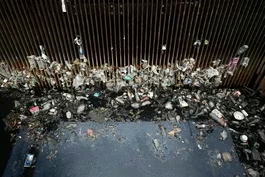
Southeast Asia flooded with plastic meant for recycling
Video has Closed Captions
Southeast Asia flooded with imported plastic waste meant for recycling (8m 3s)

'The World in a Wineglass' explores the future of wine
Video has Closed Captions
'The World in a Wineglass' explores state of wine production and future of industry (6m 6s)

Youngest NCAA coach leads her team to national championship
Video has Closed Captions
Youngest NCAA Division I coach leads Tar Heels to field hockey national championship (6m 26s)
Providing Support for PBS.org
Learn Moreabout PBS online sponsorship
- News and Public Affairs

FRONTLINE is investigative journalism that questions, explains and changes our world.

- News and Public Affairs

Amanpour and Company features conversations with leaders and decision makers.












Support for PBS provided by:
Major corporate funding for the PBS News Hour is provided by BDO, BNSF, Consumer Cellular, American Cruise Lines, and Raymond James. Funding for the PBS NewsHour Weekend is provided by...