
U.S. launches 'most intense' day of strikes on Iran
Clip: 3/10/2026 | 4m 55sVideo has Closed Captions
As Iran shows no signs of surrender, U.S. launches 'most intense' day of strikes
The U.S.-Israeli war with Iran showed no sign of slowing on Tuesday, with both sides trading strikes and vowing to keep up the attacks. U.S. officials said the campaign has destroyed most of Iran’s ability to produce nuclear fuel, and President Trump said forces also struck sea mine targets tied to Iranian threats in the Strait of Hormuz. Stephanie Sy reports.
Problems playing video? | Closed Captioning Feedback
Problems playing video? | Closed Captioning Feedback
Major corporate funding for the PBS News Hour is provided by BDO, BNSF, Consumer Cellular, American Cruise Lines, and Raymond James. Funding for the PBS NewsHour Weekend is provided by...
Support provided by:

U.S. launches 'most intense' day of strikes on Iran
Clip: 3/10/2026 | 4m 55sVideo has Closed Captions
The U.S.-Israeli war with Iran showed no sign of slowing on Tuesday, with both sides trading strikes and vowing to keep up the attacks. U.S. officials said the campaign has destroyed most of Iran’s ability to produce nuclear fuel, and President Trump said forces also struck sea mine targets tied to Iranian threats in the Strait of Hormuz. Stephanie Sy reports.
Problems playing video? | Closed Captioning Feedback
How to Watch PBS News Hour
PBS News Hour is available to stream on pbs.org and the free PBS App, available on iPhone, Apple TV, Android TV, Android smartphones, Amazon Fire TV, Amazon Fire Tablet, Roku, Samsung Smart TV, and Vizio.
Providing Support for PBS.org
Learn Moreabout PBS online sponsorshipGEOFF BENNETT: Welcome to the "News Hour."
The U.S.
and Israel's war with Iran shows no sign of slowing today, with both sides trading strikes and vowing to keep up the attacks.
U.S.
officials say the campaign has destroyed most of Iran's ability to produce nuclear fuel, while President Donald Trump says U.S.
forces have also struck sea mine-related targets tied to Iranian threats in the Strait of Hormuz.
AMNA NAWAZ: This comes as the Pentagon says about 140 U.S.
troops have been wounded in the war, including over 100 who have returned to duty.
Stephanie Sy begins our coverage.
STEPHANIE SY: In an Eastern neighborhood of Tehran, Red Crescent rescue workers locate a person in the rubble.
It's not clear if they're injured or dead.
But a broken doll signals a family lived here, anguish and ashes left in the wake of an airstrike this rescue worker blames on the - - quote -- "Zionist regime."
U.S.
Defense Secretary Pete Hegseth today warned the U.S.
will not relent until the Iranian regime is defeated.
PETE HEGSETH, U.S.
Defense Secretary: Iran stands alone, and they are badly losing.
Today will be yet again our most intense day of strikes inside Iran, the most fighters, the most bombers, the most strikes, intelligence more refined and better than ever.
STEPHANIE SY: President Donald Trump also promised further escalation over Iran's threats to the Strait of Hormuz.
This afternoon, Trump responded to reports that the Iranians are placing mines in the critical oil route, writing on TRUTH Social: "If for any reason mines were placed and they were not removed, the military consequences to Iran will be at a level never seen before."
Meanwhile, Democrats, including Senate Armed Services Committee member Richard Blumenthal came out of a briefing on Iran raising the specter of a deployment of American ground troops.
SEN.
RICHARD BLUMENTHAL (D-CT): I am most concerned about the threat to American lives of potentially deploying our sons and daughters on the ground in Iran.
We seem to be on a path toward deploying American troops on the ground in Iran.
STEPHANIE SY: White House Press Secretary Karoline Leavitt later responded.
KAROLINE LEAVITT, White House Press Secretary: I wouldn't take Democrats at their word.
As for boots on the ground, the president has talked about this repeatedly.
Wisely, he does not rule options out as commander in chief.
STEPHANIE SY: But neither in the crucial oil shipping lane nor elsewhere has Iran shown signs of surrender, launching missiles on a U.S.
base in northern Iraq, targeting a residential building in the kingdom of Bahrain's capital city.
That attack killed at least one person and injured eight.
Iranian forces also launched drone strikes on an Israeli oil refinery in Haifa, a major industrial city.
Despite mounting global pressure, the battered Iranian regime today made it clear there will not be a cease-fire, with Iran's Parliament speaker, Mohammad Bagher, saying, "We must strike the aggressor in the mouth."
An Iranian security official warned President Trump: "Watch out for yourself, lest you be eliminated."
And an Iranian military spokesperson told Iranian media the country, -- quote -- "will not allow the export of a single liter of oil from the region."
Meanwhile, in Israel, air raid sirens blared across the city today, a new normal warning residents to take shelter against incoming Iranian strikes.
Israeli Prime Minister Benjamin Netanyahu said the aim of the war is to enable Iranian citizens to rid themselves of -- quote -- "tyranny."
BENJAMIN NETANYAHU, Israeli Prime Minister (through translator): Ultimately, it's up to them.
But there's no doubt that, through the actions taken so far, we are breaking their bones and there is more to come.
STEPHANIE SY: But, for many Iranians, the cost of speaking out is too great.
EBRAHIM EIDI, Iranian Citizen (through translator): People are afraid to go to the streets.
They are not afraid of America.
Unfortunately, they are afraid of their own government.
STEPHANIE SY: At this remote mountain pass in Eastern Turkey, displaced travelers are saddled with fear and exhaustion.
They are some of the tens of thousands currently fleeing Iran.
But others are traveling back to the families they left.
For 45-year-old Leila, being with her family, even in danger, feels more bearable than death.
LEILA, Iranian Citizen: I cannot guard, be against bomb.
But when I feel I can with them together, maybe we together die.
STEPHANIE SY: For Leila and so many Iranians, there is no obvious escape.
It's now a war zone, but it's still home.
for the PBS "News Hour," I'm Stephanie Sy.

Afghans stranded by Trump's refugee freeze caught in new war
Video has Closed Captions
Afghans stranded for a year by Trump's refugee freeze now caught in new war (7m 12s)

Electric grid faces political roadblocks amid high demand
Video has Closed Captions
Electric grid faces political roadblocks as it struggles with data center demand (8m 48s)
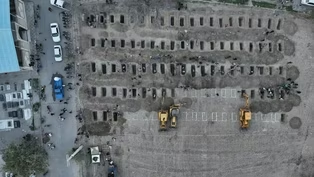
A look at evidence linking U.S. to Iranian school strike
Video has Closed Captions
A look at evidence linking U.S. to Iranian school strike (6m 53s)

News Wrap: Georgia holds special election to replace Greene
Video has Closed Captions
News Wrap: Georgia holds special election to replace Marjorie Taylor Greene (4m 57s)

NYC explosive incident highlights challenge for agencies
Video has Closed Captions
New York explosive incident highlights challenge for agencies in wake of Iran war (7m 10s)

Sauna industry heating up as more Americans embrace it
Video has Closed Captions
U.S. sauna industry heating up as more embrace it for wellness (4m 41s)
Providing Support for PBS.org
Learn Moreabout PBS online sponsorship
- News and Public Affairs

FRONTLINE is investigative journalism that questions, explains and changes our world.

- News and Public Affairs

Amanpour and Company features conversations with leaders and decision makers.












Support for PBS provided by:
Major corporate funding for the PBS News Hour is provided by BDO, BNSF, Consumer Cellular, American Cruise Lines, and Raymond James. Funding for the PBS NewsHour Weekend is provided by...