
Georgia Diversified Farming
Clip: 6/29/2026 | 4m 35sVideo has Closed Captions
A Georgia farm keeps the produce coming year-round by planting and harvesting in different locations
A Georgia farm keeps the produce coming year-round by planting and harvesting in three different locations.
Problems playing video? | Closed Captioning Feedback
Problems playing video? | Closed Captioning Feedback
America's Heartland is presented by your local public television station.
Funding for America’s Heartland is provided by US Soy, Sustainable Agriculture Research and Education, Rural Development Partners, and a Specialty Crop Grant from the California Department of Food and Agriculture.
Georgia Diversified Farming
Clip: 6/29/2026 | 4m 35sVideo has Closed Captions
A Georgia farm keeps the produce coming year-round by planting and harvesting in three different locations.
Problems playing video? | Closed Captioning Feedback
Where to Watch America's Heartland
America's Heartland is available to stream on pbs.org and the PBS app.
Providing Support for PBS.org
Learn Moreabout PBS online sponsorship(mellow orchestral music) - [Narrator] These fields in Norman Park, Georgia, are covered in vegetables, growing in the summer sun at Southern Valley Fruit & Vegetable, a cornerstone of American agriculture with deep roots in the Deep South.
(mellow orchestral music) Kent Hamilton is the President of Southern Valley, his daughter, Courtney Hamilton Griffin, is Director of Operational Support and part-owner.
Side by side, Courtney and Kent work every single day, cultivating not only fresh, high-quality produce, but a legacy of sustainability and innovation.
- We are doing something that's been done for generations, and we want to continue that.
Is it harder today than it's ever been?
Absolutely.
Is it getting easier?
No, not really.
But we are doing the basics of human life.
- [Narrator] But growing those basics of life for consumers across America is anything but simple in the southeast.
Extreme heat along with intensifying hurricane seasons turns a difficult job into an unpredictable journey.
- You can do everything right, the bees can be working, they can be pollinating the field, you can have the perfect fertilizer mix and everything else, and then all of a sudden a storm pops up, a hurricane hits your field, and destroys it.
And I mean, you can't change that because mother nature drives everything we do.
- [Narrator] The first seeds of Southern Valley were planted in 1987, and since then, a lot has changed.
Adapting to changing weather patterns also means spreading out.
Southern Valley grows vegetables in the heat of summer in Eastern Tennessee, and during the winter in Mexico's Yucatan Peninsula.
- There's a lot of planning that goes into what we do, a lot of projecting, you know, how much product are we gonna need, when are we gonna need it?
And, two, we have to project what the weather's gonna do; if the weather's cooler than what it normally is, then the crop don't come off as quite as soon as what we have projected.
(intriguing orchestral music) - [Narrator] On this late July day, it's hot and humid, and just three weeks earlier, these beautiful row crops were sitting directly in the path of a major hurricane.
This time, farmers got lucky, but the threat from the increasing heat in the tropics is nothing new to farmers here in Southeastern Georgia.
- So a hurricane can come through, if it comes through in September, October, when we're right in the heart of our production, it can be devastating, have devastating effects on our crop.
- [Narrator] It's also harvest time, and it's hopping.
These vegetables coming in from extreme heat need immediate attention to stay fresh.
This state-of-the-art packing plant is where vegetables are quickly cooled, cleaned, packed, and shipped directly to some of the biggest produce suppliers in the country.
But their biggest concern is keeping workers safe during dangerously hot days; something Kent and Courtney monitor in the field every single day, shifting outside hours to protect the workers.
During extreme heat, harvest happens early in the morning, protecting the workers from the scorching sun.
- We've had some hot days, but, you know, we start planting late in the afternoon when the sun's already starting to go down, and it's starting to cool off.
- [Narrator] On this day, there's a window just before dusk, there's a break in the heat with rain showers on the way, providing perfect conditions for workers to get these bell pepper plants in the ground.
- If you treat people with kindness and love and respect, they're going to give you that in return.
- [Narrator] With roots deep in the soil, this family hopes to show that agriculture can nourish the soul and connect the community while helping preserve the planet one table at a time.
- Thankfully, the way the climate is, the way the sun moves north and south through the year, there's somewhere in the world that we can produce food on a year-round basis.
Video has Closed Captions
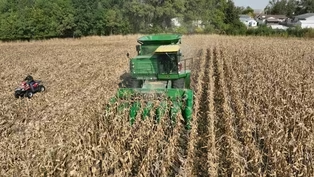
An Iowa farm thrives as one of the state’s few Black-owned farms. (6m 34s)
Video has Closed Captions
Soybeans may soon be part of the asphalt beneath you. (5m 39s)
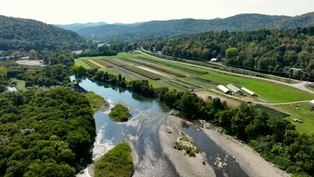
Vermont Farming Climate Challenges
Video has Closed Captions
A Vermont couple finds new ways to better protect their land from drought and floods. (5m 35s)
Providing Support for PBS.org
Learn Moreabout PBS online sponsorship
 New Episode
- Food
Christopher Kimball’s Milk Street Television
Transform home cooking with the editors of Christopher Kimball’s Milk Street Magazine.










Support for PBS provided by:
America's Heartland is presented by your local public television station.
Funding for America’s Heartland is provided by US Soy, Sustainable Agriculture Research and Education, Rural Development Partners, and a Specialty Crop Grant from the California Department of Food and Agriculture.