
Soy-Based Asphalt
Clip: 6/29/2026 | 5m 39sVideo has Closed Captions
Soybeans may soon be part of the asphalt beneath you.
Soybeans may soon be part of the asphalt beneath you.
Problems playing video? | Closed Captioning Feedback
Problems playing video? | Closed Captioning Feedback
America's Heartland is presented by your local public television station.
Funding for America’s Heartland is provided by US Soy, Sustainable Agriculture Research and Education, Rural Development Partners, and a Specialty Crop Grant from the California Department of Food and Agriculture.
Soy-Based Asphalt
Clip: 6/29/2026 | 5m 39sVideo has Closed Captions
Soybeans may soon be part of the asphalt beneath you.
Problems playing video? | Closed Captioning Feedback
Where to Watch America's Heartland
America's Heartland is available to stream on pbs.org and the PBS app.
Providing Support for PBS.org
Learn Moreabout PBS online sponsorship(lively upbeat music) (vehicles whooshing) - [Narrator] Every day, millions of people drive, walk, and bicycle millions of miles on America's highways and byways.
Virtually, all of them travel on asphalt made with petroleum-based products.
(attendees chattering) (lively upbeat music) But that may be about to change, and in a big way.
And it's starting at places like the Farm Progress Show in Boone, Iowa.
Inside this 42,000-square foot tent are over 100 ag exhibitors showing off their products and services.
And the thousands of people wandering through here are walking on asphalt made partly from soybean oil.
- I mean, man, if that doesn't say sustainable, I don't know what does.
- [Narrator] Robb Ewoldt is an Iowa soybean farmer and member of both the United Soybean Board and the Iowa Soybean Association.
Through the USB's National Checkoff Program, these organizations partnered with Iowa State University to develop soy asphalt.
The shared goal: a more sustainable, environmentally-friendly alternative to traditional roadways made entirely with petroleum products.
- I mean, that should be, "Wow, we can grow oil, harvest it, process it, and have a great product, like what we see here at the show, and what we're seeing on roads throughout the country."
- [Narrator] The concept of soy-based asphalt has already been around for more than a decade, but it steadily evolved and improved thanks to ongoing research and testing at other places around the ag expo and elsewhere, like this roadway in Alabama.
The soy component is made from soybeans high in something called high oleic oil.
That oil helps create a kind of rubber product that acts as a binder to help stabilize the asphalt as it's mixed with traditional petroleum ingredients.
- It's safer for handling and production and it's got longer storage time and stability, and it's turnkey into the current operations.
So it really just makes a lot of sense.
- [Narrator] Early research also suggests the soy asphalt lasts longer than traditional asphalt, and, says Grant Kimberley of the Iowa Soybean Association, it's more eco-friendly.
- A lot of the asphalt roadways across America are gonna be needing to be repaved, there's gonna be new roads, and this material is just perfect for that kind of thing, 'cause a lot of the government entities are looking at ways to reduce the carbon emissions and improve the shelf life of these materials and also ultimately make it better for the environment.
- But these soybean oil products, they're about 10 times more effective than those petroleum-based products in making those really brittle, heavily-processed asphalts back into usable paving materials.
So, you know, that's just the US market, and there are other international markets where, you know, they're facing the same challenges, a lot of them are big importers of soy and soybean oil.
- We can go electric with our vehicles, we can go wind with our houses, what have you, but you're gonna need some sort of oil to make these roads stick together; and this is a renewable way, a renewable product, instead of having to drill for it.
- [Narrator] And renewable isn't just a hopeful word for our planet, it represents opportunity for America's soybean growers.
It took more than 285 bushels of soybeans just to make the asphalt inside this tent, multiply that by thousands of miles of new and repaved roadways.
- We think about how many bushels of soybeans that can utilize, and what that means to farmers' bottom lines, the opportunity to grow soybeans at a better price, ultimately, where they can make a good living for their families and then provide a service and a product that's good for America and the consumers of America.
- I think that the potential is, what, somewhere in the neighborhood of approaching about a million tons of soybean oil per month.
- [Narrator] Much of this research and innovation has come about thanks to soybean farmers themselves.
By investing farmer dollars through the Checkoff Program, they're also investing in new soy products and new and expanded markets for their crops.
There's already more than a million acres of high oleic soybeans planted across the US designed for use in products like soy asphalt.
- I can't state enough how the farmers paid for this type of investment so that all can benefit.
I think that's an important fact that the consumer needs to understand.
- Continued investment in industrial uses for soy is just so critical.
There is so much value in the chemistry of vegetable fat molecules that soy just produces so well, and we have so much infrastructure in place to produce it at scale.
I really think there's a lot more potential for what we can get out of soy as a building block for a lot of the materials that we use and take for granted every day.
- [Narrator] Better product, longer lasting, lower cost; bottom line say these soybean folks is another example of the many ways they're working to improve the environment, and showing consumers their commitment to making the best and safest products, whether it's food, feed, or oil.
- I think the more they understand all these extra things that are in their everyday life, as they walk upon their their house, they will have a greater appreciation for agriculture and production ag in the United States.
(bright mellow country orchestral music)
Video has Closed Captions
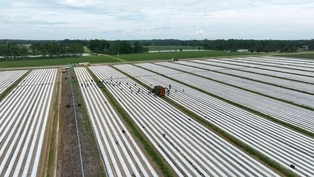
A Georgia farm keeps the produce coming year-round by planting and harvesting in different locations (4m 35s)
Video has Closed Captions
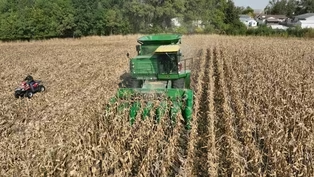
An Iowa farm thrives as one of the state’s few Black-owned farms. (6m 34s)
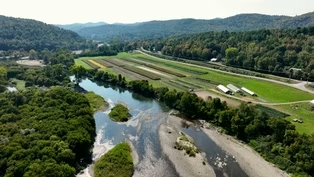
Vermont Farming Climate Challenges
Video has Closed Captions
A Vermont couple finds new ways to better protect their land from drought and floods. (5m 35s)
Providing Support for PBS.org
Learn Moreabout PBS online sponsorship
 New Episode
- Food
Christopher Kimball’s Milk Street Television
Transform home cooking with the editors of Christopher Kimball’s Milk Street Magazine.










Support for PBS provided by:
America's Heartland is presented by your local public television station.
Funding for America’s Heartland is provided by US Soy, Sustainable Agriculture Research and Education, Rural Development Partners, and a Specialty Crop Grant from the California Department of Food and Agriculture.